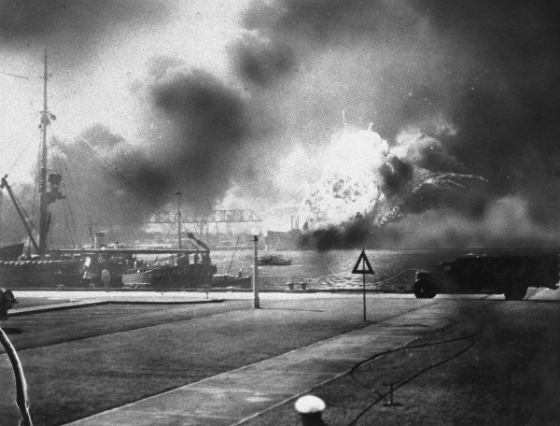
Two medics of the 274th Infantry Regiment, 70th Infantry Division take cover during a German artillery bombardment near Behren, France on February 17, 1945. The 70th was one of four divisions trained at Camp Adair, Oregon.

Two medics of the 274th Infantry Regiment, 70th Infantry Division take cover during a German artillery bombardment near Behren, France on February 17, 1945. The 70th was one of four divisions trained at Camp Adair, Oregon.
 December 7, 1941 transformed the lives of every American even more completely than the September 11, 2001 attacks did two generations later. Young Americans from all corners of the United States suddenly saw the scope of their world change radically. For most, their lives consisted of all the Depression Era travails of trying to establish a foothold in the job market, or somehow finding a way to get an education. Most had not traveled, few had been overseas. They lived in quiet small towns, on farms or in cities still reeling from the labor unrest and high unemployment rates that had become hallmarks of the previous decade.
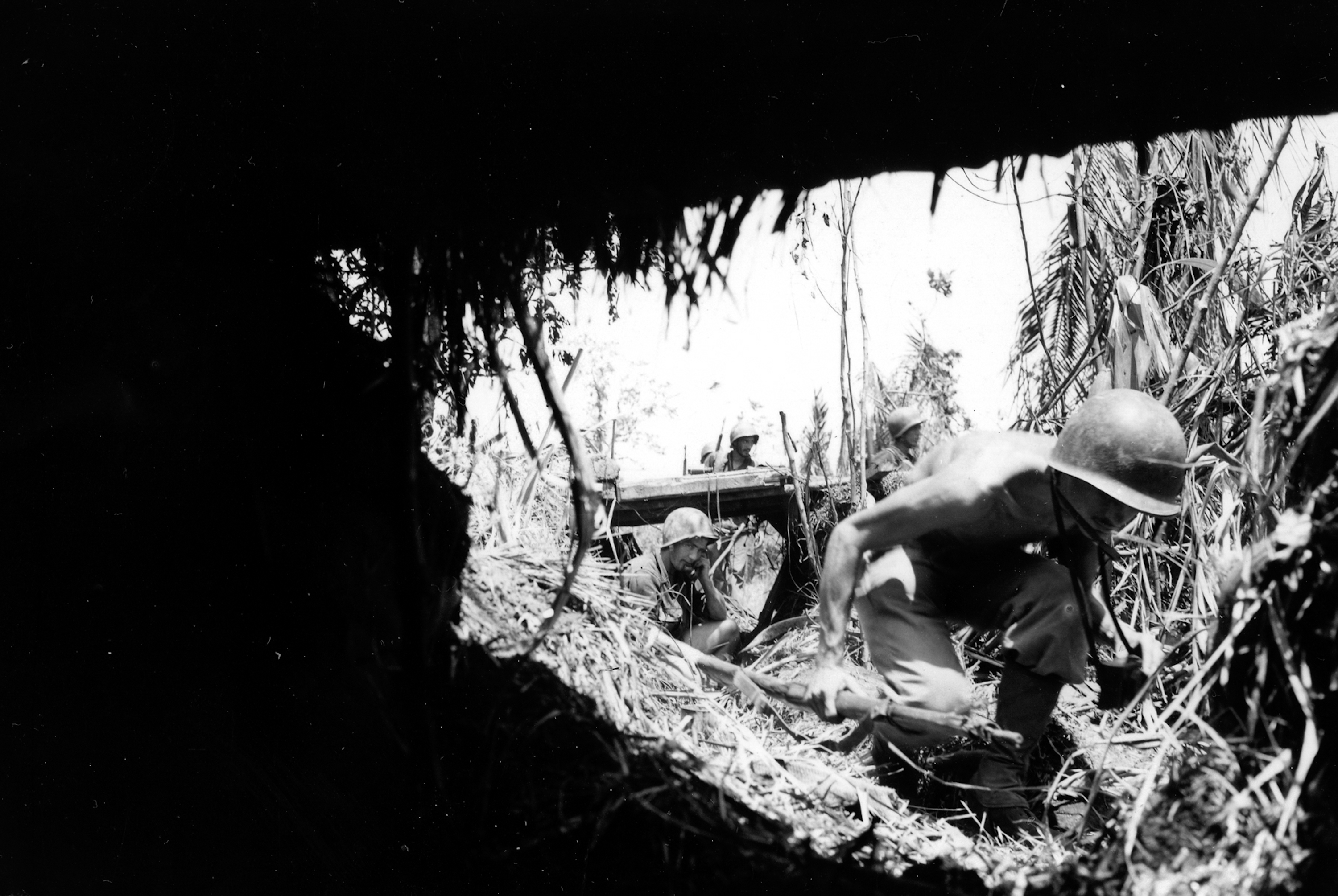
December 1942: Soldiers of the 127th Infantry Regiment fighting at Buna, New Guinea. So far from Wisconsin, where this National Guard unit hailed from before it was Federalized.
The Pearl Harbor attack scattered the Greatest Generation across the globe. Kids from small town America found themselves fighting and bleeding in places they had never heard of before December 7, 1941. Yet, those far flung places would forever be pivotal moments in their lives, and the memories the “lucky” ones carried home would haunt them for their remaining years.
There were three wartime anniversaries of the Pearl Harbor attack. Each one was exploited for its propaganda and political value by the domestic media, but for the individual Soldier, Sailor, Aviator and Marine, these anniversaries had profound personal meaning. For them, it marked the end of their peaceful lives and the start of a new arc that would test their mental, spiritual and physical endurance.

Refueling a USN PBY Catalina at Amchitka, Island. December 7, 1943. Fleet Air Wing Four. Few Americans had ever set foot on Amchitka prior to Pearl Harbor. Few have visited since VJ-Day.

An America patrol moves through the snowy Italian countryside near Pracchia, December 7, 1944.
They were caught up in a high tide of events far beyond their control, but ultimately each played a part in reshaping the world through the victories they secured.
May we be grateful for all they gave up for that victory, and may we strive to ensure that no generation, from any nation, endure such a crucible again. Peace to all of you, and best wishes for this holiday season.

December 7, 1943. Lt. Grover C. Blissard receives a DSC. From small town Texas, Blissard entered the USAAF and became a B-17 co-pilot in the 12th Air Force during the 1942-43 Torch campaign. During a mission to Italy, his Fort was hit repeatedly by flak and fighters. The attacks killed his ball turret gunner, but they stayed in formation. Then a cannon shell hit the cockpit and blew off his right leg at the knee. “My right leg was dangling there on the floor, held by a piece of flesh an inch wide,” he told his hometown paper later. He applied a tourniquet made from a torn piece of his shirt, and continued mission. His crew did not turn for home until after they had released their bombs on the target area.
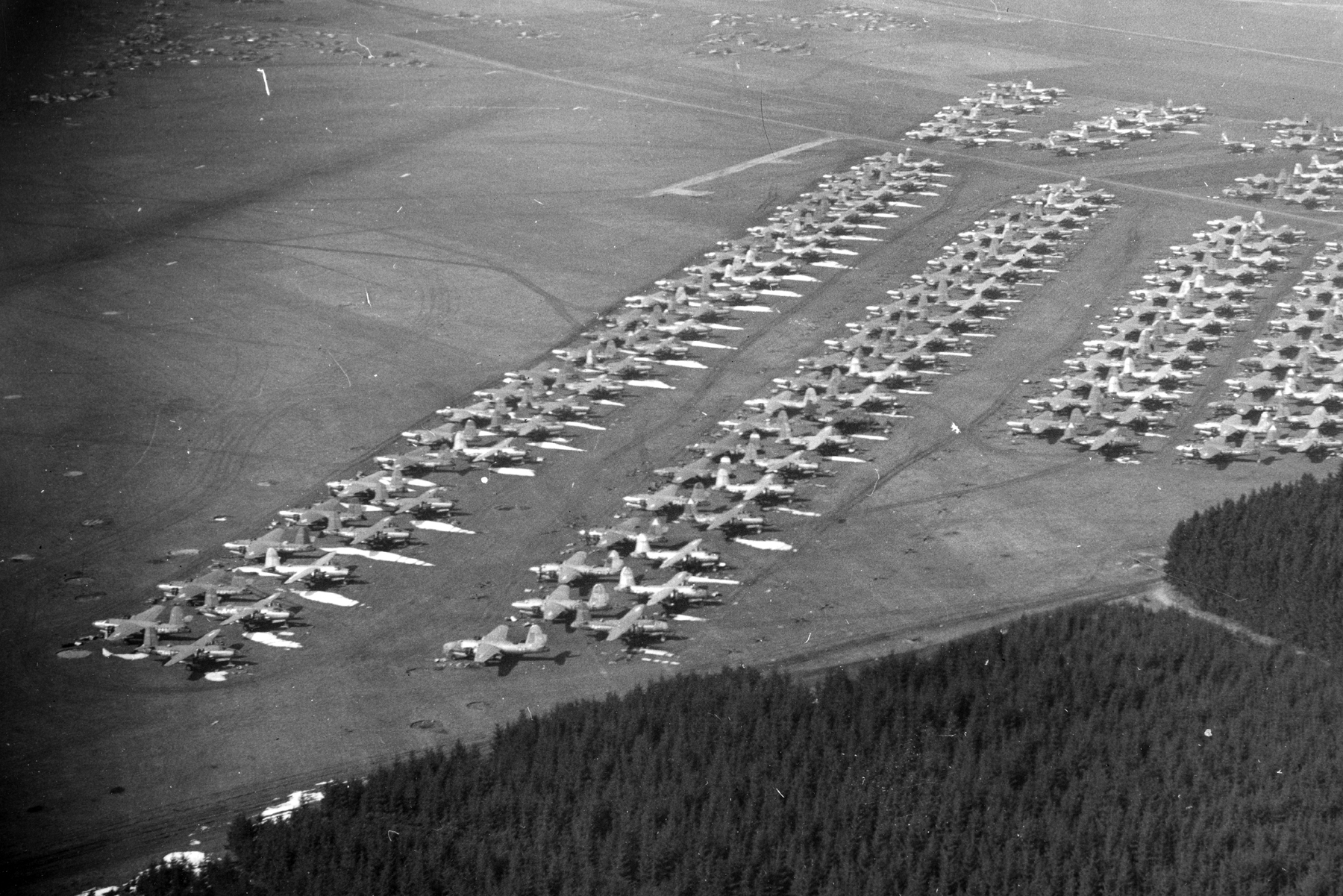
December 7, 1945. Landsberg, Germany. The end of the line for 9th Air Force’s B-26’s. They were blown up here and scrapped.

French commandos support a 5th French Armored Division M4 Sherman tank during the liberation of Belfort, France on November 20, 1944.

General Walter Krueger with men of the 511th Parachute Infantry, seen in the Philippines 1945.
During the bitter fighting for Northern Luzon, Philippines in the final months of World War II, the 37th Infantry Division (Ohio National Guard) was tasked flanking the main Japanese positions and seizing the coastal town of Aparri. This was the scene of one of the first Japanese amphibious landings in the 1941-42 campaign. General Walter Krueger decided to commit elements of the 11th Airborne Division to the attack, which he hoped would ultimately surround one of the last major Japanese army formations on the island (Shobu Group with about 50,000 men).

The 503rd Parachute Infantry Regiment, 11th Airborne, landing on Corregidor, February 16, 1945.
The storied 11th Airborne Division was the only air assault unit available to General MacArthur’s Sixth and Eighth Armies. The men of the 11th had executed airborne landings at Nadzab, New Guinea, Noemfoor, New Guinea and had dropped on Corregidor Island right atop a garrison that significantly outnumbered them. Elements of the division at taken part in the Los Banos Raid, the liberation of Manila and had fought on Leyte and Negros Islands as well.
The 1st Battalion, 511th Parachute Infantry formed the core of the task force assembled for this new mission, but men from the 187th Infantry, the 127th Engineers and the 457th Parachute Field Artillery also joined what would be known as TF-Gypsy. The plan called for a drop and glider landing on an airfield just out side of Appari. Once on the ground, the task force would push south while the Ohio National Guard advanced north to effect the link up.
The operation began on June 21, 1945 when a small group of Pathfinders air assaulted onto Camalaniugan Airfield to prep the LZ. Two days later, on the morning of June 23rd, the men of Task Force Gypsy climbed into sixty-seven C-47’s and C-46 transports for the short flight to the LZ. As the aircraft arrived overhead, the Pathfinders on the group popped colored smoke to mark the drop zones.

Four of the six Waco CG-4’s that took part in the Aparri landing are seen here in the LZ. June 23, 1945.
Heavy winds hampered the parachutists. Two were killed and at least another seventy suffered injuries as they were buffeted by the winds and thrown into trees or other terrain features on the ground. The airfield itself was poorly developed and the uneven ground proved treacherous.
A half dozen Waco CG-4 gliders landed after the parachutists got on the ground. They carried the task force’s heavy weapons and jeeps, giving Gypsy a bit of mobility.

Task Force Gypsy jumps at Appari, 0900 June 23, 1945
The task force quickly assembled and began patrolling south of the airfield, where the paratroops ran into determined resistance. For three days, the men of the 511th and 457th Parachute Field Artillery Bn (attacked to TF Gypsy), burned out bunkers with flame throwers, destroyed pillboxes with 75mm pack howitzer fire and waited for the 37th to reach them. It took until June 26th for the two American elements to link up, but when they did, the Shobu Group’s escape route to the coast had been cut off. The Japanese troops faced a grim fate: starvation, death or surrender.

TF Gypsy forming up and moving south from the LZ, June 23, 1945.
The Aparri operation was the last American combat air assault operation of WWII. A number of combat cameramen joined the mission, taking extensive film and photographs while in the LZ. Below is one reel of uncut, unedited footage shot by one of those men on June 23, 1945.
This post is dedicated to the memory of Everett “Smitty” Smith, 187th Infantry, who was part of TF-Gypsy that June. His son has a fantastic blog that chronicles his father’s experience during the war. Find it at: https://pacificparatrooper.wordpress.com
Rakkassans!

En route to England, the men of the 2nd Battalion, 503rd Parachute Infantry found and rescued this pup, Smokey, seen here in Iceland. The troops brought him to England, and he’s seen here with one of the 503rd’s members as he chats with Lt. John Timothy, the British liaison officer to the 2/503. The 503rd was the first American ground unit to reach England after Pearl Harbor. There is some confusion over 2/503rd’s history these days. The battalion took part in Operation Torch and executed the U.S. Army’s first combat jump. During the African campaign, however, the Army redesignated 2/503rd to the 509th Parachute Infantry. Apparently, the members of the battalion didn’t get that memo until after the war. Meanwhile, a new 503rd Parachute Infantry Regiment was formed and sent to the Pacific, where it joined the 11th Airborne Division and took part in the New Guinea and Philippines Campaign. That 503rd made the jump on Corregidor in February 1945.

A Soldier of the 535th Anti-Aircraft Artillery Battalion, 99th Infantry Division, with his pup during the Battle of the Bulge. Taken somewhere in Belgium on January 4, 1945.

First Selfie. Gwenie about to get her first round of vaccines since her arrival in Oregon. I have that same look on my face whenever a doc comes at me with a needle. Photo by Gwenie’s dad (that would be me).
Life has a crazy way of working out, something that Gwenie’s arrival here in Oregon underscored for me. This is the story of how a chaotic moment in combat four years ago led to a warrior’s rescued pup reaching my family this Fall.

FOB Ghazni, September 18, 2010. The first step in a long path that brought Gwenie to Oregon. Photo by John R. Bruning
September 19, 2010:
That summer and fall, I was embedded with TF-Brawler, 3rd CAB, and with Bravo Det 168 GSAB, an Oregon and Washington National Guard CH-47 Chinook company. On the 18th of September, which Afghanistan’s national election day that year, I was aboard a Chinook tasked with carrying a platoon of Polish infantry from FOB Ghazni to COP Ajerestan. The Afghan National Army and Police defending the district capital there had been surrounded by hundreds of Taliban fighters. Helicopters going into the COP’s landing zone had been taking fire, so the Chinook crew had been briefed to expect contact. En route, however, the Chinook I was aboard suffered catastrophic mechanical failure. The aft transmission overheated, and the pilots put the bird down on a dry lake bed at the foot of the Hindu Kush. The following day, the 168’s crew was ordered to attempt the run to Ajerestan. This time though, instead of troops, the Chinooks were filled with water and food for the besieged garrison. This article is how that mission forged a lasting friendship, and ultimately resulted in an addition to my family.
Ajerestan was so far from TF-Brawler’s base at FOB Shank that it did not even appear on the map in the 168 GSAB’s company CP. At the time, all I knew was that it was way, way south of Ghazni up in the Hindu Kush. We’d been there once before, and the Chinooks had to climb above their rated altitude to get over the mountain ridges there. When I wrote a piece about that, 168’s company commander, Captain John Hoffman, told me to delete the altitude reference, lest somebody Stateside see it and get everyone in trouble. Operational realities sometimes demanded pushing the aircraft beyond their acceptable performance envelope. That was just the reality of the harsh Afghan terrain.

Loading bottled water aboard the 1-168 Chinook, bound for Ajerestan. Photo by John R. Bruning.
We left Shank that morning, delivered some ANA troops to another remote valley to the west (I think) of Ghazni. Then we returned to Ghazni to fuel up and have lunch. Polish M24 Hinds were buzzing around, and I took a few photos of them until Eric, our co-pilot, came over to tell me that we’d been ordered to Ajerestan. I turned to see a forklift offloading palettes of bottled water into the back of the Chinook. When the operator finished, I climbed aboard and sat down. A moment later, we lifted off with our #2 and an Apache gunship flying escort in our wake.
It had been a long morning, and as we climbed above twelve thousand feet, I started to get tired and cold. I wonder now if part of it was hypoxia. The Chinooks had no oxygen system for passengers in back, and I don’t think they even had oxygen for the crew. Anyway, I went out like a light.

Climbing over the spines of the Hindu Kush on the way to the outpost at Ajerestan. Photo by John R. Bruning.
I woke up as the Chinook suddenly slewed into a tight bank. Grabbing my camera, I picked my way up to the right door gunner and peered over his shoulder. Ahead, I could see COP Ajerestan, a tiny base with such poor force protection that two burned out cars served as a obstacles against speeding vehicle suicide bombers at the otherwise open front gate. The COP was too small to support a helicopter landing pad, so the LZ was outside on a finger of flat ground a short distance from the overturned car.
There were two Blackhawks sitting in the LZ– MEDEVAC birds that had been called in to extract wounded ANA. As we closed on the LZ, a Taliban RPG team lit off a rocket. The RPG shot between the birds and exploded perhaps a hundred meters away from them.
Right then, our Apache escort came into sight. Thirty mike mike blazing, the gunship swept over the treeline where the RPG had originated then pulled off its run directly toward us at our one o’clock. The bird was low–I mean right on the deck, and the pilot chose to go right under us before pulling up. I snapped several photos of it as it came toward us, then quickly moved over to the left door gunner’s window and shot a few more of it as the Apache pulled up.
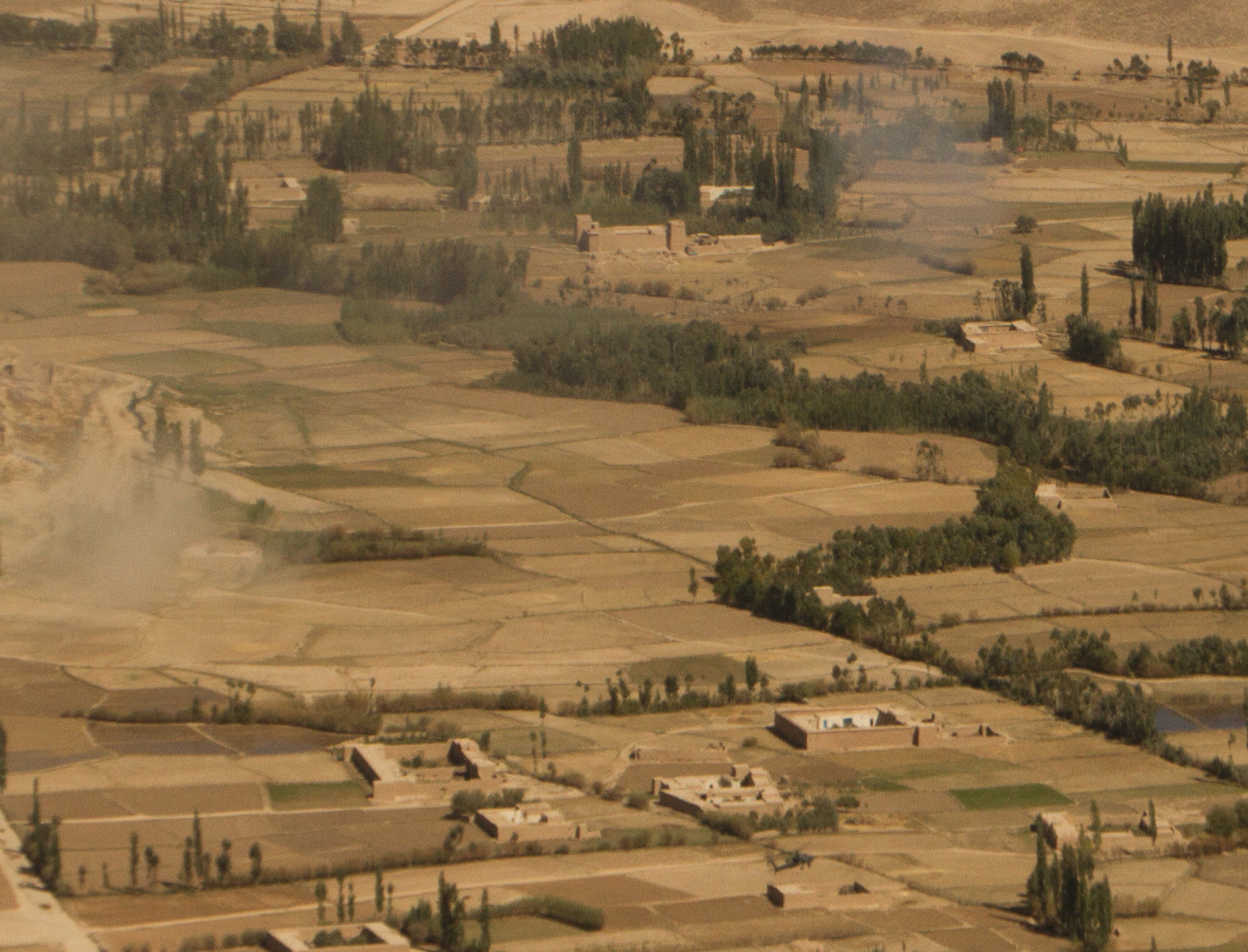
Smoke rises from the treeline (at right) where the Taliban RPG team had been concealed. The smoke at left is rising from the edge of the LZ. Scott and Cassie’s Apache can be seen at the bottom of the frame starting their gun run. Photo by John R. Bruning
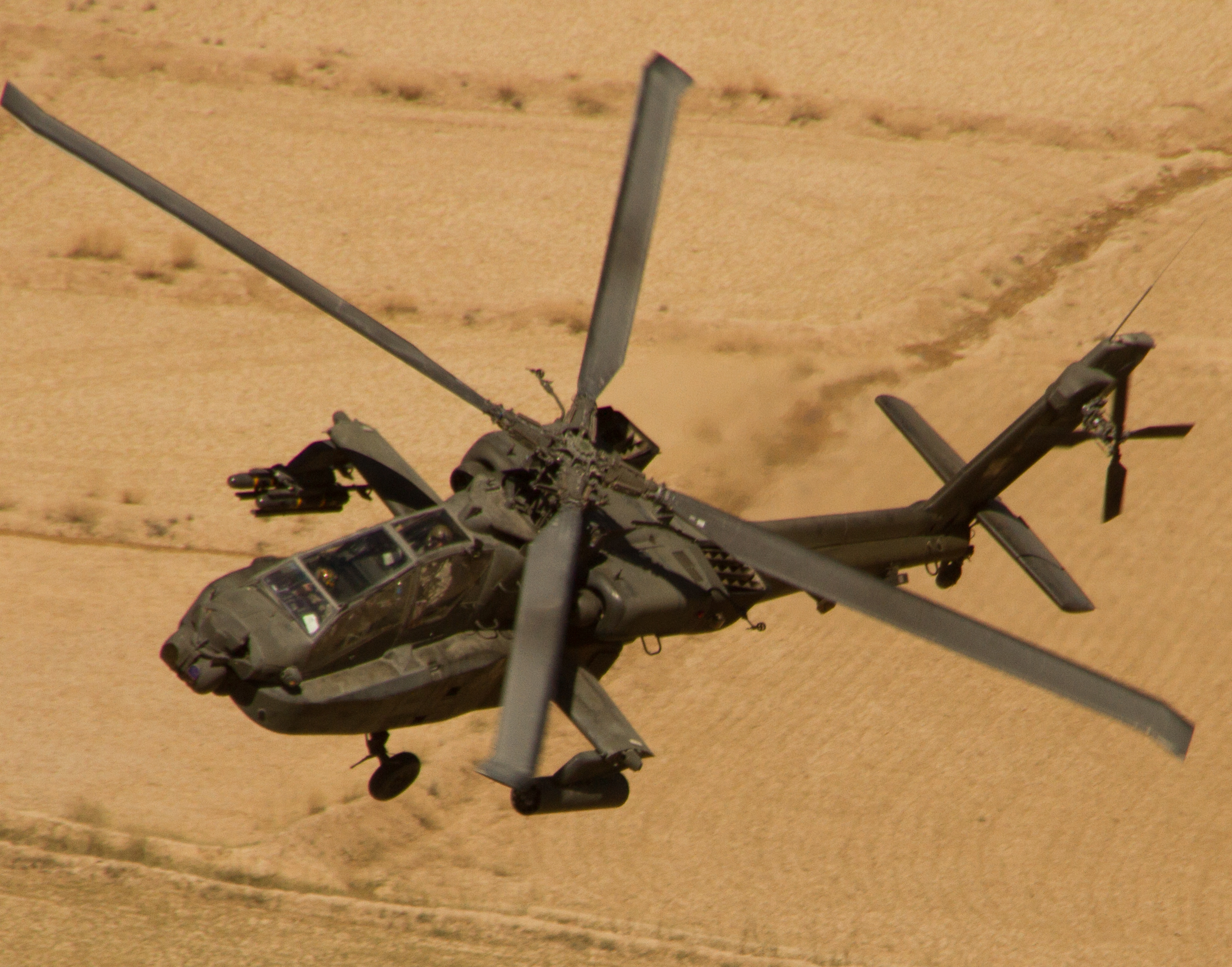
Scott & Cass coming off the gun run, passing under our Chinook. I took this over the left door gunner’s shoulder. Please don’t repost this one without permission, thank you! Photo by John R. Bruning
Moments later, the Blackhawks sped away from the LZ, and we came in to land. A mad scramble ensued to get the pallets of water off the back ramp. There was no wall between us and the Taliban RPG team’s last position, only a few gnarled strands of barbed wire. A lone ANA sentry hugged the ground not too far away from us, clutching his AK and looking terrified. The gunners helped the crew chief offload the supplies, and looking back, I feel guilty I didn’t help. I was at the right door gunner’s window, scanning the treeline with a 500mm lens on my Canon 7D, looking for anyone shooting at us.

The lone ANA sentry hunkered down by the LZ, scans the treeline for incoming. Photo by John R. Bruning.
The pallets split open, and water bottles cascaded out into the dirt as the guys struggled frantically to get the load off the Chinook. Nobody from the COP risked coming to help, so the stuff just piled up. Finally, they got the last of the water pushed off the ramp. Eric and Joe, our pilots poured on the coals and we soared up and over the COP. I could see the Afghan flag fluttering from a sandbagged bunker as we clawed for altitude.

Bob and Carmen, piloting the 2nd Chinook in our formation that day, gets airborne from the LZ while under mortar fire. Photo by John R. Bruning
Right behind us came the #2 bird, piloted by a pair of Washington National Guard aviators, Bob and Carmen. Their Chinook touched down just as the Taliban dropped a ranging round from an 81mm mortar. It landed long. As they offloaded their supplies, a second round exploded much closer. The mortar crew was walking fire right onto the LZ. The third one landed danger close, but the Chinook’s crew cleared the cargo bay and sped aloft, the Apache covering its escape.
It had been a tense moment, but none of the helicopters had been hit, thanks in large part to the strafing run the Apache executed.
That night, I was looking at the photos I took that day. The sequence I shot of the Apache included some of the best photographs I’d ever taken, and I was struck by how clear the shots came out despite the maneuvering our pilots had been doing. Then, when I zoomed in on the Apache’s cockpit, I saw a bomb sticker on the co-pilot’s helmet.
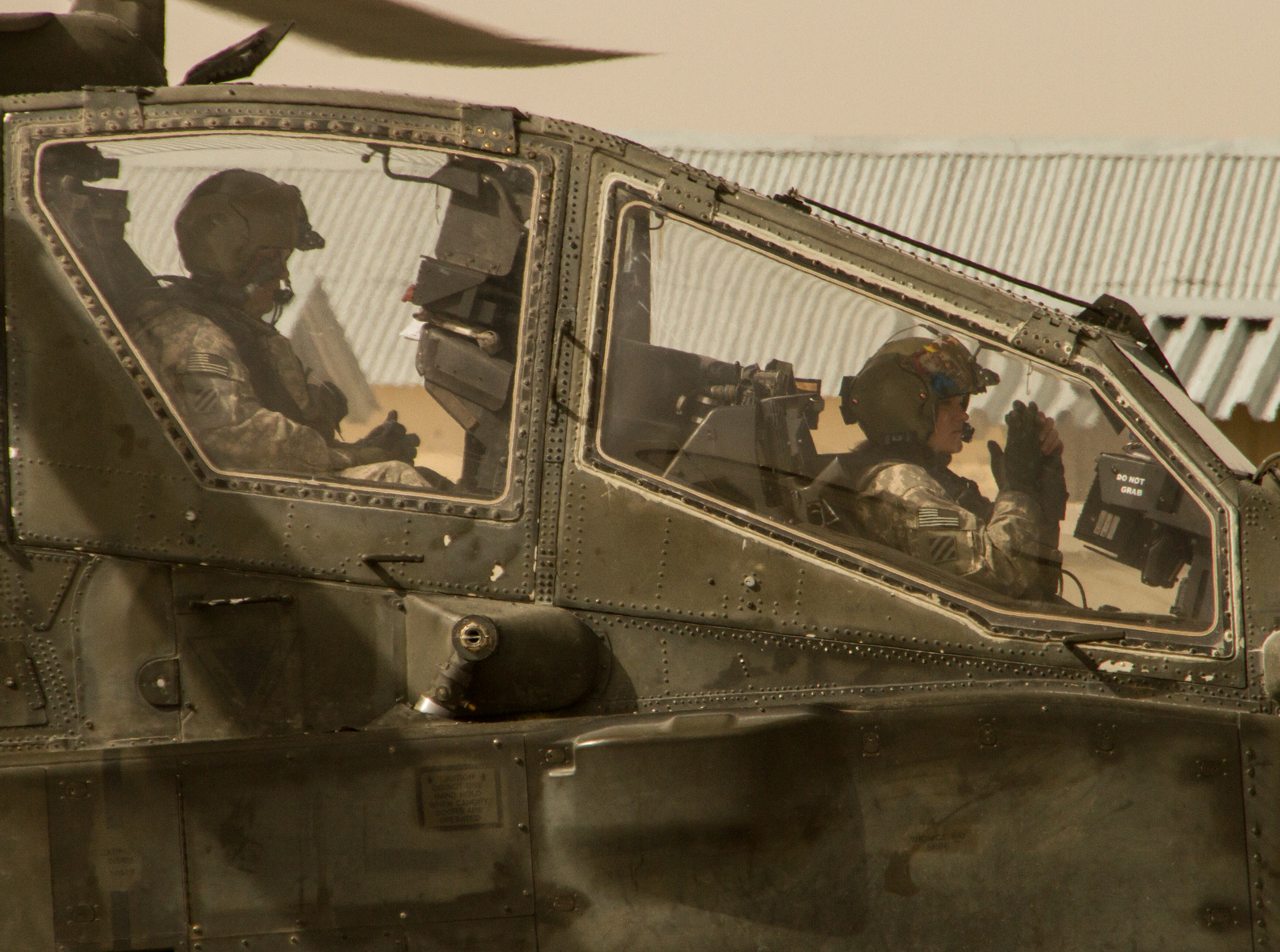
Scott and Cass at Ghazni, September 19, 2010. Scott returned for another Afghan deployment and died in a non-combat incident at Kandahar on March 29, 2013. Photo by John R. Bruning.
I remembered seeing that bomb, along with a decal of Rosie the Riveter on the helmet of a female Apache pilot whom I had photographed at FOB Ghazni the day before. I was blown away, and hurried over to the Apache Company to ask who she was, and if I could interview her. I had no idea women were allowed to be Apache pilots, and it turned out she was only one in Task Force Brawler.
That’s how I met (then) 1LT Cassie Wyllie. Cassie impressed me from the outset when I interviewed her the next morning. She walked me through what she and her pilot, CW5 Scott Reagan, had done over Ajerestan, and when she finished, I thanked her profoundly. It felt to me as if Scott and Cassie had saved a lot of Coalition lives with their timely gun run. At very least, it gave the Blackhawks time to get off the LZ, and us in and out of it before the Taliban had recovered and opened fire again.
Over the course of the next two months, I ran into Cassie several times in the Shank Defac. I would usually be sitting alone, playing Scrabble on my ITouch and eating when she would come over to say hello and sit with me. I was far from home, terribly lonely and missing my family enormously. I’d gone over as an embed without representing any media outlet or news organization, and the financial strain that was causing was pretty significant. I went four months writing nothing but articles for local newspapers about their hometown Soldiers, gratis as sort of a one-writer IO campaign to counter the intense flood of negative press the military had been getting after the McChrystal Rolling Stone piece. So to see somebody like Cass take time to talk to me did wonders for my morale.
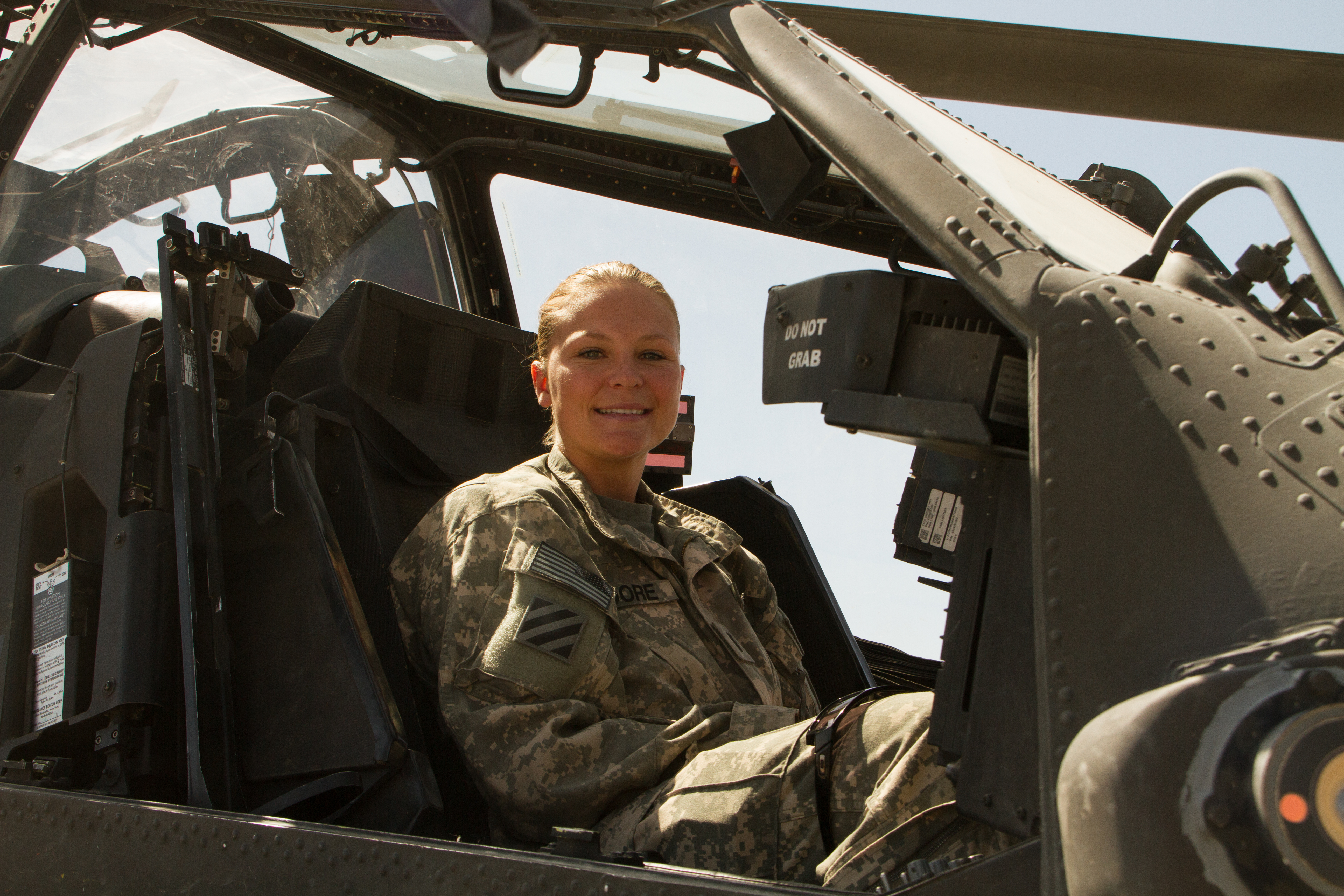
Cass in her office. FOB Shank, September 2010. Photo by John R. Bruning
We stayed friends after we both got home. And that friendship deepened and grew as we both went through some rugged times. I know I missed being out there every day, and right now writing about those experiences chokes me up. It was the most meaningful thing I’ve ever done. For those months I was out there, I was among the most dedicated, intelligent and resolute humans I’ve ever known–American, Afghan, Czech, Polish and Jordanian. They’d come together in common cause and purpose, and to be a tiny part of that as an observer and recorder, felt bonding. Staying in touch with Cass kept that bond alive for me.
We saw each other at the Reno Air Races in 2013 and had a wonderful time. I met Cass’s mom and some of her friends. We saw a theatrical production of Grease, and then promised we’d see more of each other. But life has a way of getting in the way, and before we could link up again, the Army sent Captain Wyllie overseas again.
At the end of September, 2014, between 700-2,000 Taliban fighters swarmed Ajerestan in a determined assault. The Afghan forces defending the area were overrun. At least a hundred were killed along with fifteen civilians whom the Taliban beheaded. Ajerestan is now in Taliban hands. It is a very, very difficult thing to take after seeing all the effort put forth by so many dedicated warriors–American, Polish and Afghan–to keep Ajerestan free.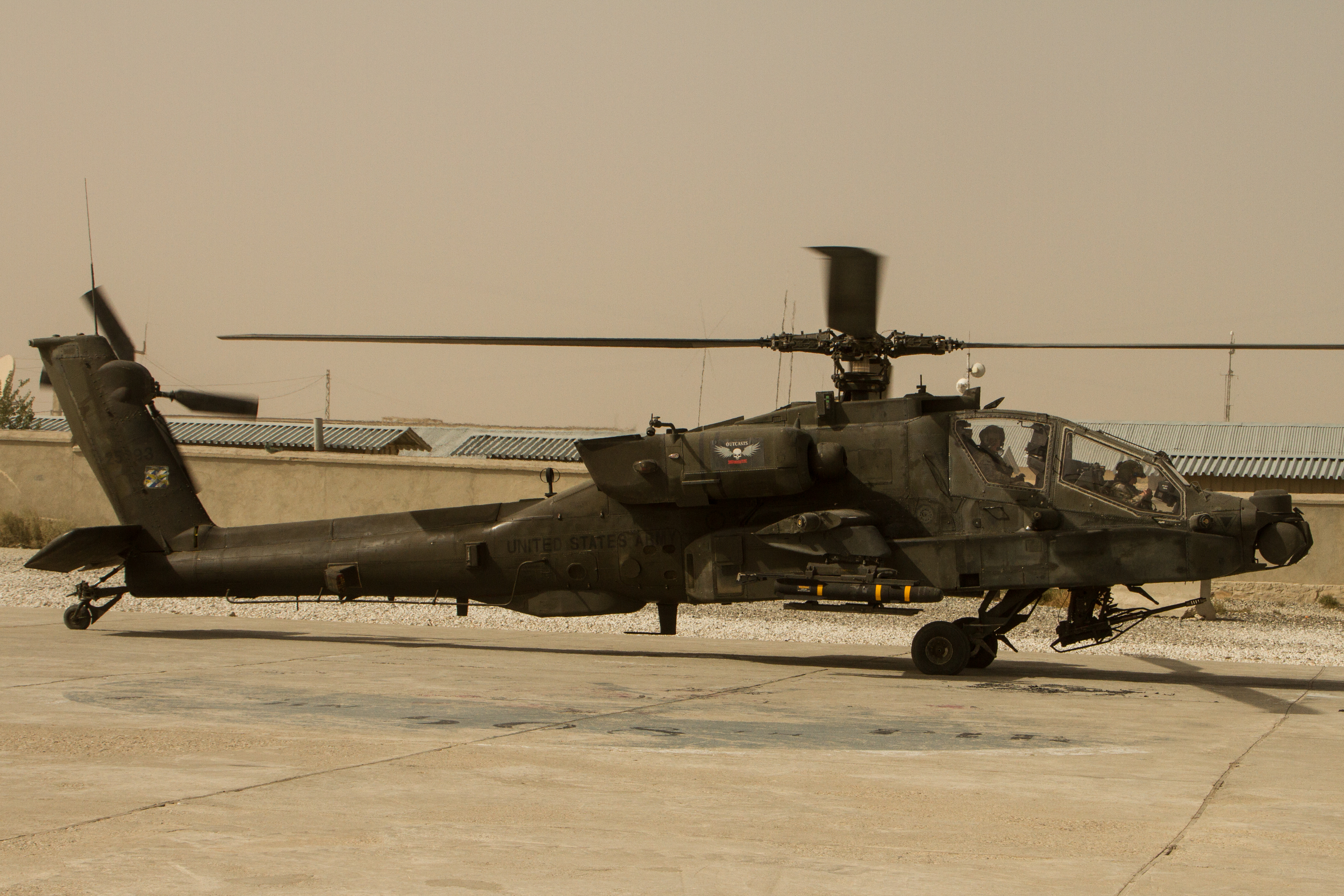
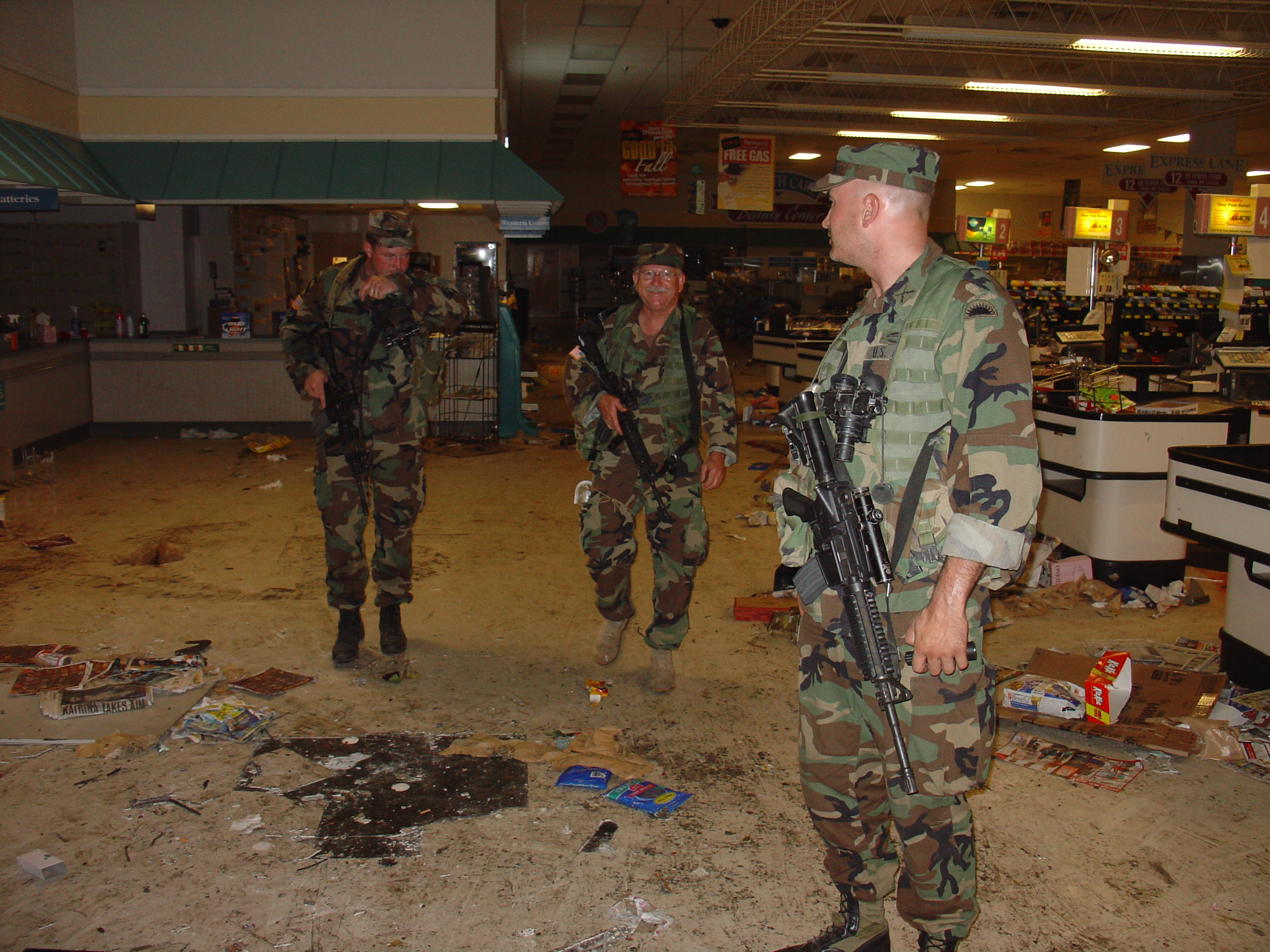
The Winn Dixie, post looting, on Gentilly Road. North Central, New Orleans. September 2005.
In September, 2005, I embedded with Bravo Company, 2nd Battalion, 162nd Infantry when the Oregon National Guard’s 41st Brigade was deployed to North-Central New Orleans during Hurricane Katrina’s aftermath. Throughout September, we lived outside on the grounds of the New Orleans Baptist Seminary and patrolled neighborhoods devastated by looting and the flood waters. In our area of operations, the Soldiers of 2-162 found forty-nine dead, many of whom were victims of gunshots.
The pets fared even worse than those who chose to stay behind after the evacuation order had been given. Some 80% of the animals left in the city died that September and October. It was a horrible thing to see, and the local authorities were doing little but interfere with the volunteer effort to save as many dogs and cats as possible.
On September 12, 2005, I was on a patrol that discovered a dog and a kitten trapped inside a flooded, looted motel. The entire first floor was coated in black, syrupy mud that stank of excrement. When we reached the second floor, both the kitten and dog began to howl. The kitten was hoarse, and sounded weak. The dog seemed to be in better shape.
One of the NCO’s rescued both animals. When the kitten appeared in the darkened hallway, he was covered with so many fleas he was anemic. They ran in packs across his nose, his eyes and his ears. His skin hung off his skeletal frame, and he was so dehydrated it had lost all its elasticity. I offered him water, but all he wanted was attention. He rubbed against my legs, purring furiously. He’d been trapped in that motel room for two weeks without food or water, living in a little nest he’d forged out of the unmade bed in the room.

While the NCO went to rescue the dog, I took the kitten downstairs, where I ran into Mark Martin of Athens, Georgia. Mark and his wife had driven into the city, established a base of operations near the Seminary, and had created on the fly a rescue organization that had already saved hundreds of animals.

Volley greeting me during a visit to the Winn Dixie parking lot and Mark Martin’s operation there.
Mark asked me if I wanted the kitten. No brainer. He took him, put him in a cage and got him down to the Winn Dixie parking lot on Gentilly Road, where vets and vet techs had gathered with other volunteers to treat the foundlings. For several days, it was touch and go with the little orange guy, but after repeated IV fluids, he pulled through. He was evacuated out of the city about a week later, and then after I got home to Oregon, Mark and Shannon Martin paid out of pocket to send the kitten to me. He actually arrived with another foundling kitten that he’d bonded with, plus a dog Bravo Company found on the street on a later patrol. The dog, Gustav, went to Sgt. Andy Hellman, a member of the 2-162 scout platoon who was wounded in Baghdad during a firefight in August 2004.
The kitten came home to me, and for the next five years rarely left my side. I named him Volunteers (2-162’s nickname), but called him Vol or Volley. He became a fixture around my little town. The coffee shops gave him his own cup of whipped cream. The cafe across the street from my office always gave me treats to share with him–ham, turkey and sometimes bacon. He’d been so desensitized to noise, vehicles and people, that crowds never fazed him. He loved car rides, the faster the better.
But most of all, he loved anyone in uniform. While I worked on my sixth book, The Devil’s Sandbox, many of the 2-162 vets of OIF II came by my office for interviews or just to visit and drink Jameson with me. Vol was always at my office with me, and he would promptly mountain climb up the Soldier’s legs to get int their lap. When then-Major Wyatt Welch came for a visit wearing a brand new, freshly issued set of ACU’s, Volley chose that moment to jump on his back and hang on him like Garfield on a screen door.
Vol traveled all over Oregon with me. He followed me on hikes through the Coast Range, spent weeks in the Cascades with me as I wrote in a remote cabin in the Willamette National Forest. He went to Autzen Stadium, home of the U of O Fighting Ducks. He went to my kids’ classrooms for show and tell, and I often took him to the school when picking them up after the bell rang. In 2010, he hung out with then-SFC Vince Jacques at the Camp Adair Rifle Range.
He was the most utterly fearless animal I’ve ever owned. He once got bent that a golden retriever had come into our yard and charged him. Before the startled dog could even react, Vol had torn up his snout, dashed sideways and was making another claw run on him when I tackled him. He was less than pleased that I intervened.
Vol became a symbol to me of everything good that came out of my time with Bravo Company and the rest of 2-162. We saw a lot of horrible stuff in New Orleans, and we came face to face with the worst our countrymen and women could inflict on each other. In later years, I ran into other Soldiers from other units who all agreed that New Orleans post-Katrina was worse than their Afghanistan deployments. That it happened here at home made it exponentially worse. Vol was the bright spot, the one good thing I brought home to counter the memories of corpses being eaten by scavenging animals in the streets. He also reminded me of the bond I’d shared with the men of the Oregon National Guard.
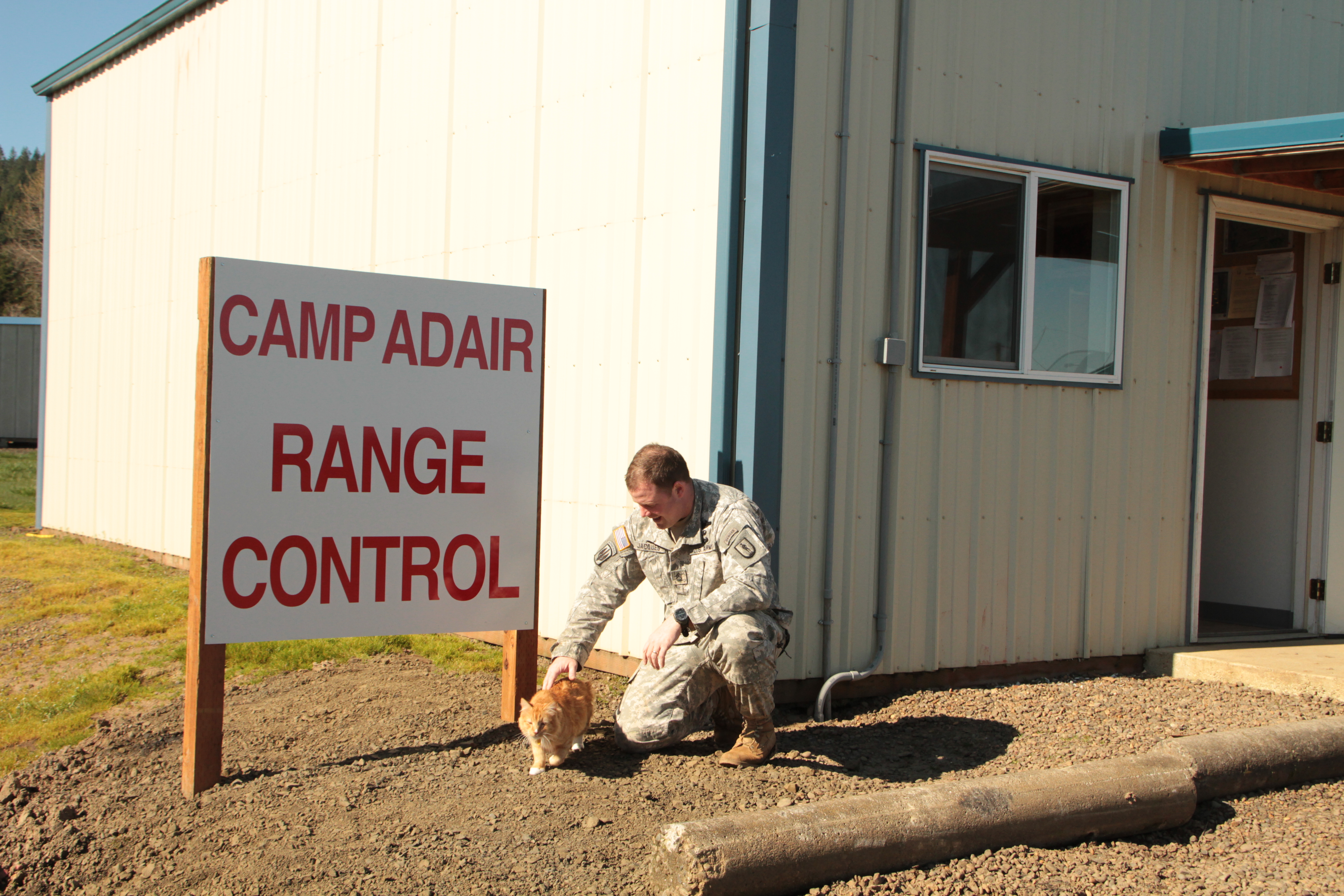
With Vinni Jacques at Adair’s rifle range, February 2010.
This was a video I put together in 2009. The music was written and performed by my friend, Barry Thomas Goldberg. The first time I heard it Remember New Orleans it resonated with me. It was exactly how it felt to me to be there. Barry’s music is powerful stuff. Check him out on ITunes and Rhapsody.
 In just two hours on June 15, 1944, three hundred amphibious tractors (LVT’s) carried over eight thousand heavily armed U.S. Marines onto Saipan Island in the Marianas Chain. It was a masterful display of amphibious warfare tactics and doctrine, but it also set the stage for a brutal, close range battle for control of Saipan’s sandy west coast. In places, the Marines found themselves pinned down by intense mortar, artillery and automatic weapons fire, and it took hours just to claw a foothold ashore. But by nightfall, the Marines had established themselves enough to repel the first of many Japanese counter-attacks.
This short film clip is raw footage shot by one of the Marine combat cameramen who went ashore with one of the first waves. It is silent, as was most of the footage shot, but that only adds to the poignancy of these scenes. The images are striking, not only for the chaos and carnage they reveal, but also for the film’s clarity. Much of the Marine Corps color footage has deteriorated over the years so that they are predominately reddish or blue. It makes for muddy looking scenes, and in many cases the more common black & white film has stood up better over the years. This clip is stark, clear and the colors have survived the decades in remarkably good shape.


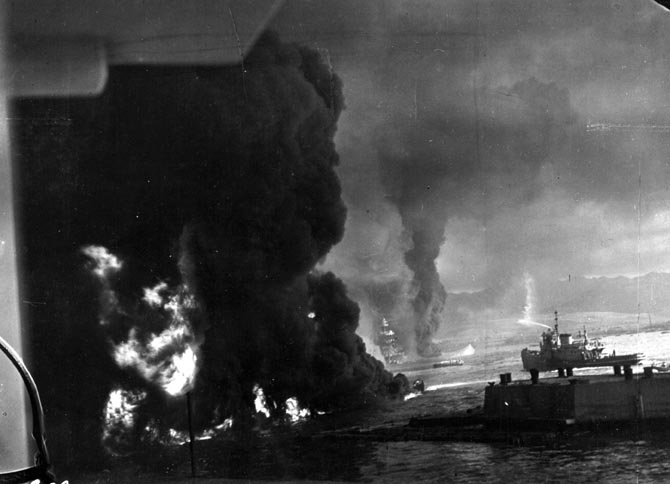

 The American Warrior