The Jordanian Comes of Age

11218233_10206445599236191_6241923071895765755_oAs you may recall….

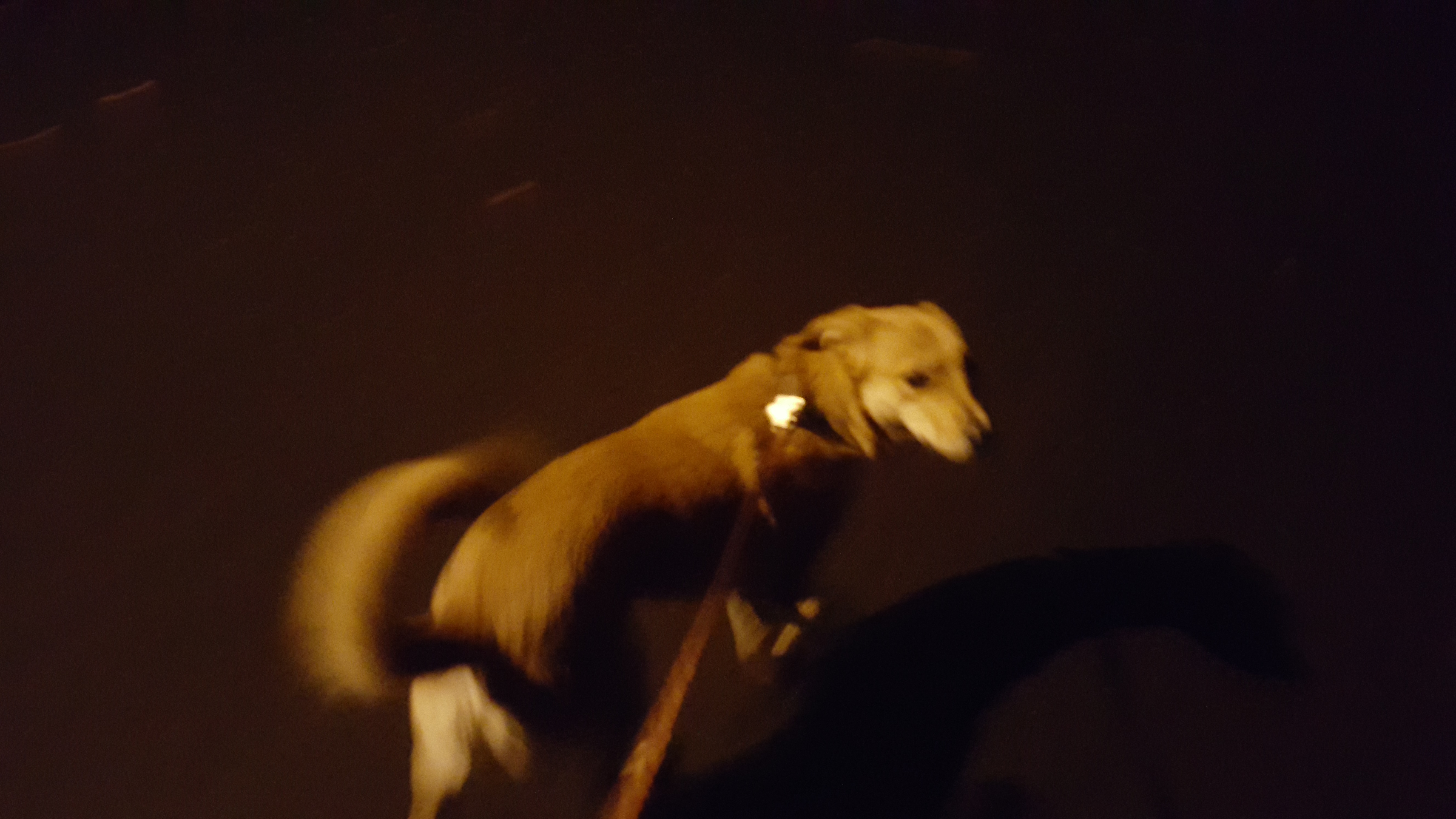
A year ago, the awesome Captain Cassie Wyllie rescued two pups from a military base in Jordan. With the help of the equally awesome folks at Puppy Rescue Mission, the two made it to the United States. One, Gwenie, reached Independence, Oregon where she has spent the last year eating furniture, getting us both covered in skunk stench, digging massive holes in the backyard, destroying the back fence and otherwise committing dog-atrocities while simultaneously fearing random things like naked cherub statues and most people. She goes absolutely berzerk when two high school lovers stop every day after school to canoodle on the sidewalk beside the house, so apparently she is not a Must Love Dogs fan.

When Gwen first came to Oregon, I could not get her to walk on a leash more than twenty or thirty feet from the house. Everything terrified her. She would venture a little ways out then freeze up. Looking sad and pathetic, she’d try to return to the front yard, growing increasingly frantic if I held firm on the leash.12027538_10206663754649940_7146249913541483235_n

Thanks to Ryder, Renee’s happy-go-lucky Aussie Shepherd, Gwenie gradually emerged from her shell. Her first Christmas was spent at the Oregon coast, where she explored on the beach with Ryder and the rest of the family. Since then, she has become a little more daring every day.

What we didn’t see was any happiness in her. She would explore and run around. She would come home to eat another section of the couch. She’d sleep beside me at night, but she always had such a lost and sad expression on the face that I wondered if she would ever know anything but degrees of less anxiety.

10842061_10204735305119907_981911803732954105_o

First beach trip about 5 weeks after Gwen arrived.

Today all that changed. I’ve been up in the woods working on the edits for Indestructible and I woke up this morning to snow. Snow is a big deal for me. Being from the Silicon Valley, I only experienced it a few times as a kid on ski trips. Renee and Ed have inherited the same exuberance for snow that I’ve got, so I gave the family a call and asked them to come up. Jenn stuffed two kids, one adult and three dogs into my Pontiac GTO and drove up here. Seriously, when they arrived, it looked like a Bruning clown car exploded. Dogs and kids running about joyfully, parents looking happily chagrined.

G86A9620

Today at Detroit Lake.

We walked around Detroit Lake and over to Piety Island (currently a peninsula) and I noticed that Gwen obeyed everything we told her. When she got too close to a cliff and we called out to her, she came back over to us. When she was hassling our little dog Mizette and we told her to stop, she did. Far from the unruly hurricane of chaos and mayhem we’ve come to know and love, she was playing within the rules today.

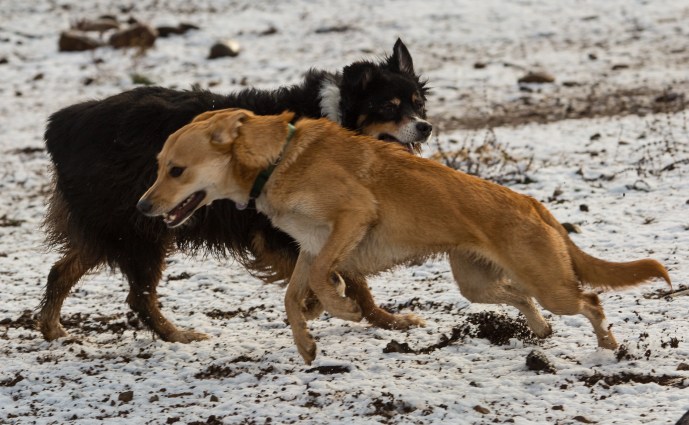
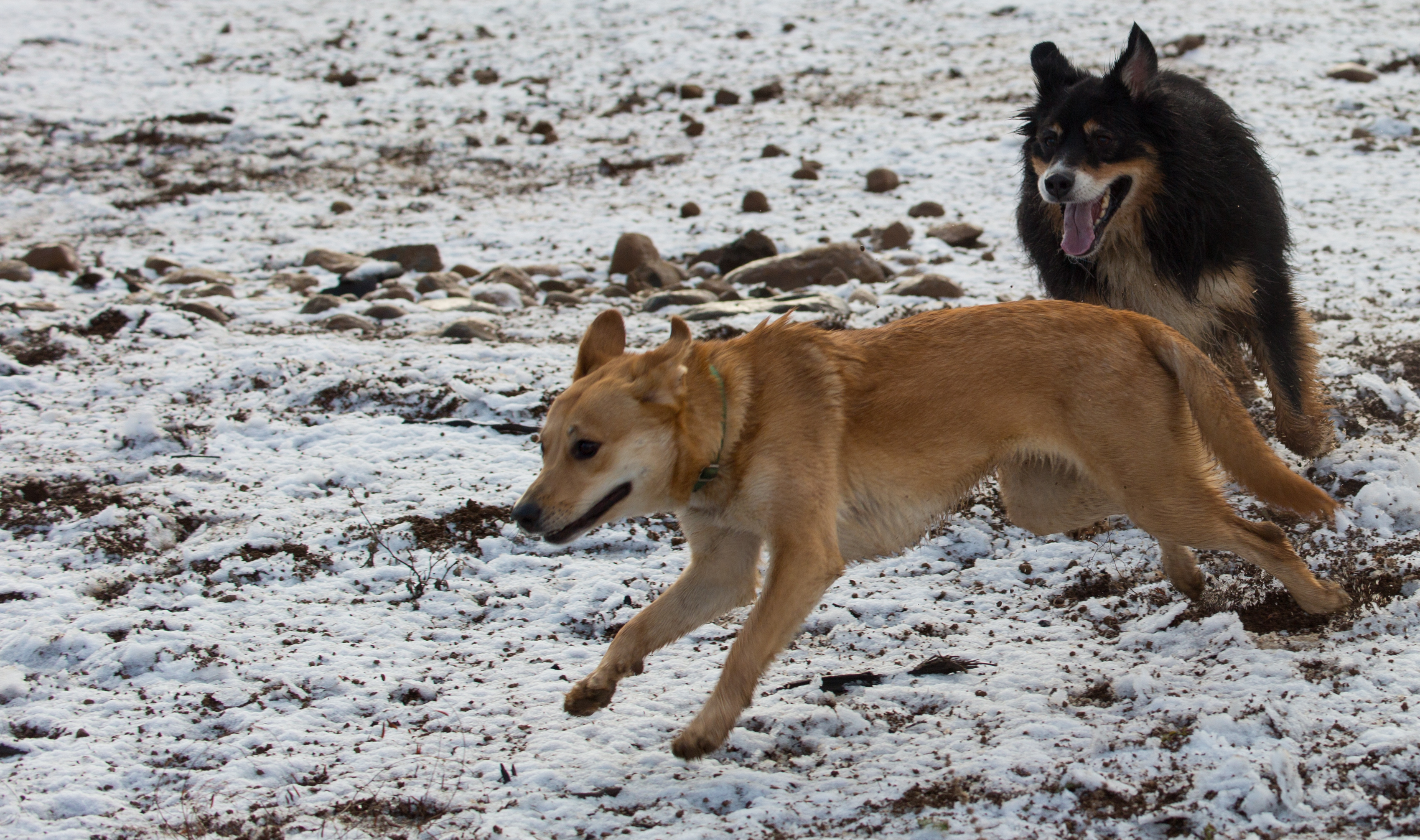
I started taking pictures, and right away I saw something different through the view finder. Gwen raced around us, letting Ryder chase her. She is fast and graceful and lithe, a beautiful sight to behold when she is in full stride.

G86A9651

Today, I swear she was smiling. Lit up, happiness radiating from her, she played and capered with all of us. She chased snowballs and jumped into a pond to wade around in search of driftwood to carry back ashore. This was a totally unexpected development, as she has always feared water. Today, she had no fear.G86A9675

As I took photos of her and the family, it dawned on me that she’s settled down. Whatever horrible things happened to her before she reached our loving arms no longer plague her. This is her home now; she has started to love it, and find comfort and tons of fun within the circle of her adopted family.G86A9655

Tonight she is with me at the cabin. The family went home at dusk. She’s exhausted and filled with warm chicken soup, which she convinced me to share with her by putting her chin on my lap as I ate. As I write, she’s curled up in front of the wood stove, eyes closed in peaceful repose.

My wild little pup has come of age.G86A9638

Now, if we can just get her to stop murdering innocent rolls of scotch tape and eating the kids’ home made Christmas ornaments…. baby steps. Baby steps.

G86A9627


Categories: Gwenie's Story | Tags: , , , , | 3 Comments

Knives and Bayonets Against the Waffen-SS:

82nd airborne bulge155 8x10The American paratroopers moved swiftly through the darkness, their speed and effort keeping the bitter cold at bay. Through thick woods they’d captured earlier that day, they would soon break out into flat, open ground broken only by rows of heavy barbed wire fences. Four hundred yards across that dead space, two companies of elite SS panzergrenadiers waited for them. Supported by heavy tanks, half tracks, 75mm gun carrying armored cars and 20mm flak wagons, the entrenched SS troops possessed the kind of firepower that could utterly wipe out an infantry assault.

The paratroopers had waited for the pre-attack artillery bombardment, but it didn’t happen. They waited for the two tank destroyers assigned to attack, but the LT in charge of them refused to move forward, arguing his M36 Jacksons were no match for the German armor on the other side of the open ground.

German Series WWII East Front Barbarossa German Halftrack and 20mm anti aircraft gun in action Beresina Russia 070341 (1 of 1)

A German 20mm flak half track. Cheneux was defended, in part, by a Luftwaffe light flak battalion equipped with eighteen of these deadly vehicles.

Without artillery or armor, the paratroopers attacked anyway. The situation was desperate.

Bulge359It was 1930 hours, December 20, 1944. Christmas season in Belgium’s Ardennes Forest. The 82nd Airborne reached the battlefield only two days before after a wild drive up from France. Thrown into the path of Kampfgruppe Peiper, the men of the 82nd had no time to get oriented, lacked winter clothing and carried nothing heavier than bazooka rocket launchers.

82nd airborne bazooka team bulge dec 20 44583 4x6

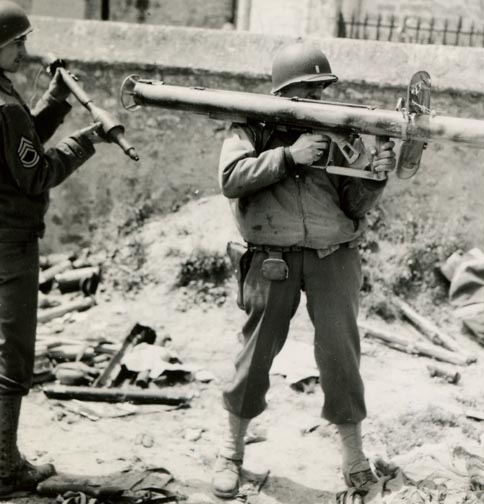
An 82nd anti-armor bazooka team covers a road near Cheneux on December 20, 1944.

The Peiper’s panzergrenadiers represented the best troops left to Nazi Germany. Fiercely loyal to the Reich, they fought with tremendous intensity and determination with the best equipment in the world. Equipped with Tiger II heavy tanks, Panther medium tanks, self propelled guns and half tracks, Peiper’s kampfgruppe was supposed to lead the way to the Meuse River in the opening days of the German Ardennes offensive. Getting across the Ambleve River was a key step toward the Meuse, but furious counter-attacks by the 30th Infantry Division had stopped Peiper’s spearhead at Stoumont. To the south, at Cheneux, the Waffen-SS troops seized two bridges, crossed the Ambleve and prepared to drive on.

82nd airborne bulge in ardennes941

Men of the 82nd moving into forward positions on December 20, 1944.

The 82nd’s 504th Parachute Infantry Regiment reached the front and its regimental commander, Colonel Tucker, realized the gravity of the situation. The panzergrenadiers had to be driven back across the Ambleve and their bridgehead destroyed. Cheneux had to be seized and the river used as the main defensive line against further German armored thrusts.

The responsibility for taking Cheneux fell to the 1-504. Second Battalion had pushed to within a half mile of the town earlier on December 20, 1944, their advance aided by a captured German half track armed with a 77mm field gun, which a scratch American crew put to good use until they ran out of ammunition. Shortly after, the attack stalled and 1-504 was ordered to attack through 2nd battalion’s lines and take Cheneux in a night attack.

Nothing went right at first. Bravo Company 1-504 formed the right wing of the assault, while Charlie was the left.  Each company went in with four waves of men with fifty yards of space between each wave.

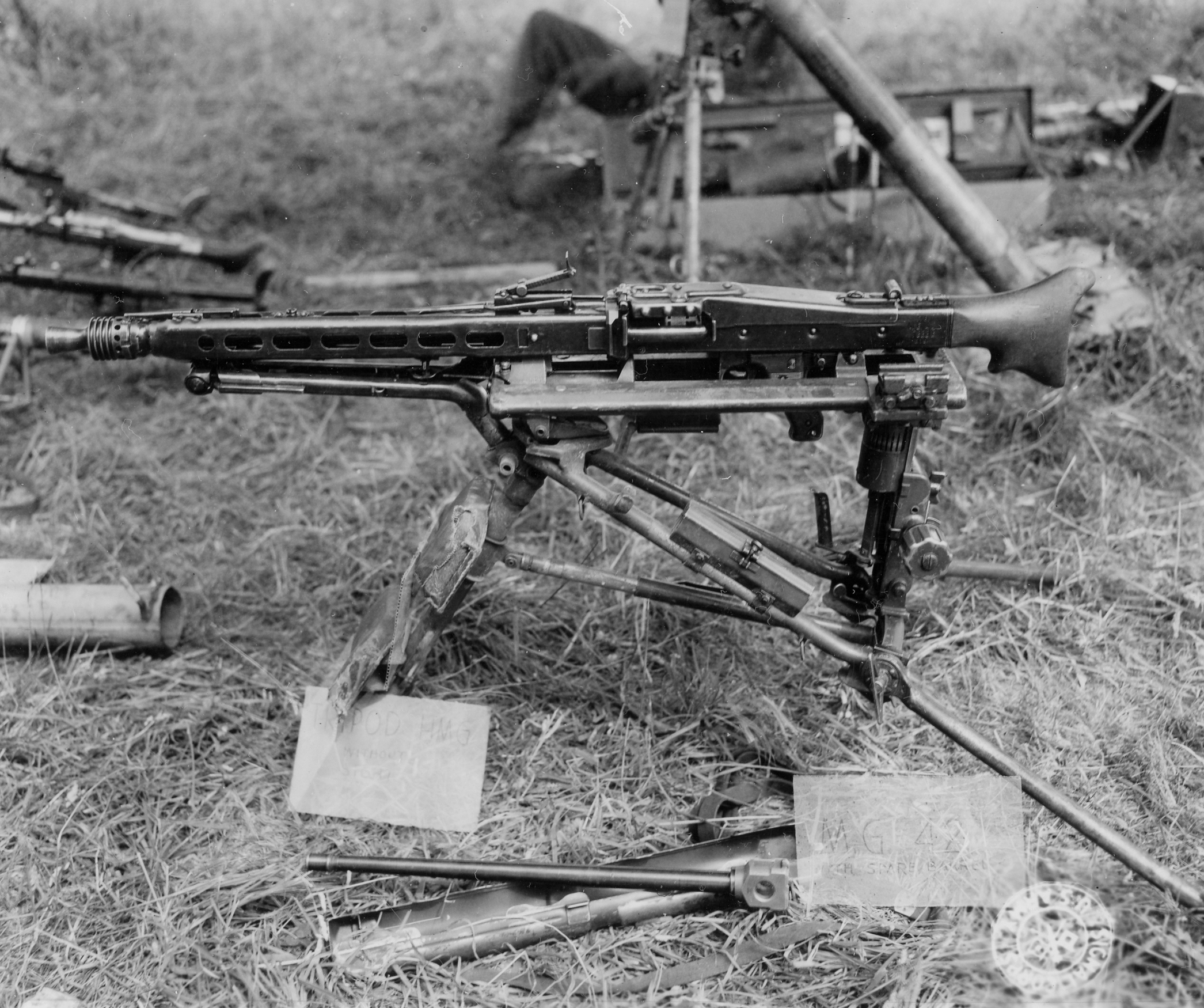
They barely made it into the open terrain when the Germans opened fire with every barrel. Mortar round rained down on the Americans. Artillery soon followed. Struggling through the indirect, the first waves crawled to the barbed wire fences. The Germans had them zeroed. Suddenly, yellow glowing 20mm anti-aircraft shells streaked overhead, exploding among the troops.  The zipper-fast sound of MG-42’s going cyclic erupted across the German main line of resistance. The Americans, caught against the barbed wire, out in the open without support, were cut down relentlessly.

1st Army Captured German Equipment Series MG42 on tripon German heavy machine gun st clair france normandy campaign 062344 (1 of 1)

The deadliest machine gun of World War II, the German MG42.

Trapped in the kill zone, the veteran NCO’s and officers of 1-504 realized they had to close with the enemy or die in the terrible crossfire. On the right, 1st platoon Bravo Company’s commander, 2nd Lt. Richard Smith and Staff Sergeant William Walsh stood up in the tracer-light night and urged their men to charge.  They hurdled the barbed wire fences, 20mm flak rounds savaging their ranks. Sprinting through the fusilade, Walsh was seriously wounded in the hand. He kept going, urging his men as the MG-42’s raked through them.

82nd Airborne Div 325th Glider Regt M1919 Browning 30 cal LMG team Odrimont Belgium Bulge 010645 (1 of 1)

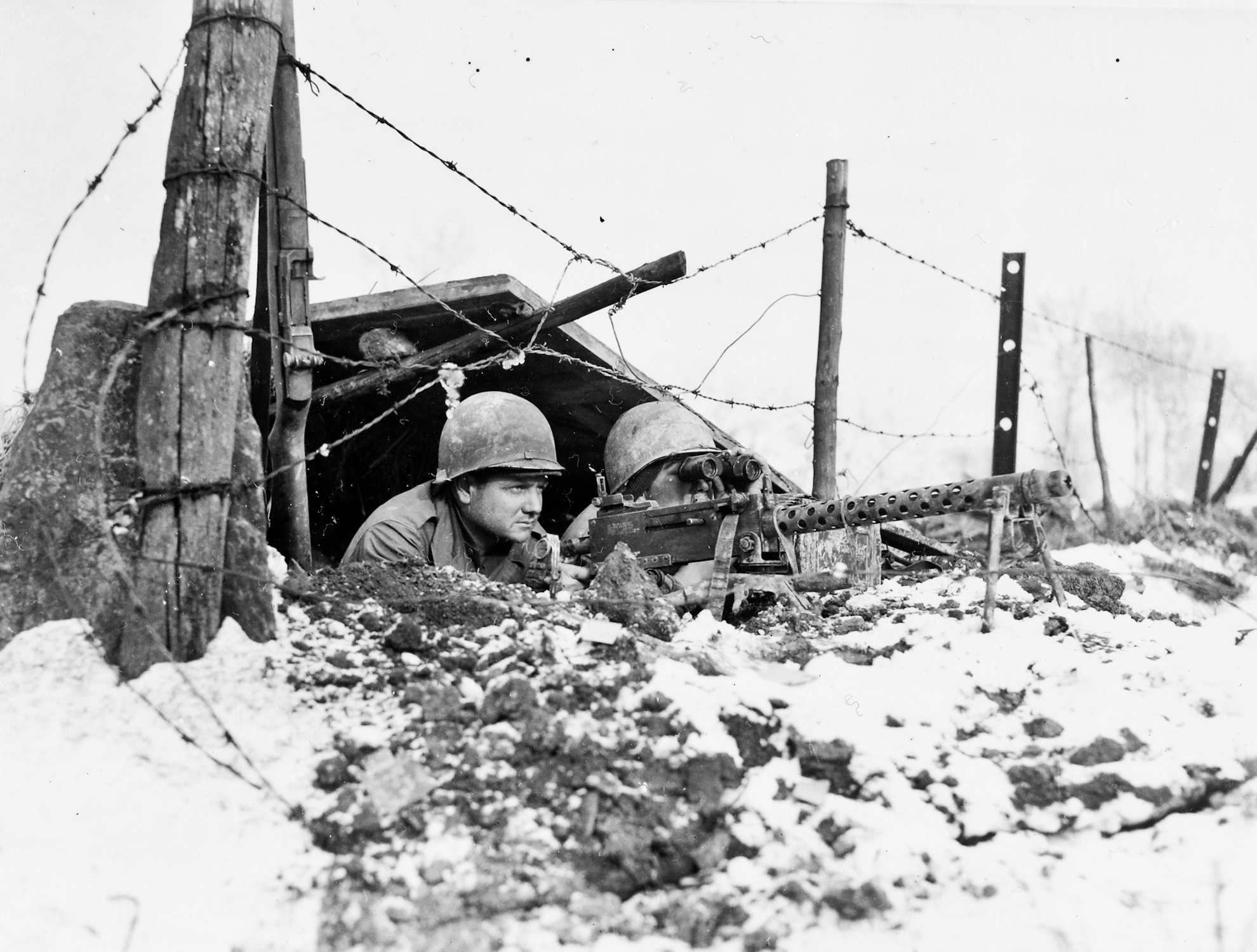
1-504th’s machine gun teams suffered catastrophic losses. Five of eight supporting the initial night assault into Cheneux were wiped out by German counter-fire. This M1919 LMG team belonged to the 82nd Airborne Division’s 325th Glider Infantry Regiment. The photo was taken at Odrimont, Belgium a couple weeks after the Battle of Cheneux on January 6, 1945.

The battalion’s .30 caliber machine guns did their best to suppress the Germans, but the American gunners didn’t stand a chance in the face of so much firepower. Panzers, flak wagons and mortars concentrated on those support by fire positions and took out five of the eight machine gun crews before the night was over.

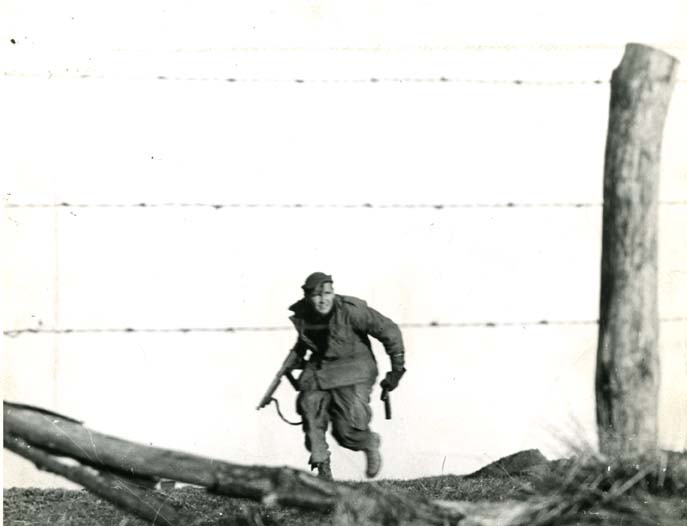
That left the paratroops on their own in the kill zone. Some tried to provide their own suppressing fire while others charged forward. Ammunition ran low; the men pulled guns and ammo off the wounded and the dead to keep going. Driven forward, the first wave finally reached the German lines. On 1st Platoon, Bravo’s section of the front, Staff Sergeant Walsh had his men prep grenades for him (he couldn’t pull the pins out with his wounded hand). Holding the spoon in place, he charged toward a German 20mm flak half track and chucked the grenade onto its bed. The weapon detonated beside the 20mm gun, wiping the crew out.

Other paras surged into the German trenches and foxholes, clubbing the panzergrenadiers with rifle butts and  beating them with bare fists. The fighting devolved into vicious man-t0-man battles to the death.

st mere eglise june 17 gis with panzerschrek156

A captured panzerschrek under investigation by U.S. troops at St. Mere Eglise during the Normandy Campaign. Captured panzerschreks were sometimes used against the Germans since they proved more effective than American bazookas.

Sergeant Edwin Clements reached one of the flak tracks. Out of ammunition, he drew his combat knife, jumped onto the back of the vehicle and killed the three man gun crew. Nearby, Private Mack Barkley did the same, slitting a 20mm gunner’s throat then grabbed a German panzerschrek and put two rockets into another armored vehicle before being wounded in action.

The fighting coalesced around the armored vehicles. The panzergrenadiers, overwhelmed in their trenches by the desperate American assault, gave ground. Twenty of them were killed in hand-to-hand fighting as the others fell back into Cheneux’s buildings. Meanwhile, the vehicle crews found themselves surrounded by paratroops willing to do just about anything to knock their guns out. Staff Sergeant Walsh was seen climbing onto a German tank and–in true Hollywood fashion–dropping a grenade on the crew from the track commander’s hatch. Others followed suit. Private First Class Daniel Del Grippo of 2nd Platoon Charlie earned a Distinguished Service Cross for knocking out an MG-42 nest, then tommy-gunning a flak track’s 20mm crew.

First Platoon Bravo made it into the west side of Cheneux with twelve men standing. Walsh and Smith urged them forward toward’s the town church, only to run into another flak track parked in an intersection. Sergeant Dock L. O’Neil, who had splintered his M1 Carbine’s stock on an SS Soldier’s head, led the attack against this vehicle and knocked it out with a bazooka just as the gun crew wounded him in the leg. As the track burned, one of the Luftwaffe gunners jumped clear, only to be cut down by O’Neil’s Model 1911 Colt .45. Smith was killed soon after while leading the remains of his platoon.

An hour into the attack and every B Co officer had been killed or wounded except the company commander. The sight of his men being slaughtered in the 400 yard kill zone proved too much for him. He went berzerk, suffering a mental breakdown and a few of his surviving men had to physically restrain him. Command fell to the XO, who pressed the attack forward.

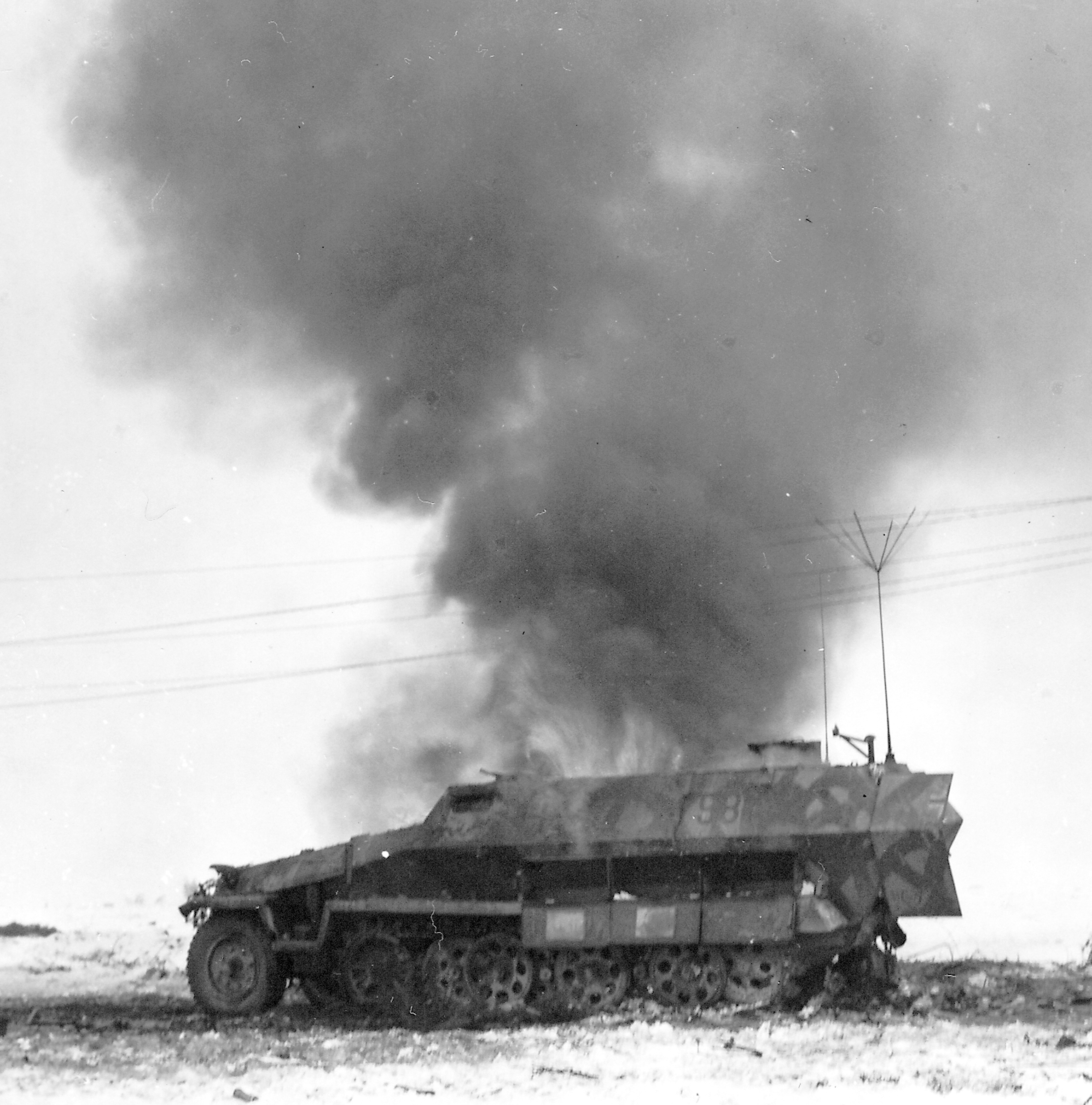
Bulge135 burnGerHTJan6On the left, Charlie Company ran into multiple barbed wire fences. Every time the assault waves climbed over them, the Germans smothered the Americans with explosive shells and machine gun rounds. Stubbornly, the surviving Americans closed with the panzergrenadiers and drove them out of the foxholes–or killed them in place.

As the attack neared the west side of town, Charlie’s lead elements ran into a Puma armored car equipped with a short barreled 75mm infantry support gun. The vehicle had been taking out the battalion’s heavy weapons crews, but now it shifted fire on the advancing paras. Corporal Harold Stevenson tried to knock it out with a bazooka, but the Puma’s gunners cut him down. The vehicle backed away into the night to continue the fight elsewhere in town.

Charlie penetrated the town, fighting room to room with the panzer grenadiers inside the buildings while simultaneously battling the Luftwaffe’s flak tracks in the streets. The two companies of SS panzergrenadiers lost half their men and began to pull back against the Ambleve to defend the two bridges.

Three hours into the fight, one of the 504th’s senior officers discovered that the two M36 Jackson Tank Destroyers assigned to the assault waves had not gone forward. Demanding an explanation, the airborne lieutenant colonel was outraged to hear a young LT explain how his tracks didn’t stand a chance against the German panzers defending the town.

The LTC stormed over to a platoon of 60mm mortars and ordered the men there to start dropping rounds on the tankers if they did not move forward. Under that threat, the LT gave the word to go get into the fight. They rumbled up the main road into Cheneux, the fighting raging in chaotic clumps on either side without any clear front line remaining. As the Jacksons neared the town, a German half track roared right at them. Surprised, the lead Jackson’s crew trained their turret on the track–only to have their 90mm gun barrel smack the German vehicle. Stunned at this collision with an American AFV, the half track crew bailed out while the Jackson’s driver backed up far enough to allow his gunner to put an HE shell into the German rig. It blew up as the M36’s killed its fleeing crew.

35th Inf Div XII Corps 3rd Army M36 Jackson TD in burning town Habkirchen Germany 121545 (1 of 1)

The M36 Jackson sported a 90mm gun, the largest and most powerful anti-tank weapon to be widely employed by the U.S. Army in WWII.

Late that night, a few of the survivors of 1-504th’s attack reached Cheneux’s picturesque church on the south side of town. Surprisingly, it was one of the few intact buildings left, and the men approached it cautiously. Led by Lt. Howard Kemble, a light machine gun platoon leader whose men were thrown into the assault as reinforcements, the small band of Americans opened the church’s front doors and found an elderly priest presiding over a congregation of terrified, traumatized civilians. Though in the midst of battle, some of the Americans–Lt. Kemble included–entered the church, knelt beside the Belgians and prayed together with them. A moment later, they slipped back out into the fight where Lt. Kemble led the men into a bayonet charge. He was killed not long afterward by German Soldier he thought was an American. Kemble received a posthumous Silver Star for his actions.

82nd airborne trooper in counter attack 12 25 44 bulge278

504th paratrooper Walt Hughes at Cheneux after the night assault.


By the end of the night assault, the 1-504 secured half of Cheneux. They clung to their foothold and awaited reinforcement. The next day, the 504th’s 3rd battalion joined the fight and finished the job, clearing the town and forcing the Germans across the Ambleve in bitter fighting.

The Germans lost at least a hundred and fifty men, four flak tracks knocked out or captured, one Tiger II lost, two Pumas, six half tracks, a 105mm howitzer and two other vehicles. The bloody coup de main forced Peiper to abandon his only bridgehead across the Ambleve. He withdrew to La Gleize to await relief that never came. Ultimately, his kampfgruppe was surrounded and virtually destroyed. The 504th’s action at Cheneux played a major role in blunting the main armored spearhead on the northern sector of the Battle of the Bulge. That strategic victory came at a terrible cost. By the end of the first night of the Battle of Cheneux, Bravo company had twenty men standing, no officers. Charlie had three officers, forty men left.

Bulge341 KingTiger82AbnJan8

Men of the 82nd Airborne examine an abandoned Tiger II.

In the days that followed the Battle of Cheneux, the 82nd Airborne Division fought against no fewer than three Waffen-SS Divisions, only retreating after General Bernard Law Montgomery ordered them to do so. Within days of that withdrawal, the division returned the offensive and played a key role in the American counter-punch that regained in January all the ground lost in December.

The 504th had not just achieved their military objective that December 20th. Their furious attack against entrenched, elite troops backed up by heavy weapons and armor–succeeded against all odds because of their sheer courage, professionalism and determination. These men exemplified the best tradition of American combat arms and proved that man-to-man, the Soldiers of the 82nd Airborne were more than the measure of the Waffen-SS.  The assault at Cheneux represents one of the most heroic and determined in the U.S. Army’s history. It has become part of the long and proud legacy of the 82nd Airborne– a legacy that our current generation has added to on the battlefields of the Global War on Terror.

82nd Airborne 504th PIR Bulge belgium 012845-1

The 504th Parachute Infantry advancing to another assembly point prior to an assault on German positions near Heersbach during the final days of the Battle of the Bulge in January 1945. The 504th saw near-continuous action for almost five months following the devastating battle of Cheneux.


Categories: Belgium, ETO, European Theater of Operations, Uncategorized, War in Europe, World War II Europe, World War II in Europe | Tags: , , , , , , , , , , , , , | Leave a comment

Grog and the National Guard

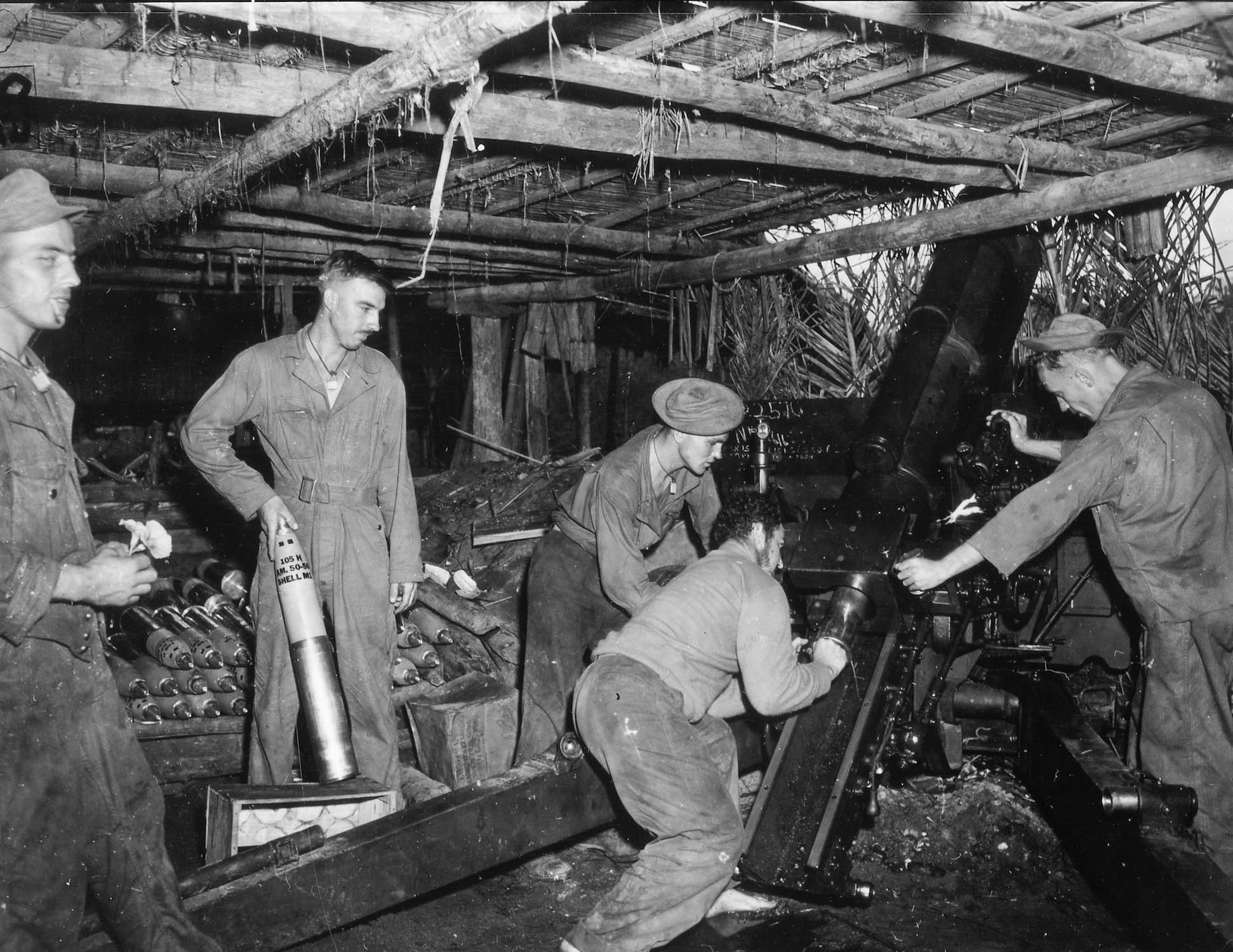
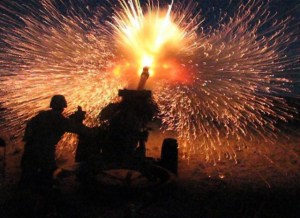
Field artillerymen of Battery A, 2-218th Field Artillery, 41st Infantry Brigade Combat Team, Oregon Army National Guard, fire a 105mm shell from a Howitzer at Yakima Training Grounds, Wash., during the units annual training Aug. 9.
Field artillerymen of Battery A, 2-218th Field Artillery, 41st Infantry Brigade Combat Team, Oregon Army National Guard, fire a 105mm shell from a Howitzer at Yakima Training Grounds, Wash., during the units annual training Aug. 9.

G86A0408

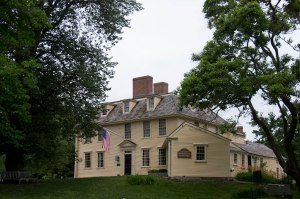
Buckman Tavern, Lexington Green.

Today, I want to write about Grog. Grog and citizen-soldiers, actually. One is the fuel, the other is the shield and sword of this great nation of ours, and our tradition of both goes back hundreds of years. What were the Colonial militiamen doing at Lexington when the Redcoats marched into town? Drinking breakfast at Buckman’s Tavern, of course!

Grog is a time-honored Army tradition. I’ve been to numerous dining outs over the years, and have always had a lot of fun with the grog bowls in each. You get to know a unit by what they put in their grog, and what they put it in. The first grog I ever sampled belonged to Bravo Company, 2-162 Infantry. I can’t remember everything that was in that grog–hell that whole night is pretty fuzzy after I started drinking it–but I do recall sand from Iraq, filthy socks and too many different types of hard hooch to count being dumped into the bowl by the unit’s senior NCO’s. It was drunk not from fine china cups or crystal glasses, but a mangled, well-worn infantry boot. Somewhere, there are photos of me drinking from the boot that should never, ever be published. God it was nasty stuff–like burn your nostrils and set fire to your face nasty.
IMG_7189

From 2005-2013, I spent a lot of time with the National Guard units in Oregon, writing about them and serving as the leader of a volunteer group of civilians who filled the OPFOR role. This gave me access to free grog!

The 82nd Engineers had their own twist on the grog bowl. Again, the details are fuzzy, but as I remember they used the bucket from a backhoe as the grog bowl. An ancient engineer boot was the drinking utensil of choice. Lots of gritty stuff in that one as well.

I was lucky to be invited to a couple of dining outs with Alpha Company, 2-162, where I made the life-threatening crucial error of trying to keep up with the Legendary Alan Ezelle as he and Brian Hambright raided the open bar. By the time the grog had been poured and stirred, I was already barely able to walk. All I remember from that night was taking a drink from the boot and feeling my ears blow off. I vaguely recall projectile vomiting in Ankeny Hill Wildlife Refuge some hours later. I tasted whiskey and coffee grounds in my mouth for days, despite gargling with Listerine (and when that didn’t work) rubbing alcohol.
IMG_0381Just to be clear, I’m not a heavy drinker. On an empty stomach, I am a complete lightweight. National Guard Grog devastates me every time.

Earlier this month, I was honored to be the guest speaker at the 2-218th Field Artillery’s dining out. I was both excited to see what artillerists put in the grog, and also very nervous about making a spectacle of myself after drinking it. The affair was hosted at the Embassy Suites in Portland, and for a change I had appropriate attire. Until about a year ago, I had not owned a suit since 1996 and was always severally under dressed at these functions (and funerals). This made me even more nervous though, as I began to wonder how one cleans grog barf out of super 120 wool.

Artillery grog is composed of seven charges. Each charge has a particular piece of history attached to it. The first charge is a special blend that is mixed and buried for weeks by one of the members of the unit so that it may properly ferment and melt your stomach upon ingestion. Charges 2-7 all represent different aspects of the U.S. Army’s heritage or the unit’s history. Sake for fighting the Japanese during WWII. Cognac to honor our French Allies who helped give us the means to achieve our freedom. Scotch in honor of the British and our special alliance with them. The grog was mixed in what looked like an early 20th Century artillery caisson, then poured into shell casing mugs. Champagne, engine oil, a sock and some ladies stockings I believe were added to the mix to give it a bit of well, je ne sais quoi.

The result was a pinkish concoction that upon first taste was light and (thanks to the engine oil) smooth. Unlike the other grog I’ve had, the Redlegs made something that was not only historically laden, but quite good. I was astonished. I looked at my new friends, cheered them and said, “See you in the ER gentlemen” as I took a swig. The champagne’s bubbliness lend itself to the charge 1 buried blend and the cognac, while the Scotch fueled a nice burn on the way down. Unfortunately, I was driving that night, so I could only have a taste. I didn’t wake up in prison nor in the ER wondering where my clothes were and how my chest hair got burned off, thus I consider the evening a win.
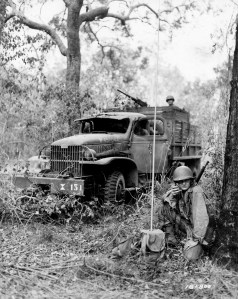
41st Inf Div 218th FA Bn FO with radio and truck during exercise Rockhampton Australia 112642 (1 of 1)

A 2-218th Forward Observer during a field exercise in Australia, November 26, 1942.

The 2-218th Field Artillery has a history that dates back to 1866, making it the first and longest serving artillery unit west of the Mississippi River. Men from the battalion served in border wars with Mexico, the Western Front of WWI, in the Pacific and ETO during WWII, and for the last decade supported almost every Afghanistan and Iraq deployment undertaken by the Oregon National Guard. The Redlegs of the 2-218th are a humble, quiet, stalwart and exceptionally professional bunch whose deeds have escaped notice since they shirk the limelight. In the coming months, I’ll be writing more about them and their fascinating history. For now, the speech I delivered at the dining out (pre-grogged) gives a glimpse into the battalion’s rich heritage:


In the summer of 1943, an Australian brigade and the 162 Infantry executed an amphibious landing at Nassau Bay on New Guinea’s northern coast. The plan was to push inland and take out the Japanese base at Salamaua. Doing so would eliminate the Japanese from eastern New Guinea and open up  the way for MacArthur’s Island hoping drive to the Philippines.


The landing was a disaster. Heavy surf swamped the only large landing craft available and most of the barges and LCVP’s were lost on the waterline as well. The 162nd struggled ashore without heavy equipment and without most of their radio gear to face a well-prepared enemy fighting from interlocking pillboxes and log bunkers.41st Inf Div 218th FA Bn 155mm Howitzer Yellow Beach Hollandia New Guinea 06--44 (1 of 1)
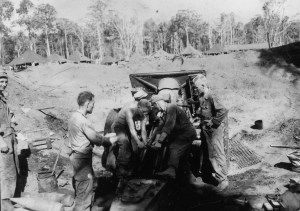
 

They called it the Shipwreck Landing. The 218th Field Artillery was supposed to have gone ashore with the 162, but the destruction of so many landing craft made that impossible. Instead, B and C Batteries, landed a few days later.


They began taking casualties on that first day. Japanese snipers lurked in the jungle around them. Hold outs laid on point-blank ambushes. Booby traps claimed several men. The weather went from steamy hot to sudden deluges that left the men shivering.
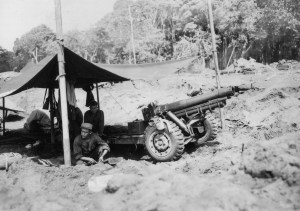
 

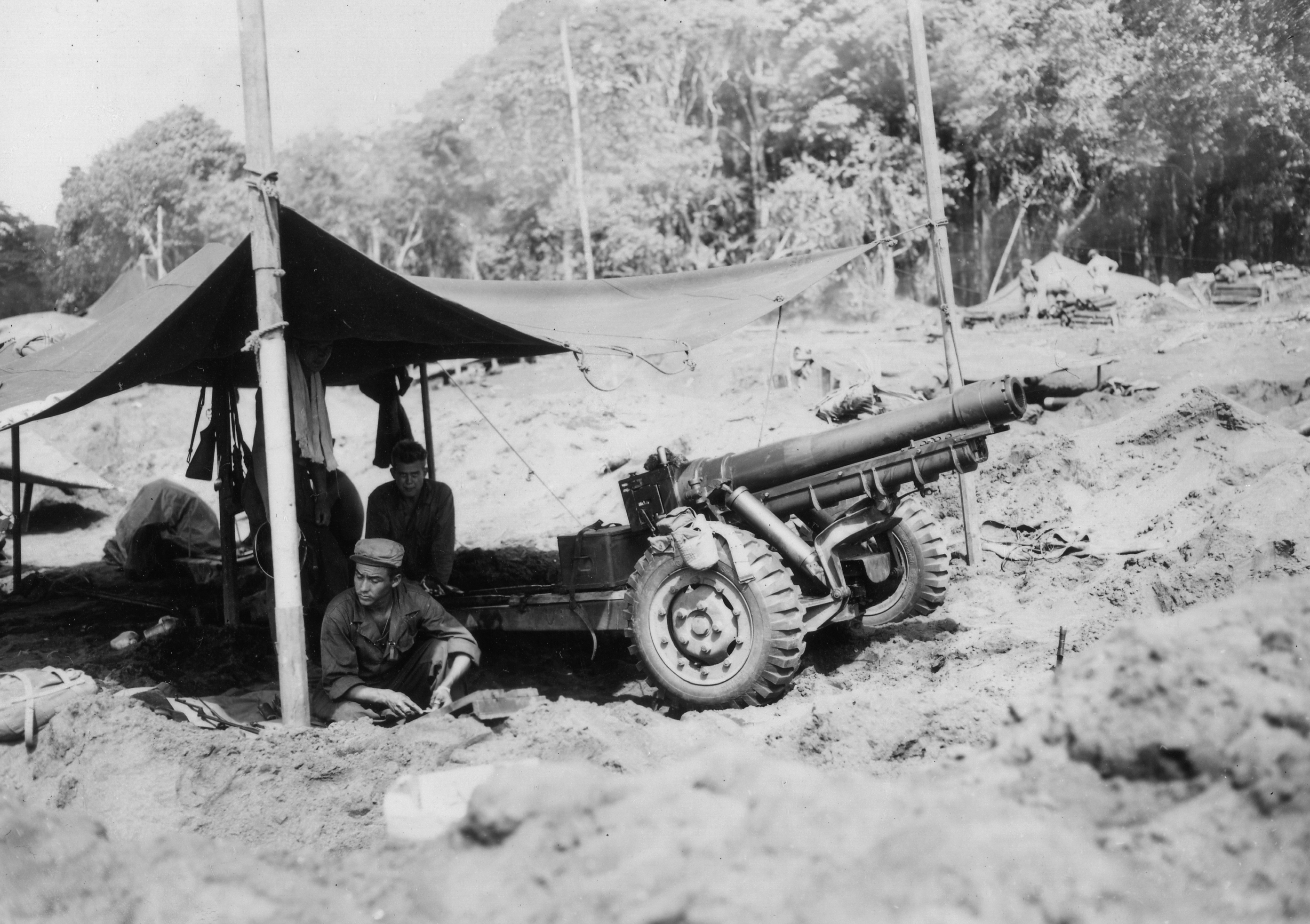
41st Inf Div 163rd Inf Regt Cannon Co 105mm howitzer yellow beach hollandia 060544 (1 of 1)The 80 men of C Battery and their four 75mm pack howitzers were of no use on the beach. The infantry had slogged inland already, and the Oregon artillerists were tasked with hauling their guns five miles through swamps, across creeks and rivers—by hand. They broke the weapons down, made makeshift litters from tree limbs to carry some of the gear and waded through chest-deep swamps teeming with crocodiles. Several men in other units had been eaten alive by those animals. Others had been swept away in the fierce current of the Bitoi River.  The men of C Battery crossed and recrossed that river at least six times as it wound around the only jungle track that could take them to the Japanese.


When they cleared the river, they had to carry their howitzers up steep slopes and down the backsides of ridges into leech and mosquito-filled swamps. With their four guns, they brought four hundred rounds of 75mm ammunition, each weighing fifteen pounds.


The morning of July 8, 1943 found C battery dug in on a hillside about six thousand yards from a major Japanese defensive position that the 162 called “The Pimple.” The Pimple was a thousand foot tall hill overlooking the Bitoi Track and River. To get to Salamaua, the Pimple had to be taken. The Aussies had attacked it three times. The Japanese, hunkered down in 25 pillboxes and 50 heavy weapon emplacements, threw back every assault and even cut off one of the Aussie companies for three days.


On the 8th, the Aussies and the 162 tried again. This time, the 218th was there to support them. It was a big moment for the Oregonians and Washingtonians of the unit. They’d never fired their 75’s in anger before, and before the pre-assault barrage began, the men gathered to sign their names on the first shell.


For days, the infantry had been charging up the Pimple into interlocking fields of fire with nothing more than grenades and light machine guns to support them. They had no tanks. Close Air Support was in its infancy and unavailable. The Japanese fought to the death. They hadn’t given ground.


That changed with the 218th’s arrival.  That day, July 8, 1943, the men of C Battery fired the unit’s first shell of World War II. In the ensuing days, the battery burned through its ammo supply. Men had to retrace their path back to the beach to hand carry another hundred shells. Others were air dropped, but most were damaged in the attempt. The NCO’s organized a party to recover those damaged shells, pull the primers and projectiles out of dented casings then refitted them into empties laying around the firing pits.
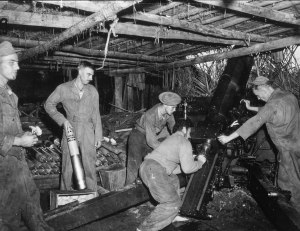
41st Inf Div 205th FA Bn 105mm Howitzer in action Salus New Guinea 080543 (1 of 1)

For almost a week, the 218th hammered the Pimple, taking out machine gun nests, mortar tubes and pillboxes. Three days into the battle, C Battery received an urgent call for support. An Aussie platoon had discovered an entire Japanese infantry company coming to reinforce the Pimple. They’d gathered for a short rest during their march in an open field—no more perfect a target for the 75’s. C Battery fired nine shells per gun in thirty-six seconds and smothered that Japanese company in high explosives. At least fifty were killed and countless others wounded. The Pimple would not be reinforced.


The Aussies took the hill the next day.


For the next month, the 218th sent shells down range as the infantry assaulted one damn ridge after another. On the 4th of August, the unit suffered its first combat fatalities when an Aussie mortar round fell short and landed on a forward observer team, killing five men.


On September 1st, with the Allied infantry at the threshold of Salamaua, The Japanese launched a furious counterattack. Dawn Company, 15th Brigade, Australian Army was cut off atop a steep ridge. Low on ammunition, the Japanese counter-assault swept toward them. Captain Burelbach, the 218th’s fire support officer attached to the Aussies, called for fire. Every gun in the 218th and 205th rained shells down on the Japanese attackers, breaking up two onslaughts and saving Dawn Company.
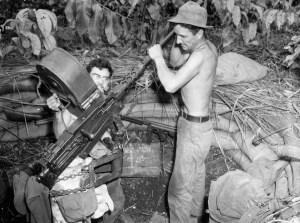
 

41st Inf Div 218th FA Bn M2 50 Cal AA Tambu Bay New Guinea 081943 (1 of 1)The ordeal did not end on the 1st. The next morning, freshly landed Japanese Marines—elite troops—stormed Dawn Company’s positions along the ridge. Exhausted, weakened by jungle diseases and weeks of fighting in horrific conditions, the Aussies could not possibly hold out for long. Burelbach called for fire. The 218th ringed Dawn Company with a curtain of steel and stopped the Japanese Marines in their tracks.


Later that day, Dawn Company’s commander, Captain Provan, limped into Smith Battery, 218th’s perimeter. Wounded, filthy and emaciated, he wanted only to thank the Americans who had saved the lives of his men. Without their 75’s, he told them, Dawn company would have been annihilated.


The 218th’s first campaign of World War II ended a few days later. It set the tone for what followed for two more years of fierce, jungle fighting in long forgotten places that served as stepping stones to the Philippines. Unheralded, these campaigns unfolded against a brutal and determined enemy that asked no quarter and gave none. The 218th played a significant role in MacArthur’s drive to Leyte which cut off 250,000 men—as many as were surrounded at Stalingrad in 1943. Of those 250,000, less than 11,000 were left to surrender at the end of the Pacific War. The 41st and the 218th took part in one of the greatest and most successful military operations in American history—and received almost no notice for it.


That is the hallmark that characterizes the artillery, unfortunately. Overshadowed by the infantry, by special forces, the whiz-bangs of the Air Force’s smart weapons, the artillery has been virtually ignored by the American media, except to demonize it over collateral damage.41st Inf Div C bat 218th FA fires 105mm howitzer at Arara New Guinea 052544 (1 of 1)
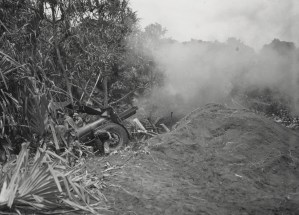
 

The truth is, those who matter know its importance. They know that the U.S. Army’s success on every battlefield from Boston Harbor in 1776 to the most furious onslaughts in Afghanistan and Iraq are built on the backs of the men and women who crew the guns. The superiority of American artillery tipped the odds in 1848, stopped Pickett’s Charge at Gettysburg, blasted the holes in the German defenses in the Meuse Argonne that the infantry exploited. The 75’s, 105’s and 155’s of World War II were the main casualty producers—something like 85% of the German losses on the Western Front came from indirect fire. Time on Target, the ability to shoot and scoot, the speed at which the artillerists could get shells downrange—those assets saved countless Allied lives and broke up countless Axis counter-attacks.


Without the artillery in Korea, the mass Chinese human wave attacks would have destroyed the U.N. and the American 8th Army in 1950. Without the artillery emplaced on Vietnam fire bases, how many would have been overrun by the NVA? And the Gulf War? While the technology got all the attention, the real work was done by the artillery.


The Global War on Terror changed everything. The concern for collateral damage and the cost of paying for every broken doorknob in Iraq and Afghanistan led the artillery away from its traditional role as the King of the Battlefield. Firepower, accuracy and speed were replaced with convoy security, military police duties, infantillery patrols. The Artillery, the most specialized and technical branch of the Army, became a jack of all trades, doing whatever needed to be done to support the mission.


19may04 034Yet the need for infantry support, firepower and the protection of American lives with that deadly steel curtain remained. The skills and weaponry that made the U.S. Army an unbeatable force for two hundred years have atrophied across Big Army and the Guard alike, but the threats of conventional warfare remain. Russia and the Ukraine, the demented regime in North Korea, Chinese expansion in Southeast Asia—these are threats our infantry and aviators cannot alone deter.

The men and women of the 2-218th have proven their skills in this traditional role are the best in the nation. Despite deployment after deployment in non-artillery roles, the infantry you will support on future battlefields will rest a little easier knowing that the Oregon Guard has their back. Your commitment to your training has ensured these crucial skills have not atrophied.

The men and women of 2-218th have proven this by winning the coveted Hamilton Award in 2012.

You accomplished this despite the many competing demands you have faced since 9-11. Men and women from this unit have served on every battlefield since 2004. They have been in ambushes, kinetic small arms fire engagements. They’ve called for fire at critical moments in key battles. No finer example of this can be found than Patrick Eldred, Bravo Company, 2-162’s Fist of God. While serving as a forward observer during the Battle of Najaf in 2004, Pat brilliantly called for both artillery and air support, sometimes danger close to 2nd Platoon Bravo during sixteen days of house-to-house fighting. Pat’s precision and coolness under continuous, sustained fire for those two weeks played a decisive role in defeating the Mahdi Army fighting around the Imam Ali Shrine.


Personal examples of bravery abound. Luke Wilson, a 2-218th veteran who volunteered to go out with 2-162 during OIF II is an exemplary case of selfless devotion to his Brother warriors. On the first night the battalion drove into Baghdad from Kuwait, sixty plus Syrian volunteer insurgents hit the Oregon convoy. Luke’s plywood walled 998 Humvee took an RPG that wounded everyone in back. Luke’s leg was blown off below the knee. Instead of calling for help, he continued to fire at the enemy until their rig cleared the kill zone. Even after, he refused to call attention to himself until everyone else was treated. He almost bled to death before reaching the Baghdad CASH as a result.
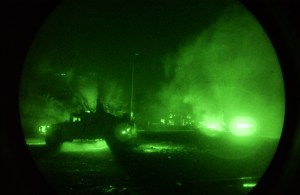
Smoke rises behind a Charlie Company HUMVEE from a car that charged the scene firing at the unit. Charlie Company returned fire, stopping the car, to secure the area, during increased tension in Sadr City, Iraq on July 5, 2004. U.S. Air Force photo by Staff Sgt Ashley Brokop (Released)

U.S. Air Force photo by Staff Sgt Ashley Brokop (Released)


This is your heritage, your legacy. From its first inception in the 1860’s to the battles our nation fights today, the men and women of the 218th serve with great distinction and honor. More than any other National Guard unit I’ve encountered, 2-218th is also a family. Generations serve here. It is a rite of passage for many families to serve in this unit. It becomes the core of their lives. While America has endured crises and convulsions here at home and abroad for over a century and a half, the 2-218th has been a constant. Here, service is valued. A commitment to something greater than self is at the core of that service. It is not a unit you join for financial benefits—there are no tier one bonuses to be had. This is a family you must seek out, you must want to join and be a part of this extraordinary heritage. You must want to build on that with your own actions.


They say our grandparents were the Greatest Generation. They won a war with the full support of a nation mobilized in every aspect for it. They won that war with a draftee military, on broad shoulders of patriots young and old.


This generation has been asked to do far more with far less. You are volunteers in the longest war in American history, a war being fought by a tiny warrior class while the rest of the nation is busy with their own self-involvements. On your capable shoulders is the flag of our nation, and members of this unit have worn it in the most remote corners of the globe. You are doing it without the full support of our political leadership or our fellow Americans. You are doing it in anonymity, without rewards beyond the fulfillment of knowing what you do has tremendous value. American artillery exists to save American lives. Without you, without your pride and professionalism, there would be far more empty seats at holiday tables across the country this year.

That is what a century and a half service means. In the many trials ahead that we face overseas, the men and women of 2-218th will meet those challenges with steadfast resolve, courage and the commitment that has long since made the Oregon National Guard and its values the bedrock of our state.


Our grandparents may have been the Greatest Generation. But in my book, you are the Most Noble one. If we are to save our nation in this time of great crises, it will be those like you who will get the job done. Those of us who still believe ours is the greatest nation and humanity’s last hope, vest in you our complete trust and support.


On this most sacred of American holiday seasons, pull your loved ones close. With family, we will persevere. God bless you, and God Bless America.
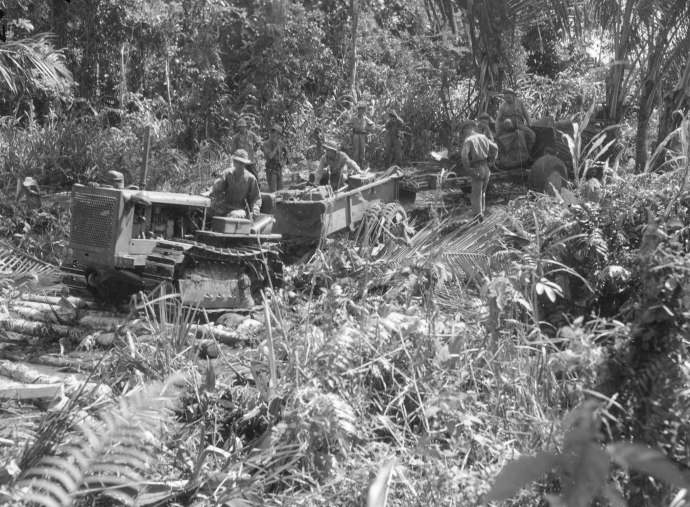
41st Inf Div fa bn tractor and 105mm in New guinea jungle 070743 (1 of 1)


Categories: Uncategorized | Tags: , , , , , , , , , | 1 Comment

The Ardennes Offenisive Begins

59th signal ban rail jeep 1st army bastogne belgium 121644 (1 of 1)December 16, 1944, the German Army launched the largest offensive operation ever conducted against United States ground forces. Known as the Battle of the Bulge, the fighting raged for over a month and consumed most of the Third Reich’s remaining reserves of fuel and oil. Somewhere between 65,000-125,000 Germans troops were killed, wounded, captured or missing during those furious six weeks of fighting. The U.S. Army suffered more than 89,000 casualties and the loss of over eight hundred armored vehicles and tanks.
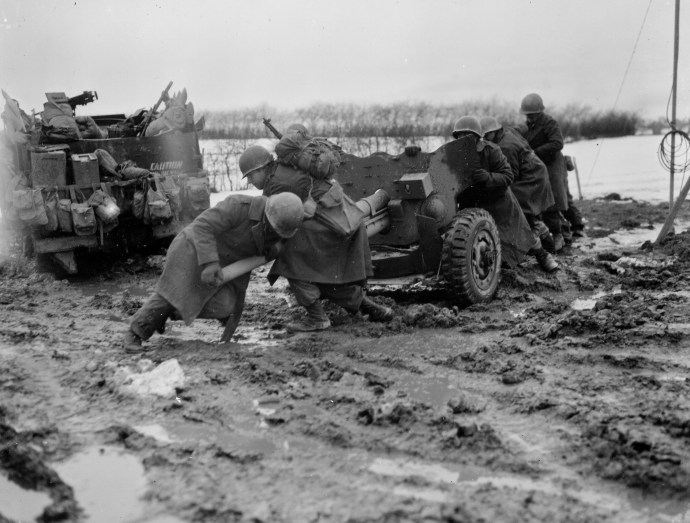
Photos from the early days of the German offensive are few and far between, but here are some shots taken on December 16, 1944 throughout the Western Front by U.S. Army Signal Corps photographers. Over the next few weeks, we’ll be posting more photos that captured key moments during the Ardennes Offensive and the subsequent Allied counter-offensive.

1st Inf Div 26th Inf Regt V Corps 1st Army 57mm AT Gun Germany Belgium Border 121744 (1 of 1)

Men of the 26th Infantry Regiment, 1st Infantry Division, muscle a 57mm anti-tank gun into position at what became known as the Hot Corner, a patch of ground the division denied to the advancing Germans which ensured the North Shoulder of the Bulge would hold. The photo was taken on December 17, 1944.


German Employed Captured M8 Greyhound Armored Car Knocked Out at St Vith Belgium Bulge Seen 020345 (1 of 1)

Some German units employed American vehicles during the Ardennes offensive. This captured M8 Greyhound armored car was knocked out during the pivotal fighting for St. Vith, Belgium.


45th Inf Div 180th Inf Reg Bobenthal Germany Counter Sniper 121644 (1 of 1)

Fighting along the Western Front did not stop with the German offensive in the Ardennes. Here, a patrol from the 45th Infantry Division’s 180th Regiment fights house to house in Bobenthal, Germany under sniper fire on December 16, 1944.

90th Inf Div 807th TD Bn 3 inch 90mm AT gun St Barbara Germany 121644 (1 of 1)

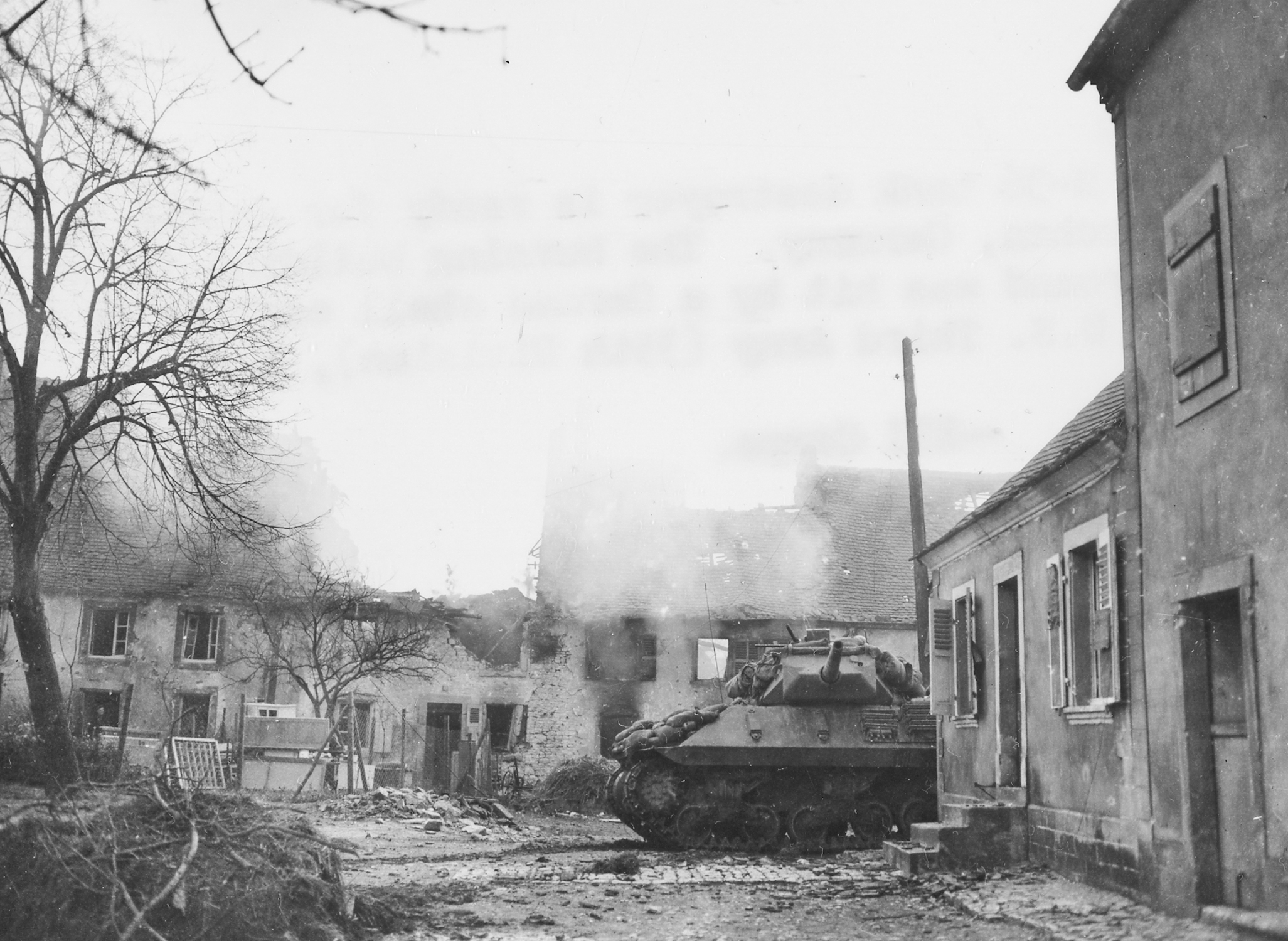
Men of the 807th Tank Destroyer Battalion, 90th Infantry Division, rain shells down on German positions near St. Barbara, Germany on December 16, 1944. The 90th would later be thrust into the American counter-attack and ended up fighting around Bastogne.

A Waffen SS soldier with Kampfgruppe Hansen seen after elements of the 14th Cavalry Group were ambushed and destroyed outside of Poteau, Belgium on December 18, 1944.

Categories: War in Europe, World War II Europe, World War II in Europe, WW2, WWII | Tags: , , , , , , , , , , , , , , , , | 1 Comment

The Curious Case of the Ohio National Guard’s 147th Infantry

147th inf Regt Japanese MMG with M1917 30 cal MMG on range at New Caledonia 112444 (1 of 1)

Men of the 147th on a heavy weapons range learning how to fire a captured Japanese Nambu machine gun. The photo was taken on New Caledonia Island in November 1944.

During the Second World War, the Ohio National Guard’s division, the 37th, served in the 1943 Solomons campaign before playing a key role in the liberation of Manila during the 1945 battle for Luzon. The division was one of the only National Guard units to be commanded by the same general through the entire war.

The 37th Infantry Division’s service was exemplary, and its courageous Soldiers earned seven Medal of Honors and a hundred and sixteen Distinguished Service Crosses during its two years in island combat.

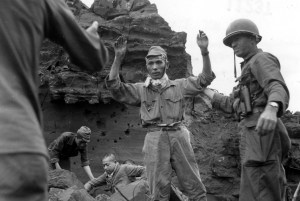
Men of the 147th capture a Japanese hold out on Iwo Jima during their three month long ordeal on the volcanic island.

Men of the 147th capture two Japanese hold outs on Iwo Jima during their three month long ordeal on the volcanic island.


37th Inf Div M-4 Sherman and GI's Drive on Manila Luzon Philippines Campaign 01--45 no cap-1

While the 147th Infantry battled against the Japanese on Iwo Jima, the rest of the Ohio National Guard was fighting to liberate Luzon during the 1945 Philippines campaign.

This post is about the division’s lost regiment, the 147th Infantry.  The 37th had been organized as a square division during World War I which meant it had four infantry regiments. The 147th became the odd unit out when the Army reorganized to the triangular division.  In 1942, the 147th was pulled from the 37th. It spent the entire Pacific War as an independent regiment, bouncing from campaign to campaign and doing heavy fighting that has been all but forgotten to history.

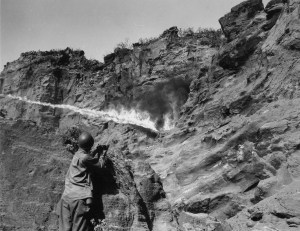
To clear the caves and tunnels, the 147th's infantry platoons went into action with an exceptional level of firepower, including extra BAR's, bazookas and flame throwers.

To clear Iwo Jima’s caves and tunnels, the 147th’s infantry platoons went into action with an exceptional level of firepower, including extra BAR’s, bazookas and flame throwers.

The 147th first saw combat on Guadalcanal in 1942-43, taking part in the U.S. Army’s bloody counter-offensive that ultimately forced the Japanese to abandon the island in February 1943. The regiment then pulled garrison duty on Emiru, later serving on Saipan and Tinian in the wake of the Marine Corps’ landings.

147th Inf Regt Flame Thrower Attack on Japanese Cave Iwo Jima Bonin Islands 040845 (1 of 1)

An infantry platoon from the 147th attacking a Japanese-held cave with a flame thrower during a firefight on April 8, 1945–months after Iwo had been declared secure.

In the spring of 1945, the 147th landed on Iwo Jima, ostensibly to perform more garrison duty. Instead, they found themselves locked in a bitter and thankless battle with thousands of Japanese hold-outs waging a desperate guerrilla campaign against the Americans on the island from well-supplied caves and tunnels.

For three months, the regiment slogged across the island, digging out these Japanese with explosives, flame throwers and satchel charges. Some sources credit the regiment with killing at least six thousand Japanese soldiers in those anonymous and merciless small unit actions.

Always serving in the wake of the Marines, the regiment’s service in the Pacific has been virtually lost to history, yet this National Guard unit was the only one in the Army to fighting in the Solomons, the Marianas and Iwo Jima.

I first came across the 147th while scanning photos at the National Archives a few years back. I came across these combat scenes from Iwo Jima and was absolutely stunned to learn the Ohio National Guard had taken part in what is remembered as the quintessential Marine Corps battle.

If anyone has further information about this regiment, please feel free to post. These men need some recognition for what they did during WWII.

147th Inf regt Soldiers Exhausted on March in Burma CBI 120444 (1 of 1)

If being overlooked by history is not painful enough, the Signal Corps also misidentified this group of GI’s in Burma as being part of the regiment. The combat cameraman’s caption says these men belonged to 2nd Battalion, 147th Infantry, and the shot was taken 30 miles behind Japanese lines in Burma following a night patrol on December 4, 1944.


Categories: National Guard, World War II in the Pacific | Tags: , , , , , , , , , | 5 Comments

Photo of the Day: Prelude to Operation Grenade

4th inf div in bunker near prum germ feb 45 4x6

Soldiers of the 4th Infantry Division hunkered down in a cellar near Prum, Germany just before Operation Grenade, the crossing of the Roer River in February 1945.

Categories: World War II, World War II Europe, World War II in Europe | Tags: , , , , , , , | Leave a comment

Photo of the Day: Sunrise at FOB Leatherneck, October 2010

IMG_2844

Categories: Uncategorized | Leave a comment

Deeds, Not Words

hurtgen forest troops and mmg fall 44173 8x10December 1, 1944

Grosshau, Germany

Eastern Edge of the Hurtgen Forest


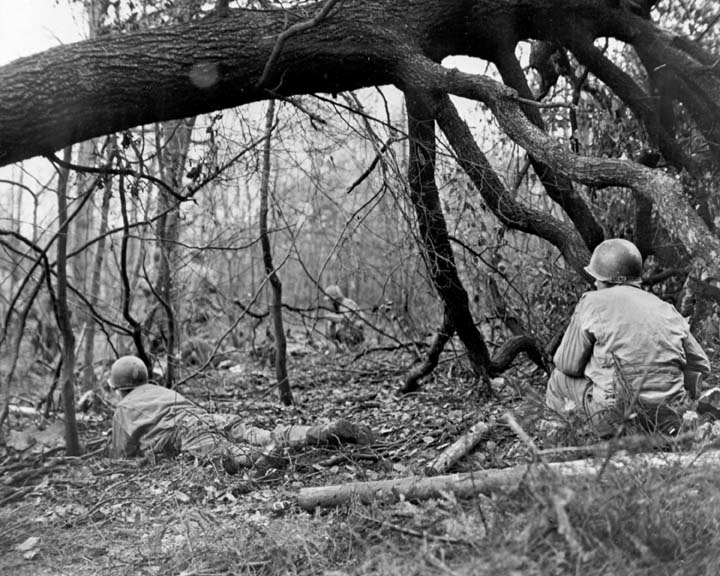
Cold, wet and hungry Soldiers hunkered down in foxholes, side by side with complete strangers. In two weeks, the 22nd Infantry had lost 151% of its riflemen while fighting for six thousand yards of ground in the Hurtgen Forest. Urged forward time after time, the line companies had endured an onslaught of German artillery barrages, machine gun fire and minefields. Many attacks had been stopped cold, smothered by German shells and bullets. So many men had been lost that the rifle companies were filled with green replacements thrown into the line with bewildering speed. Once considered the pride of the 1st Army, the 22nd had become a shell of its former self.

The attacks continued with relentless intensity until the 22nd Infantry had lost almost all its veteran dogfaces, the men who had come ashore at Utah Beach earlier in the summer. Somehow, the regiment ground forward, inch by inch against withering fire and counter-attacks until by the end of November, one of the 22nd Infantry’s battalions had reached the outskirts of Grosshau, Germany, the last town before the Roer Plain. Take the town and another push would thrust the entire 4th Infantry Division into open ground where the 5th Armored Division, waiting in reserve, would exploit.

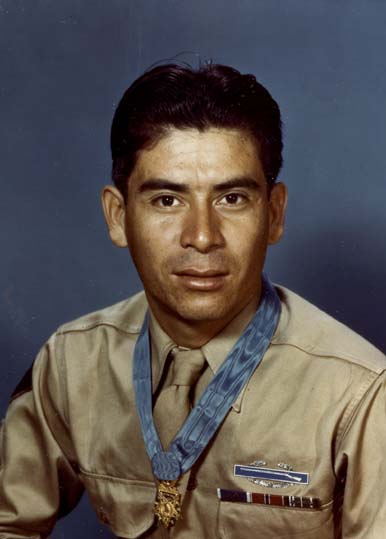
gst marcario garcia cmh147 5x7On November 27, 1944, B Company 1st Battalion 22nd Infantry advanced into a German kill zone while pushing on for Grossau. Pinned down by machine gun fire, B Company was soon hit by an artillery and mortar barrage. With casualties mounting, an acting squad leader named Private Marcario Garcia launched a one-man attack on the machine gun nest. Despite being wounded, he pressed his assault, killed three Germans and knocked out the machine gun. He returned to the company line, which was now being raked by another machine gun nest. He located it and stormed the nest, killing three more Germans and capturing four others. The second attack freed up B Company and the advance continued. Only then did Garcia go to the rear for medical treatment.gst marcario garcia cmh146 4x6

Private Garcia received the Medal of Honor for his actions that day, the first Mexican citizen to receive America’s highest award for bravery. He became an American citizen in 1947. Shortly after President Truman bestowed the MOH on him at a White House ceremony in 1945, Garcia tried to order food at a restaurant south of Houston, Texas. The owner refused to serve him because he was Hispanic. When Garcia protested, the owner beat him with a baseball bat. Walter Winchell later reported on the incident, and Garcia’s beating became a rallying point for Latino-Americans.

On the 29th, 3rd Battalion, 22nd Infantry fought its way into Grosshau with the help of a platoon of tanks. The Germans defending the town refused to surrender, and the fighting devolved into point-blank building-to-building battles. Grossau, which had been subjected to countless barrages of American artillery, was almost completely destroyed in the fighting. Germans held out in cellars and within the ruins until nightfall, but the 3rd Battalion eventually cleared them out and secured the town.

hurtgen forest us troops fighting 1944351 8x10One more push and the regiment would clear the Hurtgen Forest and break into the open ground beyond. The regiment was ordered forward, reinforced by the 46th Armored Infantry Battalion, the regiment tried to clear the Hurtgen on the 30th. Little progress was made beyond reaching the woodline on the far side of Grosshau.

On the 1st, 2-22 and the 46th tried again. The men ran into a massive German artillery barrage that pinned them down and savaged their ranks.  The Germans counter-attacked and flung the 2nd Battalion back. The Germans were stopped only when the battalion’s reserves were thrown into the fight. By the end of the day, 2-22 was down to a hundred and twenty-five men.

On of the 22nd Infantry's 81mm mortar crews firing in support of the rifle companies holding off a German counter-attack at Grosshau on December 1, 1944.

On of the 22nd Infantry’s 81mm mortar crews firing in support of the rifle companies holding off a German counter-attack at Grosshau on December 1, 1944.

Colonel Charles T. Lanham, the 22nd’s commanding officer, saw that his men had nothing left to give. With his battalions down below company strength and the Germans massing on his northern flank for another counter-attack, he organized a scratch force composed of headquarters troops and supply clerks. That gave him a hundred man reserve.

Lanham was a highly regarded officer who’d been with the 22nd since Utah Beach. Known for his grit, he was also a warrior-poet and short story writer. Ernest Hemingway befriended him that fall while the 22nd fought its way through the Siegfried Line and later described him as, “The finest and bravest and most intelligent military commander I’ve ever known.”

Ernest Hemingway and Colonel Lanham together in the fall of 1944.

The Germans hit Lanham’s 3-22 the next day in a furious counter-assault. The onslaught was too much for the battalion, and one skeletal company was overwhelmed. The Germans poured into the regiment’s rear, hitting both the headquarters of 1st and 3rd battalions. Lanham ordered his men to hold on and keep fighting. He threw in his scratch reserves, supported by a few tanks. They contained the German breach, cleared it and restored the line.

That night, the 4th Infantry Division commander, Major General Raymond Barton, sent in a regiment from the 83rd Infantry Division to effect a relief in place. As it was underway, the Germans hit the 22nd again and overran part of 1-22. Again, headquarters troops and a few men from a heavy weapons company contained the German attack and eventually threw it back. Later that day, as the 22nd was pulling out, about thirty Luftwaffe fighter-bombers made a final, parting attack on the regiment. Fortunately, the trees that had sheltered the German defenders from American air power returned the favor for the 22nd that day, and few men were hit in that last crucible in the Hurtgen Forest.

1st army 4th inf div 22nd inf regt jeep in grosshau germany 120144 (1 of 1)

Grosshau, Germany December 1, 1944. A jeep from the 22nd Infantry moves among the ruins.

In eighteen days of close quarters combat among the woods and hills of the Hurtgen, the 22nd Infantry suffered 2,773 casualties. They’d gone in with a total strength of about 3,200 men. Everyone suffered, not just the line units. In the Hurtgen, there were no rear areas, only targets for German long-range artillery. During the battle, Lanham’s men captured 762 German soldiers. They had advanced six thousand yards and had taken their main objective despite some of the worst terrain and most formidable defenses the U.S. Army encountered in Europe during World War II.


Categories: ETO, European Theater of Operations, World War II, World War II Europe, World War II in Europe, WW2, WWII | Tags: , , , , , , , , , , , , , , | 1 Comment

The 1950 Fighting Marine

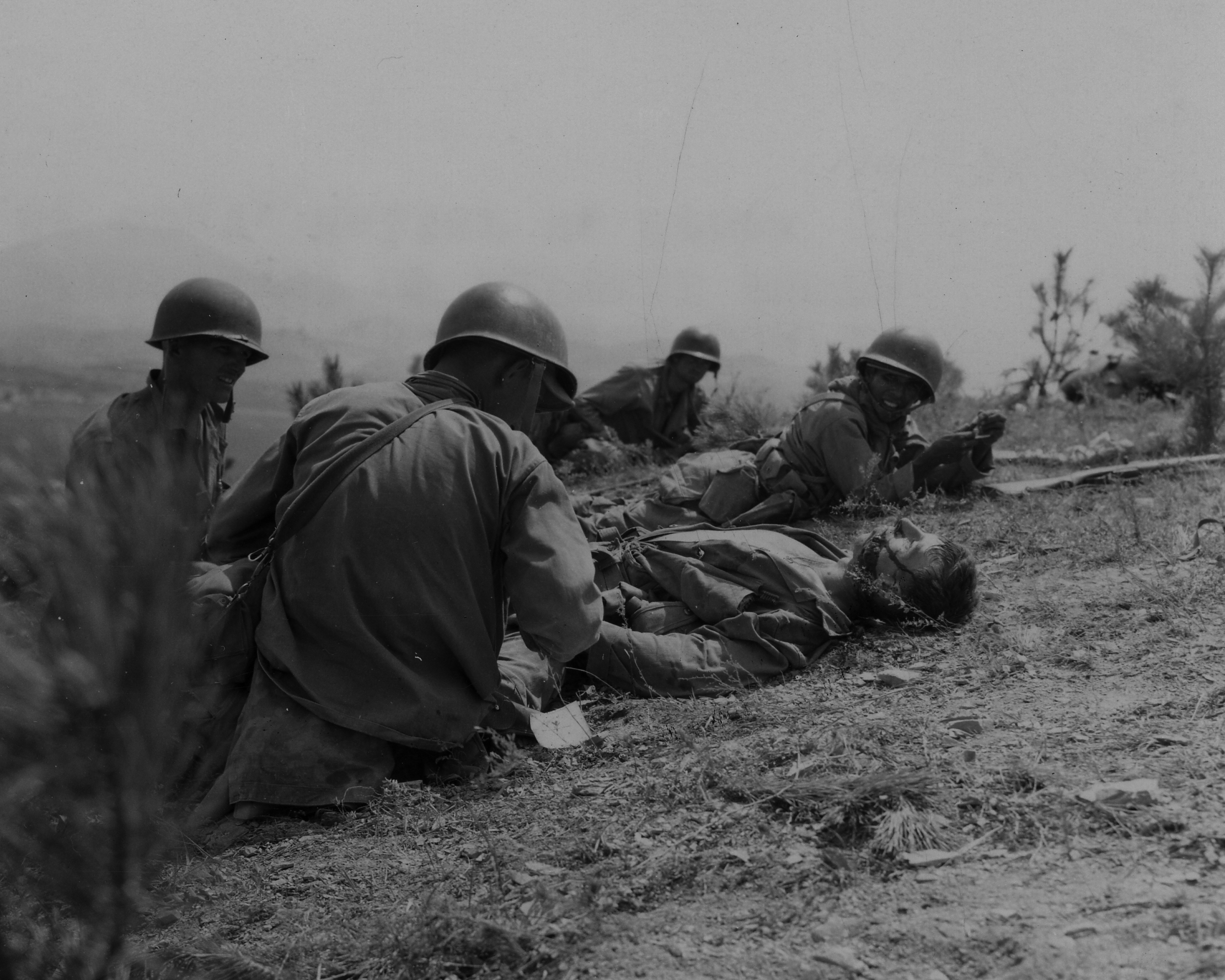
Corpsmen work on a wounded Marine during the 2nd Battle of the Naktong River, September 3, 1950.

Corpsmen work on a wounded Marine during the 2nd Battle of the Naktong River, September 3, 1950.

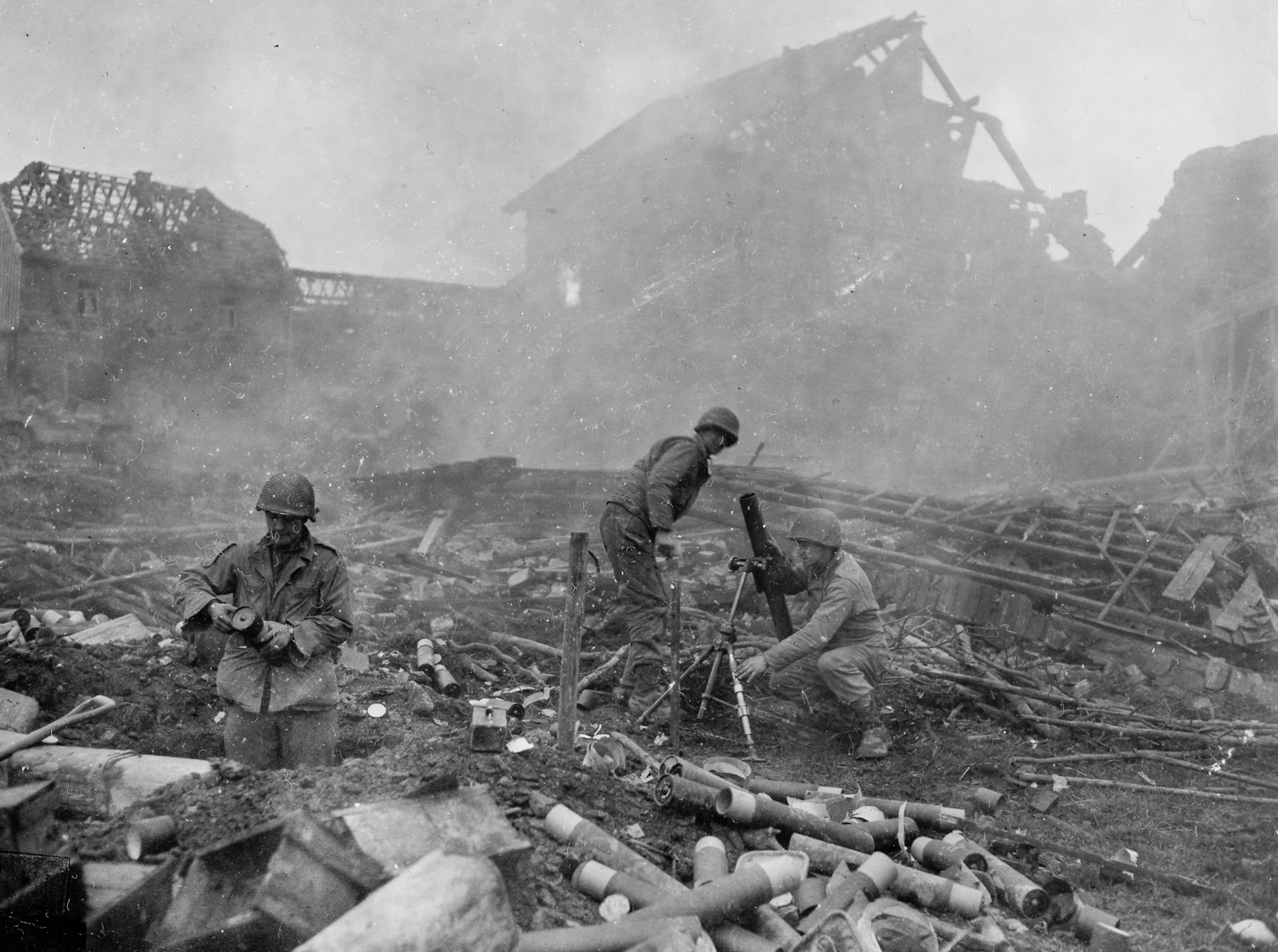
From the summer of 1950 through the end of the year, the Marine Corps endured one of its greatest crucibles in its history. Starting with the desperate fighting to hold Pusan after the North Koreans had unleashed their surprise offensive, through the stunning success of the Inchon Landing to the frozen shore of the Chosin Reservoir, the Marines who fought the 1950 campaign in Asia have been overlooked by historians and and American alike. During the 2nd Battle of the Naktong Bulge in September 1950, the 1st Provisional Marine Brigade was thrown into line to blunt the last North Korean offensive of the summer. Fierce fighting followed that broke the back of the North Korean units around Pusan.

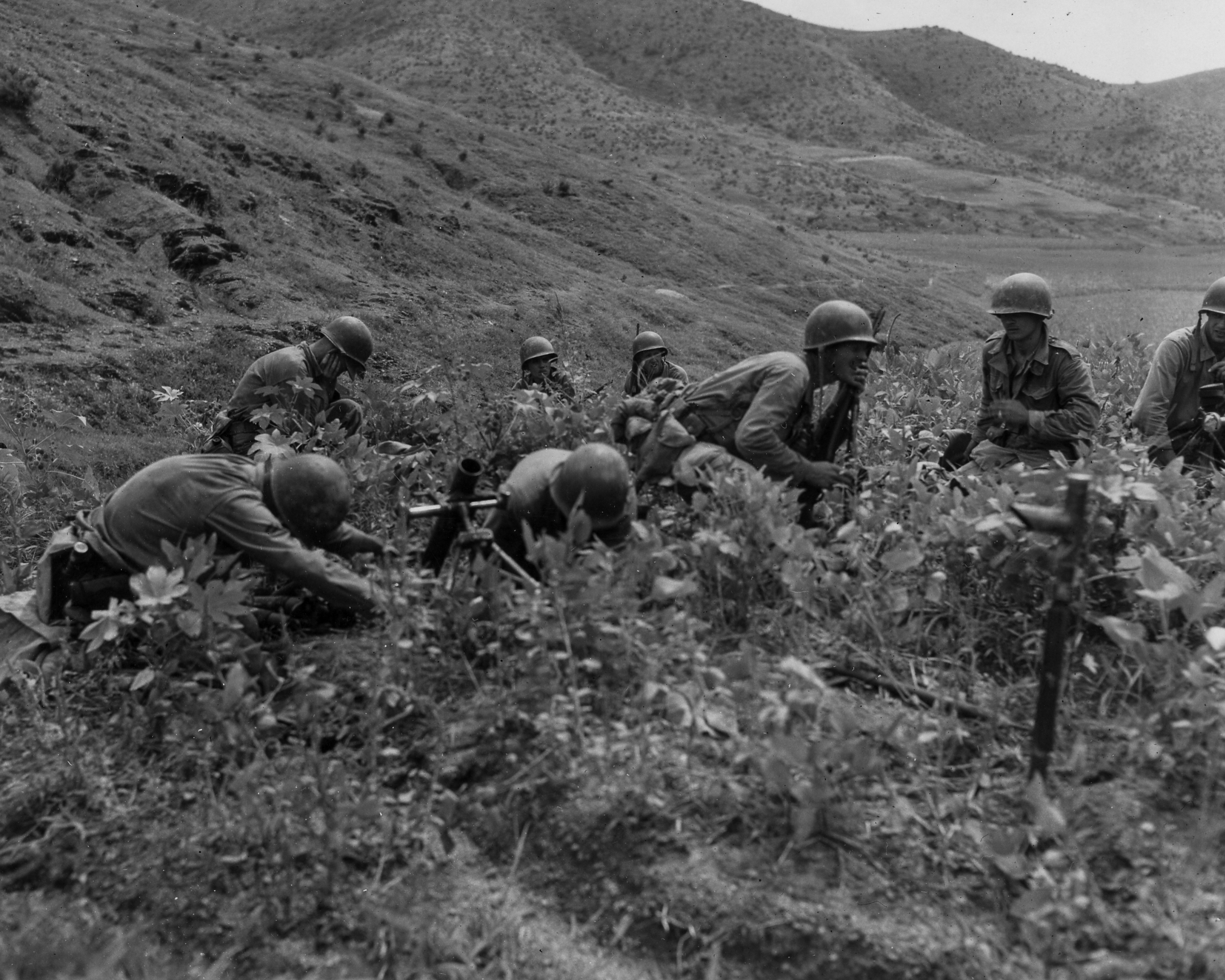
A 60mm mortar platoon engaged along the Naktong, September 3, 1950.

A 60mm mortar platoon engaged along the Naktong, September 3, 1950.


With hardly any respite, the 1st Provisional Marine Brigade was deactivated and its subordinate units folded into the freshly assembled 1st Marine Division. A week later, the men took part in the Inchon landing on the west coast of Korea. The success of that amphibious offensive crushed the North Korean Army, liberated Seoul and sent the Communist forces retreating for enclaves along the Yalu River.

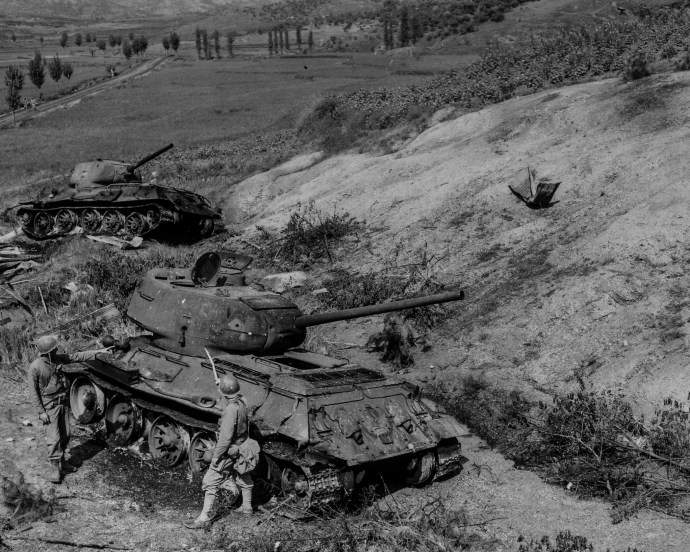
Men of the 1st Provisional Marine Brigade examine knocked out North Korean T-34 tanks during the 2nd Battle of the Naktong River, September 4, 1950.

Men of the 1st Provisional Marine Brigade examine knocked out North Korean T-34 tanks during the 2nd Battle of the Naktong River, September 4, 1950.

The 1st Marine Division was pulled out of the line and sent to execute another seaborne invasion, this time at Wonsan on the east coast of Korea. From there, the division drove north for the Yalu. In November, as the weather deteriorated, the Marines advanced slowly toward the Chosin Reservoir, establishing a series of supply dumps and securing airfields as they went. The 1st Marine Division commander, General Oliver Smith, believed the Chinese Army had intervened in force in North Korea, and was loathe to cut loose and drive for the Yalu with all possible haste as his Army corps commander, General Almond, kept demanding.Korean War USMC Series 1st Marine Div Chosin 120750 -1

On November 27, 1950, The 30,000 strong, reinforced 1st Marine Division was hit by the Chinese 9th Army and its ten division. The Chinese had been  poorly equipped, having not even been issued winter clothing despite the fact that the temperatures had dropped to freezing levels. The Chinese Army also couldn’t supply and sustain its troops on the south side of the Yalu. They were not only suffering from exposure, but units were on the brink of starvation. As a result, the ten divisions could only count on 67,000 combat effectives when the offensive started.

Korean War USMC Series 1st Marine Div Chosin wrecked vehicles 120650 II-1Despite the logistical problems the Chinese faced, their offensive against General Almond’s X Corps caught the Americans and UN troops by complete surprise. UN units were cut-off, surrounded and some wiped out. The Marines fought with unrivaled tenacity. Some units, despite being surrounded, held out against daunting odds, sustained by air resupply drops and air strikes while they faced wave after wave of Chinese attacks. Fox and Charlie Companies of the 7th Marines played a pivotal role in holding open the road south so two full regiments could escape the Chinese onslaught.
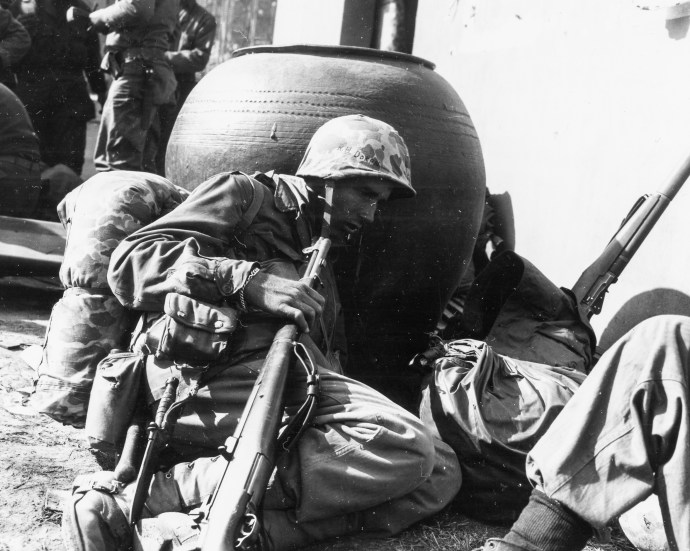
Over the next two weeks, the 1st Marine Division was forced to fight its way back to the coast while under near-constant attack from the pursuing Chinese. Finally, on the evening of December 11, 1950, the last of the division reached the port of Hungnam, where a 193-ship task force evacuated all of X Corps over the following fourteen days.

The 1st Marine Division, 30,000 strong at the start of the Chosin campaign, lost almost 4,400 men killed and wounded during the engagements with the Chinese. The brutal cold claimed another 7,300 men as non-combat casualties. Almost a third of the division had been lost in less than a month’s fighting. The attacking Chinese Army suffered almost 50,000 battle and non-combat casualties during the same period.Korean War USMC Series 1st Marine Div Yudam-ni Chosin Campaign 120150 -1

From stopping the final summer offensive against Pusan to saving X Corps from total destruction, the Marines in Korea played a pivotal role in this, the first, and bloodiest, Cold War “police action.”

As we spend the holidays with our families, please take a moment and give thanks to these brave young men who spent their Christmas season 65 years ago slogging along a frozen road in bitter cold, fighting an elusive and determined foe that gave no quarter.


A 2/7 Corpsman at an aid station, November 3, 1950.

A 2/7 Corpsman at an aid station, November 3, 1950.


Categories: Korean War | Tags: , , , , , , , , , , , , , , , , | 1 Comment

Skunkpocalypse

Skunk-smell-DTAs you may recall…


A year ago, Gwenie arrived from Amman, Jordan, saved from certain death by my dear friend Captain Cassie Wyllie, whom I’d met in Afghanistan during an air-ground engagement in the Hindu Kush. Gwenie’s arrival in our little Oregon town turned the household into utter chaos, and it has yet to settle down as Gwen blazes a trail through life that is one part raging curiosity, one part stark terror at everything, and three parts hurricane-force destruction.

I love this dog.11218233_10206445599236191_6241923071895765755_o

So, there we were, out in the ‘hood for a midnight walk not too long ago. I had just purchased a new leash for Gwenie which is a little longer and more robust than the ones we’d been using. As we stopped for a restroom break on my lawn, a dark shadow flitted across my neighbor’s driveway. Gwenie saw it first and bolted straight for it without any warning. Seriously, she went from full squat to Carl Lewis on fire in an eyeblink. She moved so fast and with such surprising power that she tore the leash right off my wrist before I could even react.

20151111_190423

Last photo from that fateful walk….

I charged after her, but had only take  two steps when she collided with the dark shape and seized it in her mouth. Appalled, I shouted at her, thinking she’d attacked one of the local cats. I reached her as she was about to shake the poor creature back and forth. Before she could, I grabbed her collar and pulled her upward. She dropped the critter right on my foot.

I looked down. NOT a cat.  No not a cat indeed.skunk

For a fleeting instant, I thought she’d caught our black-and-white Gaulic stink badger (Mizette the papillon, which is a breed of dog I adore but am not convinced it is truly canine. More like the missing link between cats and dogs, with a strange stray gene set from Mephitis mephitis). That fear lasted only a second, though, as my eyes registered what was sitting atop my favorite pair of topsiders. Yep. A severely annoyed skunk.

1917387_1226474819415_6166418_n

North American Gaulic Stink Badger (easily misidentified with skunk).

Now, some may argue that Gwenie’s nibbling on the skunk made the poor creature feel unsafe. It was perhaps a microaggression; I will concede the point. However, I would also like to point out that this particular skunk has been a carpet bagger for months now, living under my house and nocturnally raiding the cat’s food for goodies. A few months back, I was out late and coming home when I encountered this little Oreo devil standing on my porch. It saw me, puffed up its tail and hissed. Yes, the thing actually hissed at me. Ingrate.

20151031_155121

In the days before the Skunkpocaylpse, Gwen met her first goat. Here I am trying to keep her from freaking out when the goat walked up to her.

So there this skunk was, sitting atop my boat shoe looking terrified, annoyed and indignant.  I never saw it raise its tail. I never saw a stream of skunkstench. There was just a moment when I swear I was engulfed by greenish-yellow mist and the most repellent, noxious and nauseating smell ever to reach my nose assailed me. That’s saying something too, dear readers. I’ve been to New Orleans.

What followed seems to have happened in slow motion. The skunk waddled off to go hide under the house. Gwenie chased after it, but lost interest as I screamed at her while trailing in her wake. When I finally regained positive control over my Jordanian refugee, the skunk had disappeared under the house, leaving the entire neighborhood smelling like a cross between a sewage lagoon and a tire fire.

Gwenie looked pretty shell-shocked. I was trying not to barf. Together, we trudged to the front porch and I knocked on the door, not wanting to go inside in our current state.

20151031_154637

In the pre-skunkpocalypse days, we were free to roam among our fellow humans, unfettered by stink badger stench. Here my daughter Renee and Gwenie pick out a a future rotting porch decoration during our refugee’s first ever trip to the local Halloween corn maze and pumpkin patch.

When the fam came to the door, our stench assailed them. Undeterred, Renee and Jenn swung into crisis mode. Jenn went to whip up anti-skunk potion #9: dish soap, baking soda and hydrogen peroxide–while Renee took the Jordanian Pup straight upstairs and dumped her into the tub.

Despite our best efforts, the entire house filled with skunk stench. It lingered for days, got into everyone’s clothes and wrecked the upstairs bathroom and dog-washing tub for human use. Vinegar and lots of disinfectant had only limited success. Meanwhile, in the ‘hood, the skunk’s WMD detonation filled the block with the wretched reek for two days even though it rained the entire time.

Meanwhile, the skunk has not been seen since the incident, which leads us to believe it is under the house, plotting revenge, possibly with the help of a domestic ISIS cell.

I sat down with Gwenie the other night to discuss the incident with her. I wanted us to both smell better before we had our little face-to-face. I told her we needed to chalk this incident up as a learning experience in her continuing education on life in America. Of course, I told her that she needed to rethink chasing after non-cat critters who are smaller than she is, lest she encounter something with even nastier defensive mechanisms, such as a porcupine or a badger or a wolverine. Her new motto: Can’t we all just get along?

20151022_093848

Get along with all but the couch anyway. Came home to this scene not long before Skunkpocalypse night. Now, I don’t want to jump to any conclusions as to who might be responsible for this destruction, but….

Apparently, that will remain an open question. Cause even a week later, we still stink and nobody wants to be around us. 🙂

Categories: Gwenie's Story | Tags: , , , , , , , , , , , , , , | 5 Comments

Blog at WordPress.com.