Author Archives: John R Bruning

Allies: Brazilian Consolidated PBY Catalinas in the Atlantic War

PBY 1a BrazilianDuring the Second World War, Brazil served as the critical partner in the Allied alliance in Latin America. Brazilian troops served in combat in Italy, as did one of their fighter groups. Brazilian Naval Aviation also played a an important role in anti-U-boat patrols in the South Atlantic. Flying Lockheed Hudson’s and Consolidated PBY Catalinas, Brazilian air crews scoured the seas in search of the ever-elusive German submarines that were taking such a heavy toll on Allied shipping.

On July 31, 1943, a Brazilian PBY crew discovered U-199 on the surface east of Rio de Janeiro. Along with a Brazilian Hudson and a USN PBM Mariner, the PBY crew attacked the U-boat with depth charges. Second Lieutenant Alberto M. Torres and his Catalina crew received credit for sinking her.Twelve German sailors, including U-199’s skipper, were able to escape their doomed boat. When Torres spotted them helpless in the water, he ordered his men to drop them a lifeboat. The Germans clambered aboard and were subsequently rescued by a U.S. Navy seaplane tender, USS Barnegat.

12-30 Brazilian PBY and Crew in Color

Categories: Allies, Atlantic War | Tags: , , , , , , , , , | Leave a comment

A Moment in the Afghan Surge

IMG_1451

Ben Shroyer, a Soldier from the 173rd Airborne Brigade carries home a rusted 107mm artillery shell discovered in a cache during a patrol between FOB Shank and FOB Ghazni, Afghanistan during the height of the American surge in Afghanistan. September 2010. Photo taken by John R Bruning with a Canon 7D.


Categories: Afghanistan | Tags: , , , , , , , , , , , | Leave a comment

Hard Day for the 549th Bomb Squadron

Piccadilly Queen returns home to Great Ashfield with wounded aboard on June 14, 1943. This Fort was a B-17F and was part of the 385th Bomb Group’s original contingent of aircraft. It soldiered through the harshest air battles of the 1943 campaign only to be shot down by Luftwaffe fighters during a raid on Frankfurt on January 29, 1944. Piccadilly Queen crashed near Kaiserlautern, where about half the crew survived to be taken prisoner.


Categories: World War II in Europe | Tags: , , , , , , , , , , , , | Leave a comment

Photo of the Day: Marine M5 Stuart Tank Crew 1944

1st Marine Division M3 Stuart Cape Gloucester New Britain 011644  (1 of 1)

1st Marine Division M5 Stuart light tank crew taking a short break during the brutal fighting at Cape Gloucester, New Britain. January 16, 1944.


Categories: World War II in the Pacific | Tags: , , , , , , , , , | Leave a comment

The Last Photographs

During the final months of the Pacific War, MacArthur tasked the Eighth Army under Lt. General Robert Eichelberger with liberating the Central Philippines. The 40th Infantry Division, a National Guard unit from California, Nevada and Utah, played a key role in this all but forgotten campaign. In March 1945, the “Sunshine Division” landed on Panay, encountering stiff resistance in places during a ten day battle to clear the island.


On the first day of the landing, March 18th, two Signal Corps photographers followed an infantry company from the 185th Infantry Regiment ashore to photograph the fighting and their advance. A company of M4 Sherman tanks spearheaded the push into Panay’s jungle interior, and the men of Alpha Company, 1st Battalion, 185th Infantry followed cautiously behind. The photographers, Lt. Robert Fields and T/5 Howard Klawitter, ignored Japanese incoming machine gun and light artillery fire and stayed right with the GI’s of Alpha Company, snapping photos as they dashed forward with them.

As the combined force pushed up along a dirt road, they encountered heavy resistance and Alpha Company took cover behind the tanks. The Shermans blasted away at the Japanese defenders while Fields and Klawitter, standing a few yards apart, snapped pictures of the firefight.

Both photographers went down within minutes of each other. Fields was killed and Klawitter wounded. These two photos are the last ones they took.

40th inf div 185th inf regt m4 sherman and troops panay island philippines photographer kia 031845 (1 of 1)

Howard Klawitter’s final photo before he was wounded in action while attached to Alpha Company, 185 Infantry, 40th Infantry Division, California National Guard.


40th inf div 185th inf regt m4 sherman and troops panay island philippines  031845  (1 of 1)

This is the last photo taken by Signal Corps photographer Lt. Robert Fields. We was killed by incoming Japanese fire moments later. His camera was recovered and the film developed. He’d snapped four photos on the roll before his death while chronicling Alpha Company, 1st Battalion, 185th Infantry.


Categories: World War II in the Pacific | Tags: , , , , , , , , , , , , , , , , , , | Leave a comment

Little Things Mattered

Categories: World War II in Europe | Leave a comment

Happy Birthday, U.S. Marine Corps

4th marines on corregidor 1942865 5x7

4th Marines on Corregidor, early 1942.


tommy gunner marine peleliu 4x6 ii

1st Marine Division fighting on Peleliu, September 1944.


Vietnam Series 1st Marine Div 1st Battalion 1st Marines PFC with Sniper Hole In Helmet Hue City 020168  (1 of 1)

Private First Class William Purcell, A Company, 1st Battalion, 1st Marines, checks out the hole in his helmet after he was hit by a North Vietnamese sniper during the fighting for Hue City, February 1, 1968.

marine tankers450

Marine M3 Stuart crew, Guadalcanal Campaign, fall 1942.


Marines struggling on the beach at saipan 5x7

First morning on Saipan. June 1944.


skynight marine korea 4x6 color

Marine night fighters, Korea 1953.

Korean War Series 1st Marine Div LVT Buffalo  Haengju Crossing of Han river 092150  (1 of 1)

1st Marine Division crossing the Han River at Haengju, Korea, September 21, 1950.

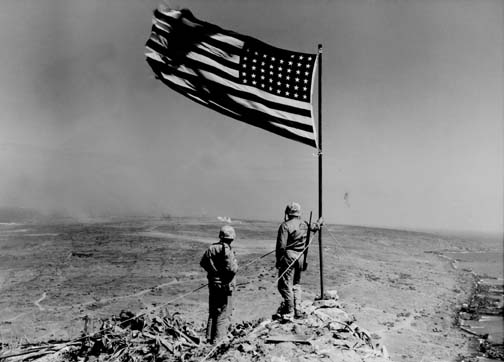
marines and flag at iwo not famous shot ii768

Mount Surabachi, Iwo JIma, February 1945.

Categories: Korean War, Vietnam, World War II in the Pacific | Tags: , , , , , , , , , , | Leave a comment

Last View of a Doomed Flying Fort, Chelveston 1943

Rum Runner was one of the original B-17F’s that equipped the 305th Bomb Group when it reached England in late 1942. This photo was taken shortly before the Fort was lost with Boomerang on the February 16, 1943 raid over France.

In the Fall of 1942, the 305th Bomb Group arrived in England after a six month work up cycle in Utah, California and Washington. When the men reached East Anglia that fall, the Army Air Force assigned them a batch of factory-fresh Boeing B-17F Flying Fortresses with which they would soon begin operations against German targets in Western Europe. One of those original B-17’s was #41-24611, which the crews named “Boomerang.”  The 305th was one of the first bomb groups to reach the 8th Air Force, which attracted a lot of media and PAO attention. This film clip was taken at the start of one of the unit’s earliest combat missions, either in late 1942 or early 1943. Seen taxiing toward its take off run is Boomerang and her crew.

On February 16, 1943, the 305th flew a bombing mission over Brittany, France. The Forts were hit by flak and fighters, and the Luftwaffe interceptors singled out Boomerang. Firing passes knocked out two of the B-17’s engines, and it dropped out of formation on fire. Other members of group saw a number of parachutes blossom from the aircraft just before it disappeared into a layer of clouds. Another Fort was cut out of its squadron box and sent down in flames at about the same time. Both B-17’s crashed near Molac, France, with one crew member from each aircraft dying in the ordeal.
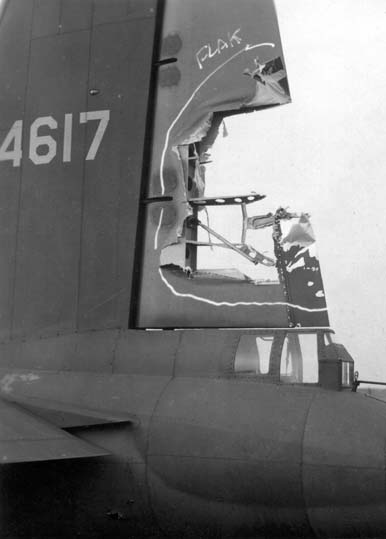
305th bg b17 battle damaged feb 26 43 flak 5x7

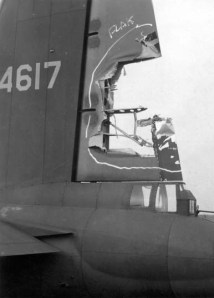
Battle damage suffered by a 305th Bomb Group B-17 during one of the February raids over Western Europe in 1943.

Boomerang’s surviving crew tried to escape and evade. Several of them were able to avoid capture–at least at first. They were split into two groups, and one eventually was run down by the Germans and taken prisoner. Two men successfully evaded and returned to Allied territory.


Boomerang’s crew that day:

Pilot: Charles Steenbarger

Copilot: Thomas Mayo

Navigator: John Carpenter Jr. (Killed in Action)

Bombardier: Joe Varhol

Radio Operator: Carey Ford

Top Turret Gunner: Fred Dewig

Ball Turret Gunner: Charley Gilbert

Tail Gunner: Lowell Lewis

Waist Gunners: Dale Markland and Don Wall

Norris Miller was also aboard the aircraft.


Here is the film clip:


Ford and Markland were the two who successfully evaded capture.

The townsfolk in Molac later erected a monument honoring the two crews shot down that day. It can be seen here:

http://www.uswarmemorials.org/html/site_details.php?SiteID=762


Categories: World War II in Europe | Tags: , , , , , , | Leave a comment

Photo of the Day: 1st Marine Division, Peleliu 1944

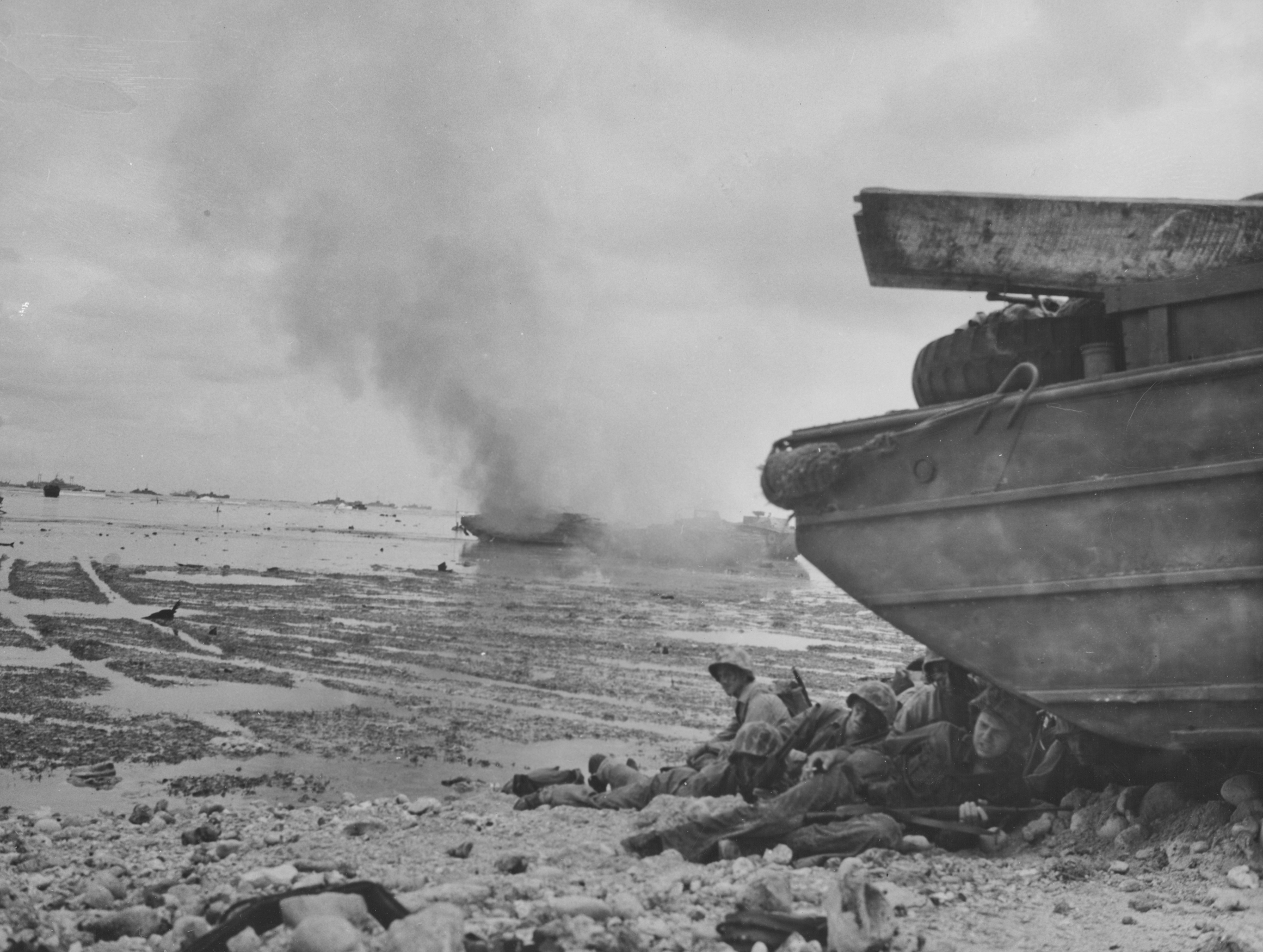
1st Marine Div Wrecked DUKW Beachhead men pinned down 091544 no caption (1 of 1)

Men of the 1st Marine Division take cover behind a destroyed DUKW amphibious truck on the beach at Peleliu during the first day’s landings, September 15, 1944.

Categories: World War II in the Pacific | Tags: , , , , , | Leave a comment

Across the Rhine: The Remagen Bridge in Color

On March 7, 1945, Combat Command B of the 9th Armored Division reached the west bank of the Rhine River across from the German city of Remagen. To the surprise of all the Americans there that day, they found the Ludendorff Rail Bridge intact. The Germans had blown nearly every other bridge spanning the Rhine as they retreated behind the river to make a last stand for the Fatherland.

The Americans seized the bridge by coup de main, then reinforced their tenuous hold on the east bank in the days that followed. The bridge was severely damaged, and engineers went to work trying to shore it up. At the same time, pontoon bridges were constructed on either side to increase traffic flow to the east bank. The Germans repeatedly attacked the bridge with air, artillery and even V-2 rockets. They also sent underwater demolitions teams after the bridge, and attempted to use floating mines to destroy it.

These three film clips were taken from the west bank during the struggle to shore up the bridge. The cameramen were part of SFP-186, a special project commissioned by General Marshall to document the final months of the war with color film. The footage ended up classified for decades, and it was only in the late 1990’s that it began to filter out of the National Archives for public viewing. The scenes show the Ludendorff Bridge from different angles, plus some of the U.S. Army’s anti-aircraft defenses arrayed around it. There are also some scenes showing USAAF P-38’s patrolling over the bridge, as well as the wreckage of a downed German aircraft.

On March 17, 1945, the badly damaged Ludendorff Bridge suddenly collapsed, killing eighteen American engineers who were working on it at the time. Though the bridge was gone, the drive into the Reich from the Remagen area was already well underway. Pontoon bridges kept the traffic and supplies flowing to the front line troops.


A few post-war notes:

Aces_Over_Europe_A

Roger Smith’s original box art for Aces Over Europe. To assist Roger, designer Chris Shen built a 1/72nd scale replica of the Ludendorff Bridge, which was then photographed from the angle Roger used for the composition. Model aircraft of the Arado 234 and Tempest were also constructed by members of the Aces Team.

Today, one of the original bridge’s towers houses a peace museum.  In 1993, American computer game company  Dynamix Inc. produced a PC-based flight simulator called Aces Over Europe. The game’s box cover, an original piece by noted artist Roger Smith, depicted an Arado 234 Blitz jet bomber attack on the Ludendorff Bridge during the fighting around Remagen that March. Ace Pierre Clostermann in his Hawker Tempest can be seen in the foreground pursuing the German jet. When the mayor of Remagen learned that the bridge and part of his town would be depicted on the box of a computer war game, he threatened to sue the U.S. company. As a result, the European release of the game used a different piece of art for the box cover.

56082_front

The European box art. Note Dynamix had to delete the swastika on the Fw-190A’s tail in order to conform to German law.


Categories: World War II in Europe | Tags: , , , , , , , | Leave a comment

Blog at WordPress.com.