Most. Unusual Distinguished Flying Cross. Ever.

The Philippine Air Lines hangar at Nielson Field in 1941. PAL flew Beech 18's and a Staggerwing (at right).

The Philippine Air Lines hangar at Nielson Field in 1941. PAL flew Beech 18’s and a Staggerwing (at right).

When the Pacific War broke out in December 1941, thirty-three year old Harold Slingsby was employed as a pilot with Philippine Air Lines, working for the legendary Paul “Pappy” Gunn from the company’s hub at Nielson Field outside of Manila. Far Eastern Air Forces had no transport force in 1941, and in those dark December days, the huge hole that left in MacArthur’s air capabilities was keenly felt. With no way to move personnel or supplies around by air, General Louis Brereton drafted Philippine Air Lines’ pilots and aircraft into the USAAF. Slingsby became an instant captain.*

At the end of December, it was decided to move General Brereton’s headquarters to Australia. Key staff officers were ordered out of the Philippines to help establish the new HQ. Slingsby was one of the pilots who flew those officers to Northern Australia. Upon arrival, he was pulled into the nascent Air Transport Command as part of the 21st Troop Carrier Squadron (the only cargo squadron in theater at that point) and spent much of the rest of 1942 flying the PAL Beech 18’s, Lockheed Lodestars and C-47’s around from base to base before returning to the States in early 1943.

The 5th Air Force was just being set up, and things were pretty chaotic in Australia in early 1942, so these transport missions were often anything but routine. On February 23, 1942, he was tasked with flying to Brisbane to haul back to Batchelor FIeld the intact wing of a Boeing B-17 Flying Fortress. Pappy Gunn, who commanded the 21st, was probably on this flight with “Buzz” Slingsby and took photos of this remarkable salvage job. They arrived at Brisbane and somehow shoehorned the wing under the fuselage of their transport. Exactly what aircraft Slingsby was flying is unknown, but it was probably an ancient B-17D the ATC pilots had been using since it had been flown out of the Philippines. The  B-17 wing was lashed to the underside of the fuselage, and they took off the following night to get it back up to Northern Australia where ground crews were waiting to pair the salvaged wing with another damaged Fort so it could be returned to service.

In times of great peril, the men of the 5th Air Force rose to the occasion and figured out a way to stay in the fight without adequate supplies, spare parts or aircraft. If Buzz and Pappy had been flying the old 19th Bomb Group B-17D’s that day, and nothing else in theater could have handled such a load, they were piloting an aircraft whose engines were so worn out and unreliable that the 19th had cast it off as uncombat worthy at a time when they were desperate for flyable bombers. Every minute in the air must have been a gut-check for them, but Slingsby made three landings and take-offs with the heavy, awkward load and got the vital wing up to the Darwin area.

For this incredible feet of ingenuity, Pappy put Slingsby in for a DFC. Here is his award citation:

G86A5185


*Kenney’s book, The Saga of Pappy Gunn states that Slingsby was a Consolidated employee ferrying PBY Catalina flying boats to the Dutch East Indies when the war broke out, but other sources state he was an employee of PAL in December 1941.

Categories: World War II in the Pacific | Tags: , , , , , , , , , , , , , , | 21 Comments

Gwenie’s Story, Part III: Terror in the ‘Hood

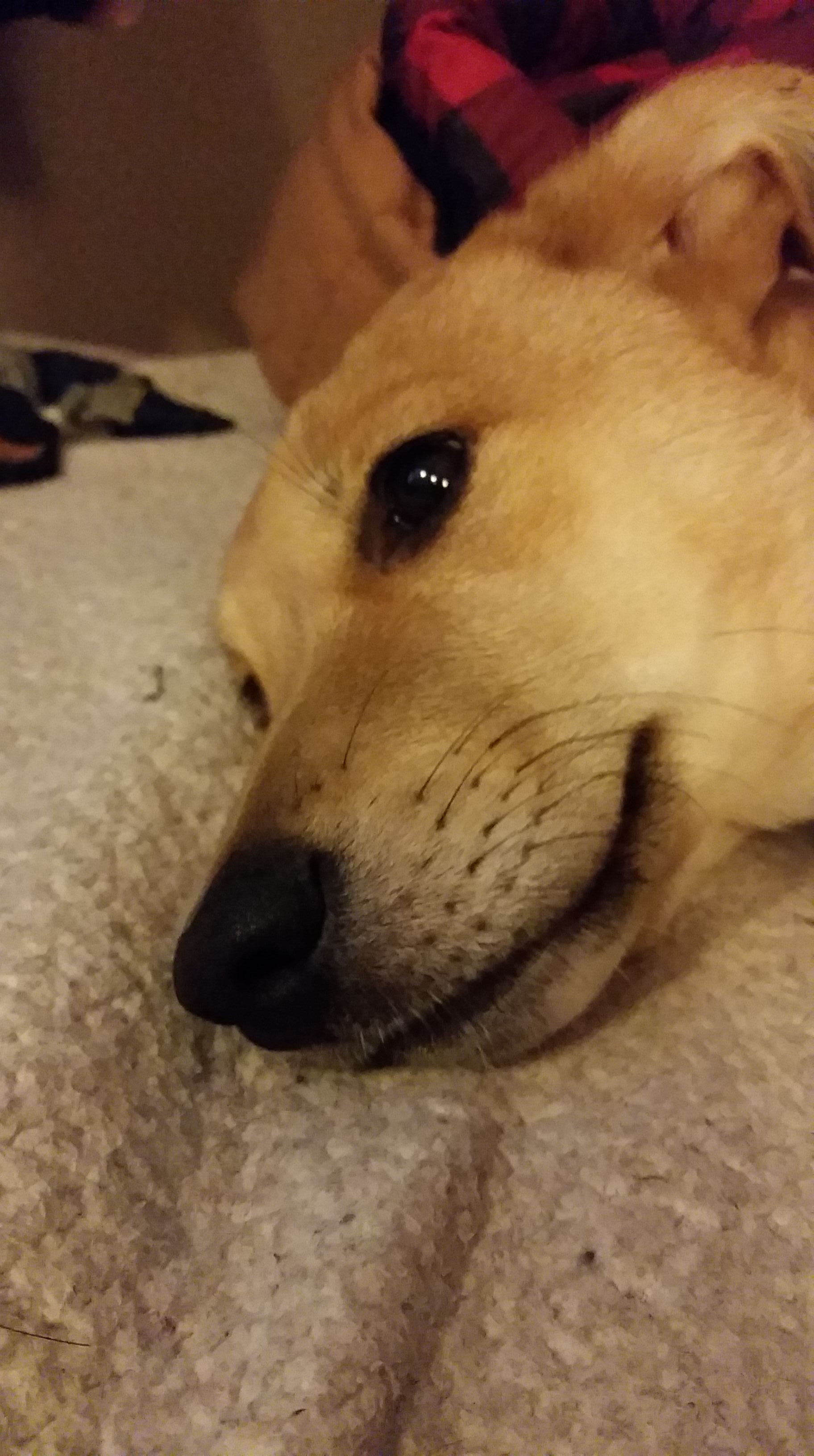
IMG-20150115-WA0009So, as you may recall, we have a Jordanian puppy that came to us through the combined awesomeness of Captain Cassie Wyllie and Puppy Rescue Mission (http://www.puppyrescuemission.com/). In her first days in America, she and I ended up marooned in the Cascade Mountains in the middle of the Willamette National Forest, about as un-Middle Eastern-like terrain as we could have selected for Gwenie’s debut in the Pacific Northwest.

Back in the valley the next morning after our mountain adventure, I figured I ought to show Gwenie the neighborhood. The leash was not something she was terribly thrilled with at first, but she soon got used to it as I walked her around the front yard. That said, the sad puppy eyes she kept flashing at me suggested I was crushing her little soul with this new torture device. Resigned and broken, she trudged around whining every few minutes to let me know she was not okay with this gig. Fortunately, after a bit, she perked up and began bouncing along beside me as we explored the yard. I bent down and pet her and said, “Not so soul-sucking after all, is it dog?”  She ignored that and did her best to still look wounded every time she caught me looking at her.

Now it was time to introduce Gwen to the neighborhood. we stepped across the front lawn, crossed the threshold of the sidewalk and out into the street. The minute we left the property, she fell behind me. I turned and looked at her. Here was my puppy, a world traveler, survivor of snow and car marooning in the mountains, staring at me with an expression of abject fear.

She got up off her haunches and tried to leap back toward the yard, bucking furiously against the leash. I tried to calm her down, but she would have none of that. So, I moved back to the lawn. The minute we made landfall at Chez Bruning, she calmed down and sat quietly beside me.

I wasn’t sure what to make of this. The last warrior animal I had, Volunteers the cat, tore around the neighborhood at Mach 2, getting into everything, attacking dogs, making friends and reveling in every bit of trouble he could find. He once chased a tennis ball for blocks after Renee threw it for him down the street. I had to run after him to make sure he didn’t get gobsmacked by a commuter returning home.

Volunteers eagerly awaiting Ed's next throw of the tennis ball. This was a game that went on for months between the kids and our Katrina refugee.

Volunteers eagerly awaiting Ed’s next throw of the tennis ball. This was a game that went on for months between the kids and our Katrina refugee.

Gwenie saw everything beyond the realm of our yard as a potential threat. For two days, I worked to coax her off the lawn. I have a place of my own that is my writing refuge about a half block from the house, and I was able to convince her to go back and forth between them. But stray from that pattern, and she would flat out refuse to budge. At times, I even had to carry her between the two places.

So, I had a puppy I couldn’t take for a walk. I had no idea what to do. Clearly, my pup had suffered trauma. She’d watched two of her litter mates die in Jordan. Her mom had vanished long before that. Before Cassie found her, she was slowly starving to death in a little den, only a few weeks old. Combine that background with the car rides, plane flights, cages and disorientation over coming to America, it was no wonder she wanted to stick close to the one place familiar to her.

Each night, I took Gwen out and inched her a little at a time, out of her comfort zone. Within a few days, we could make it across the street, outside the normal path we took to get to my other place. I was excited, things were looking up.  I have plans for her–road trips back to the woods and nights on the beach in Aptos, California. But first, we needed to be able to walk around the block. Baby steps.

One evening, I put the leash on Gwen and took her out front. She padded across the lawn, nose pointed for my other place. But I stopped her and said, “Okay, darlin’, we’re going up the street tonight.”

She whined. She gave me the Please, Writer, noooo! look of pure, doggy anguish. We needed to do this. I was not swayed.

I stepped off the curb, and Gwen reluctantly followed. She bolted toward my other place, but the leash stopped her cold. Then she tried to make a break back to the house. Nope. That didn’t work. I waited patiently. It was a cold night, and our breath was fogging around us. The lamp posts nearby cast orange pools of light on the asphalt. Beyond them, the ‘hood was unusually dark. Clouds overhead blocked the starlight and the moon. Gwenie scoured the blackness, looking for threats. I stood and let her do her thing until she calmed down at last.

We started walking up the street, the opposite direction from my writing loft. Gwenie trailed behind, whining periodically. We reached the edge of our property which sits on the corner of two cul-de-sacs. I paused and let her get used to being beside in me in the street, twenty feet from her familiar lawn.

“Okay, ready?”

She didn’t really look ready. But I think I saw her muster up some courage, and I took a step. She followed. Two more and she was trotting next to me.

“Good girl!”

She jumped up and pawed my hip, so I stopped briefly to stroke her head.  She was building herself up for a new adventure, and perhaps she was starting to trust me a little. All that she had known for the last few weeks now was not going to go away. She wouldn’t be torn again from what she found safe. She would be with me, and it would be okay.

We moved forward together and I sensed confidence flowing into my little refugee.  I wanted to make it to the intersection about three blocks north of our place. If we could do that, I figured she’d be able to do anything with me.

We reached the edge of the next cul de sac over. Suddenly, Gwenie recoiled. She keened and kicked backwards, uttering sounds I’d never heard come from a canine before. Fearing she’d cut her paw on something, I spun around to check on her. Terror filled her eyes. Her mouth hung half open, and she was desperately backpeddling. What had happened? There weren’t any people out. No other animals.

“Gwenie! Gwenie! You’re fine, relax!” I kept telling her. She didn’t believe me. Something was about to get her, and I was keeping her from escaping.

I knelt down and tried to coax her over to me. She tugged hard at the leash to get away. That’s when I realized she wasn’t even looking at me. I followed her gaze. She was staring at the naked cherub statue in my neighbor’s front yard.

A faux stone statue had panicked my puppy.

I scooped her up–she weighed all of about fifteen pounds at that point–and carried her home. Enough for one night. We’d try again tomorrow.

IMG-20150104-WA0006


Categories: Gwenie's Story | Tags: , , , , | Leave a comment

The Last Full Measure to the End


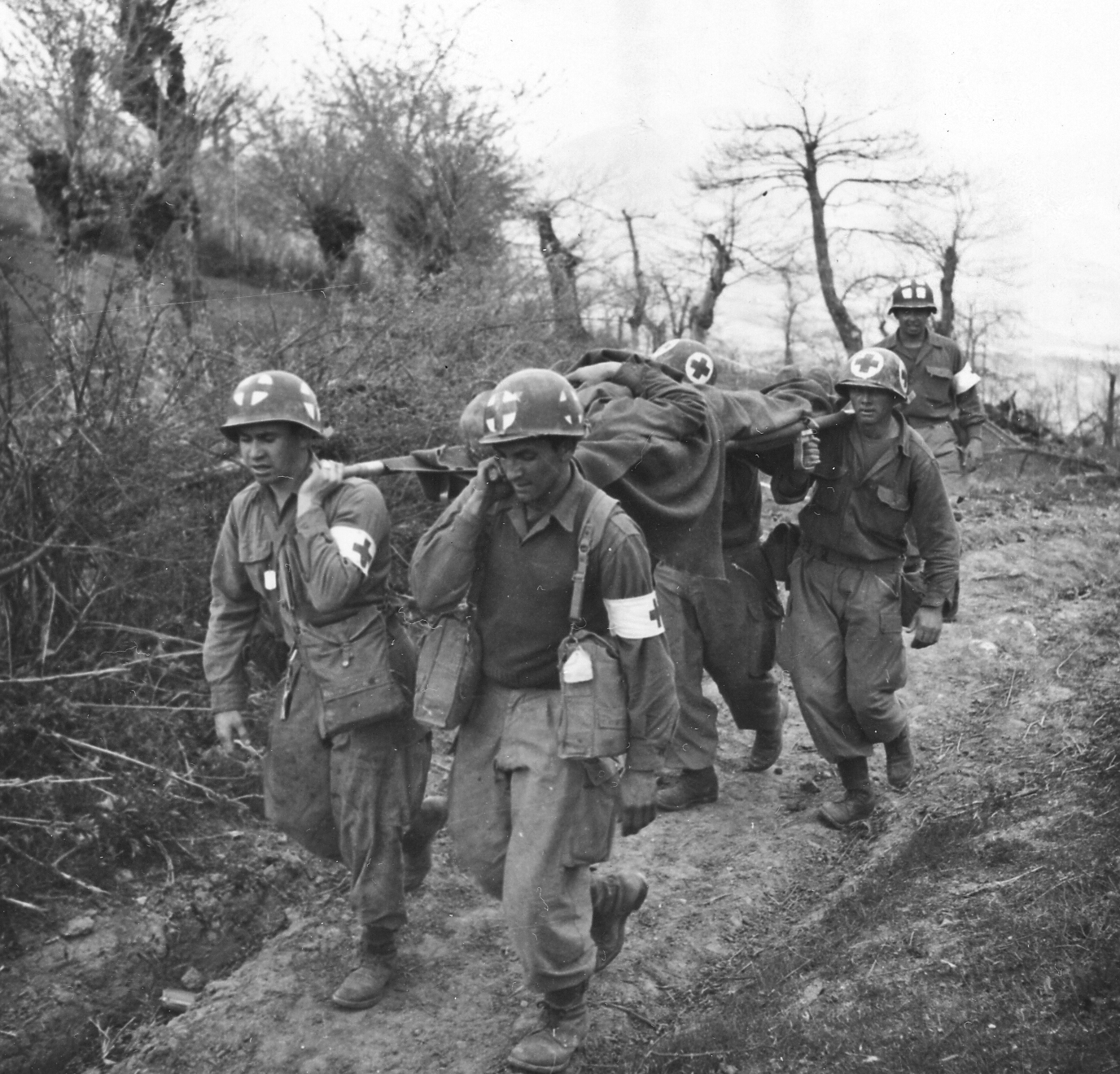
Medics of G Company, 87th Mountain Infantry, 10th Mountain Division, carry a wounded GI to an aide station during the fighting around Bologna, Italy on May 1, 1945.

Medics of G Company, 87th Mountain Infantry, 10th Mountain Division, carry a wounded GI to an aide station during the fighting around Bologna, Italy on May 1, 1945. This anonymous GI was one of the last casualties suffered by the regiment. The next day, the German forces in Italy surrendered and the fighting came to a merciful end.

Categories: World War II in Europe | Leave a comment

The Coming Storm

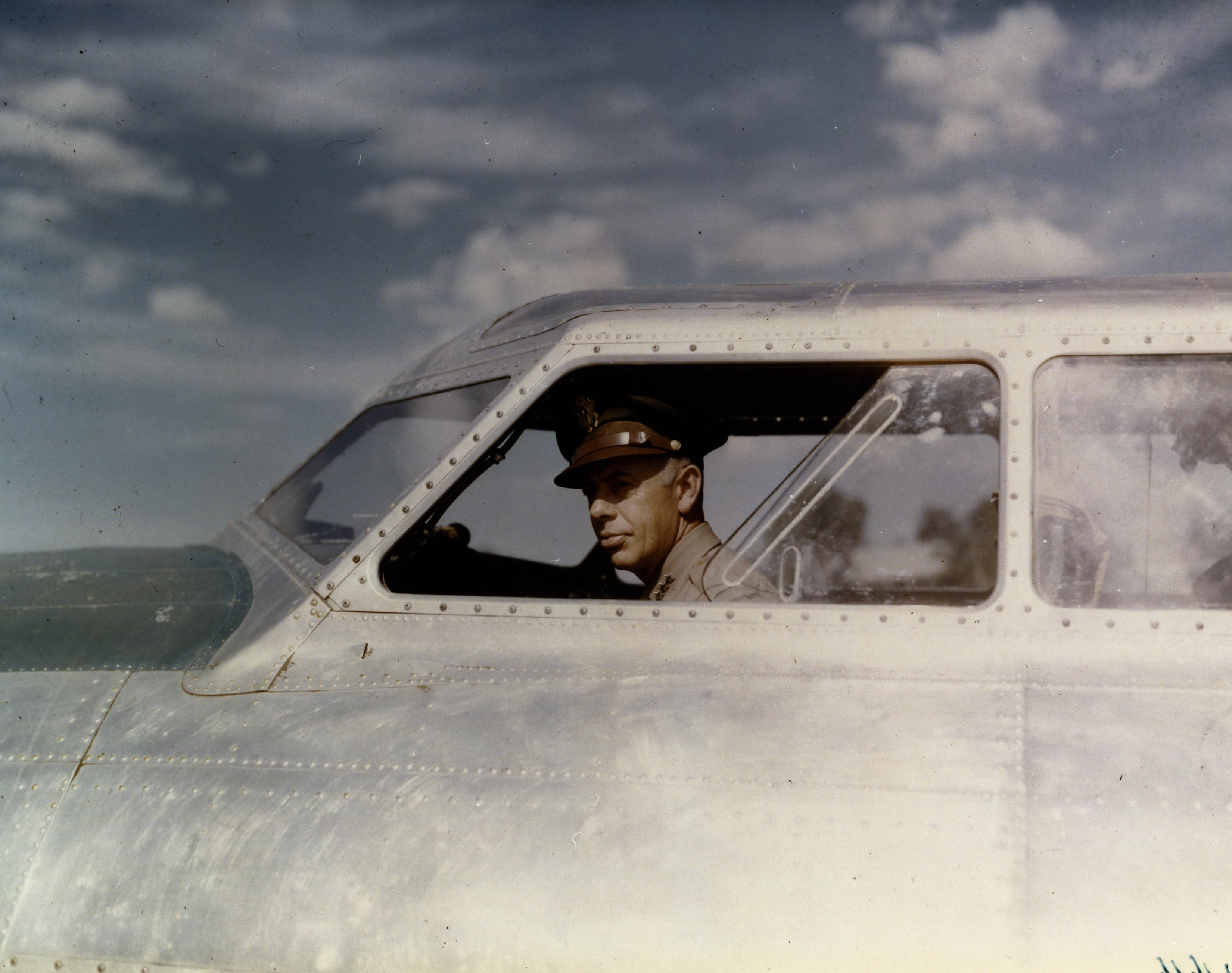
General George Kenney, commander of the 5th Air Force in early 1943.

General George Kenney, commander of the 5th Air Force in early 1943. Kenney was a combat aviator from the Great War, having served on the Western Front as an observation and reconnaissance pilot. He and his gunners claimed three kills during their months in France in 1918.

At the end of February 1943, Allied intelligence picked up signs that the Japanese were going to undertake a full scale resupply effort in Papua New Guinea. Two months after the brutal Battle of Buno-Gona, where General MacArthur’s forces had suffered chilling losses against a relatively small force, the Japanese now planned to send a fully equipped, reinforced infantry division to New Guinea–something like 12,000-15,000 troops. Their arrival could have tipped the balance of power in the SWPA against the Allies, so stopping the convoy that would carry those men became the 5th Air Force’s top priority.

The sense of urgency at MacArthur’s headquarters can’t be underestimated. The Allies had thrown 20,000 troops into the fighting around Buna, where they had faced about 6,500 dug in, but starving and unsupplied Japanese. The defenders resisted so fiercely, that at the end of the battle, Allied troops had to wear gas masks to overcome the stench of rotting corpses. The Japanese had been using their dead to buttress their defensive positions, fighting atop their decomposing brothers. Few of Japanese survived the battle, and of MacArthur’s men, over two thousand were killed and another 12,000 were wounded or debilitated from disease. Not only could the SWPA command not afford such losses again, there was no way the remaining combat worthy troops could overcome 15,000 fresh, fully equipped and supplied Japanese soldiers. MacArthur just didn’t have the strength to do so.

9th fs johnson & whitehead nadzab 8x10

General Enis “Whity” Whitehead (at left). He was also a WWI vet, having enlisted as a private in 1917. He’s seen here at Nadzab, New Guinea in 1943 with Gerald R. Johnson, who commanded the 9th Fighter Squadron from the fall of ’43 through early 1944.

In January, the Japanese managed to slip a convoy through the Allied air cordon that delivered vital supplies and some troops to the garrisons in New Guinea, but that effort was a minor one compared to what the Japanese had in the works for March.  The 5th Air Force was the only Allied organization in theater that had any chance of stopping the convoy, but its anti-shipping track record was, to say the least, spotty. The 5th AF commander, General George Kenney knew that if he was to stop this threat, he would need every available aircraft, including his highly modified B-25 Mitchells from the 3rd Attack Group that had been practicing for months a new type of anti-ship tactic.

The stage was set for a major air-sea battle, one that would define the course of the 1943 campaign in the Pacific.

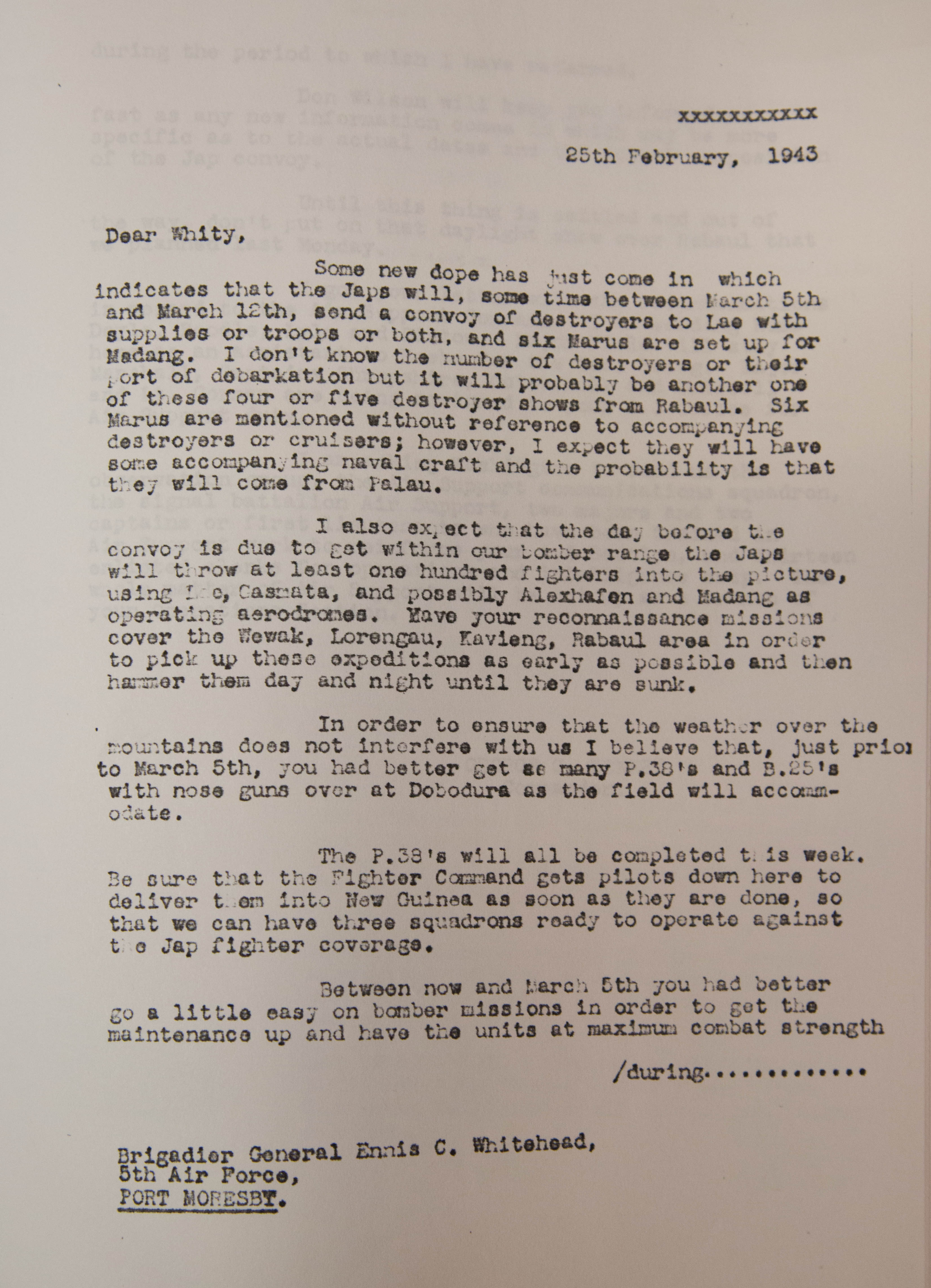
The document here was a message sent to General Enis Whitehead, deputy 5th Air Force commander whom General George Kenney had sent up to Port Moresby, New Guinea to establish the Advanced Air Echelon HQ there to ensure operations against the Japanese were better coordinated. This was Whitehead’s first notice that something big was afoot, offensive operations would need to be curtailed so the 5th AF’s bomber squadrons could be at maximum readiness for the coming battle. G86A5169

G86A5170

Categories: World War II in the Pacific | Leave a comment

Hunters

TF Brawler AH-64 Apache, FOB Shank, 2010.

TF Brawler AH-64 Apache, FOB Shank, 2010.

Categories: Afghanistan | Leave a comment

The Jordanian Puppy School of Interior Design

IMG-20150104-WA0006

Remodeling takes a lot out of a pup.

Okay, so I was going to sit down tonight and write a new post about the second book I had published. I’m way behind on that section of this website, and call this ego, but I hate seeing only Crimson Sky up there when I’ve written sixteen others. 🙂

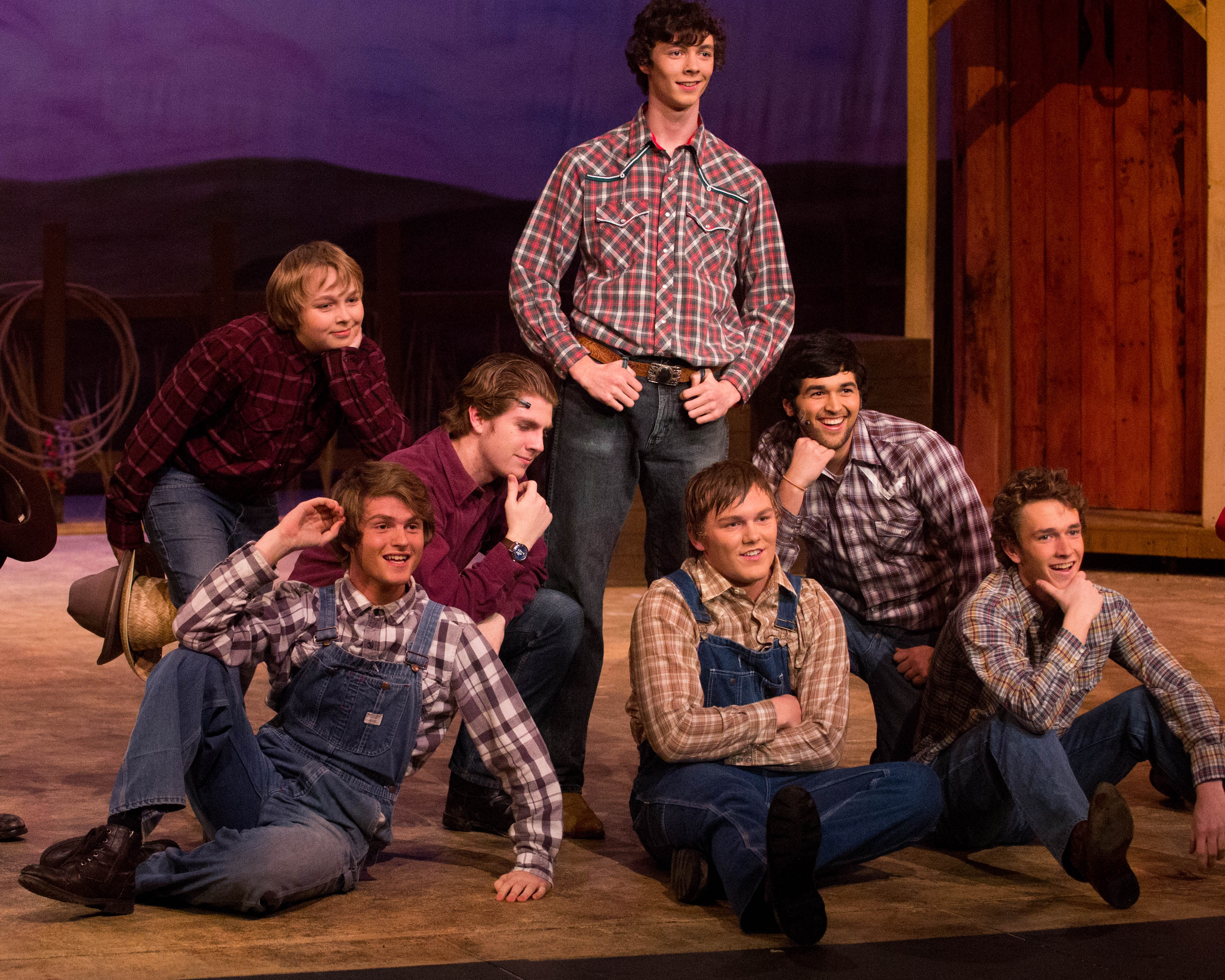
But, it has been a long day. Both kids are in the school play, Oklahoma, and opening night is tomorrow. As a result, they’ve been at the theater every night until at least 10 pm, and they are totally smoked. Half the cast is sick, and if anyone had gone to Disneyland over the holidays, we’d all probably have measles too.

Oklahoma dress run through. Ed's at far left in the back row.

Oklahoma dress run through. Ed’s at far left in the back row.

So, I returned to an empty house tonight. Well, not so empty. Gwenie has decided to redecorate the living room. With shoes. Boots. A toilet brush, which she artfully used to bedazzle the couch. A couch, by the way, that she has done her best to eat. Good thing it was twenty-one years old anyway and in desperate need of replacement. There also appears to be a torn up, unraveled roll of toilet paper coiling around the furniture and leading, like a white ribbon, into the kitchen. Where the trash has been thoughtfully placed on display across the floor. Just in case we accidentally threw something away that we needed. The new floor, which was mopped and scrubbed two days ago, is covered with muddy puppy prints and long paw skidmarks from where Gwenie was learning to drift I guess. She’d be great at that–she’s got a supercharged V8’s worth of energy and is all wheel drive.

Add to the mix a few socks, some kitchen towels, a couple of pillows, some chewed up nerf darts and a couple of Legos  caged out of Ed’s room, and I have a near complete remodel here.   I believe the style is called Early Jordanian Puppy.

I think this was payback for not taking her for a walk. In the meantime, she has now captured a feather duster and is sampling its feathery goodness.

I need to teach her to mop the floor. Seriously, it was spotless on Monday.

I need to teach her to mop the floor. Seriously, it was spotless on Monday, and Jenn bought the runners so the dogs would dry their feet as they came in and padded across them. Hasn’t worked out that way.

That’s all for now, I have some cleaning to do….


JohnB


Categories: Gwenie's Story | Tags: , , , , | Leave a comment

Joint Attack

US Army WWII Series M3 Stuart light tanks support Biritsh Army infantry Tunisia prolly 1943-1

Two American M3 Stuart light tanks support a company of British infantry during the fighting in Tunisia in early 1943.


Categories: Allies, World War II Europe, World War II in Europe | Tags: , , , , , | Leave a comment

Gwenie’s Story Part II: American Homecoming

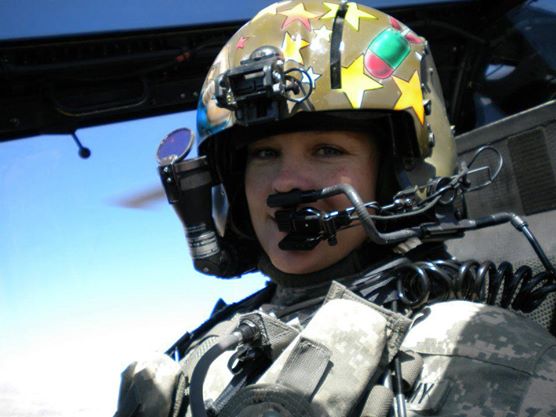
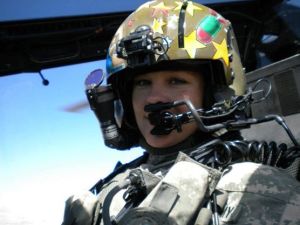
Cass in her Apache's cockpit. See Part I of Gwenie's story for how we met in Afghanistan, and how Cass and her fellow pilot, CW5 Reagan, saved a lot of lives (including my own) over Ajerestan in September 2010.

Cass in her Apache’s cockpit. See Part I of Gwenie’s story for how we met in Afghanistan, and how Cass and her fellow pilot, CW5 Reagan, saved a lot of lives (including my own) over Ajerestan in September 2010.

A few weeks back, I wrote a story about my dear friend Cassie Wyllie, ace Apache pilot and animal lover. Cass and I met in Afghanistan during the Surge in 2010 and have remained close friends ever since. In 2013, we saw each other for the first time since our time at FOB Shank, meeting up for the absolutely awesome Reno Air Races. (side note: if you love aviation and have never been to Reno, go. There is nothing like the sight of Sea Furies, Bearcats and Mustangs tearing around pylons a few dozen yards off the desert floor at four hundred miles an hour.)Gwenie to Oregon
Anyway, Cass was deployed to Jordan last fall in what would be her final overseas trip for the Army prior to her retirement. While on post there in the Middle East, she discovered four orphaned puppies huddled in a make-shift den. They were starving, and there was no sign of their mom. Animals on American bases are strictly prohibited, so these four little guys were almost certainly doomed. Cass rescued the four and got them off post to a foster home in Amman. Two of the pups died while in foster care, but Gwenie and Penny survived. Determined to get the pups back to the States, she started a gofundme.com campaign that raised several thousand dollars to cover their expenses. Partnering with the epic and well-organized Puppy Rescue Mission, a non-profit totally devoted to bringing home the animals our service men and women bond with while in combat theaters, the two pups were saved and sent to the United States.
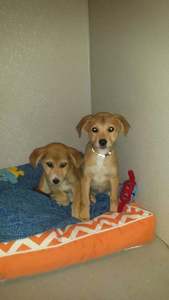
Gwenie and Penny in Chicago. Some truly dedicated and awesome volunteers there took great care of these two during their layover, for which we're extremely grateful.

Gwenie and Penny in Chicago. Some truly dedicated and awesome volunteers there took great care of these two during their layover, for which we’re extremely grateful.

Three years and half a world removed from that day we met in Afghanistan, Cass and I reunited at the Reno Air Races. Our mini-reunion one of the unforgettable moments of my life.

Three years and half a world removed from that day we met in Afghanistan, Cass and I reunited at the Reno Air Races. Our mini-reunion will always be one of the unforgettable moments of my life.

Just before Thanksgiving, Gwenie and Penny were flown from Jordan to Chicago, where the PRM folks fawned all over them, giving them tons of love and comfort in what had to have been a very taxing journey for them. From there, Penny went to Texas to await Cassie’s arrival home. Gwenie flew to Portland.

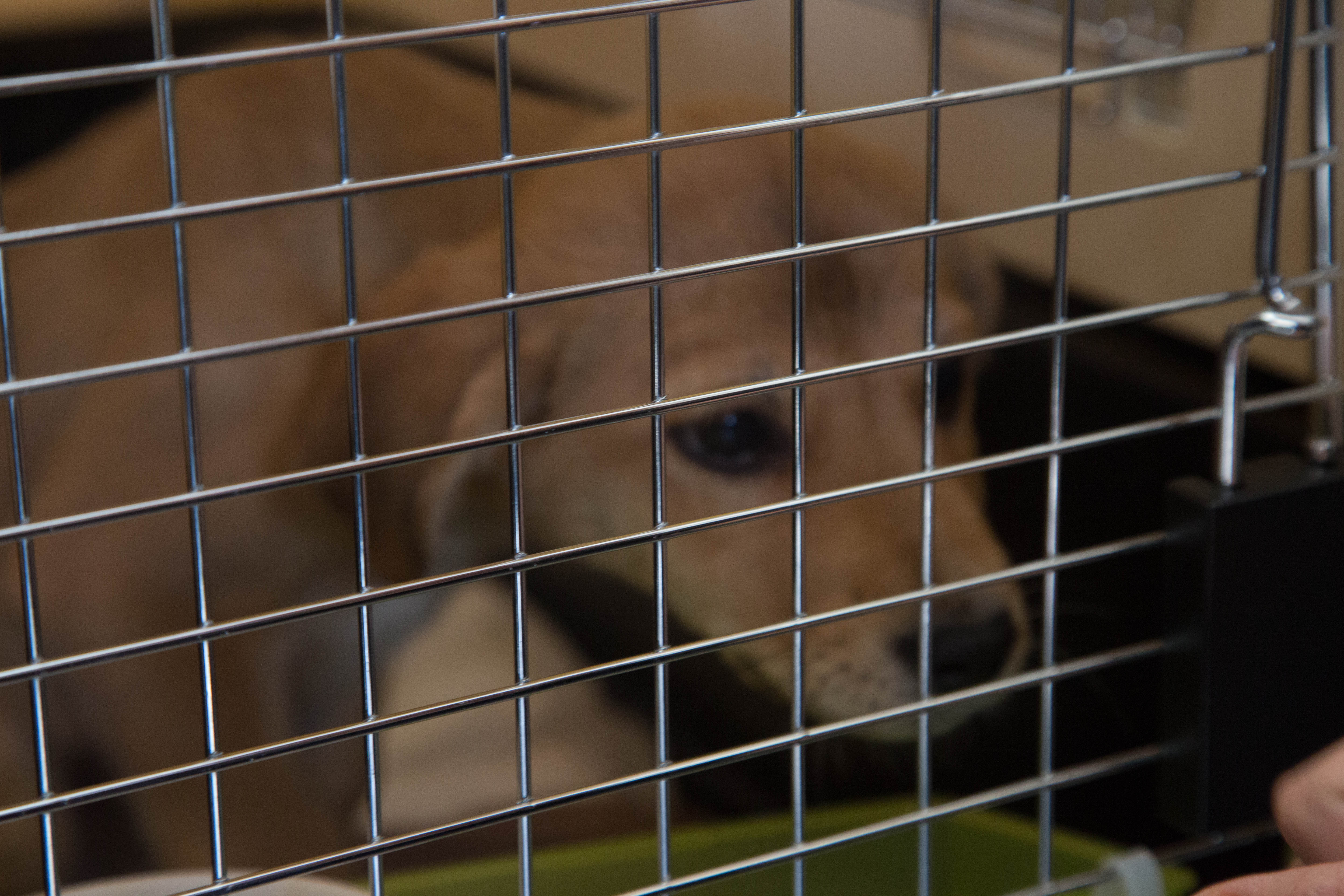
On the day she got into PDX, my family climbed into our ancient but much-loved Ford Explorer and drove up to the airport’s cargo center. Waiting for us was a twelve pound, tan pup with big doe eyes who starred out from her crate’s barred door with a look of interminable sadness. My daughter, Renee, bent down and began stroking her nose. My son Ed, quickly joined her. The two soothed and calmed our new pup as I filled the paperwork out officially transferring her to my care.

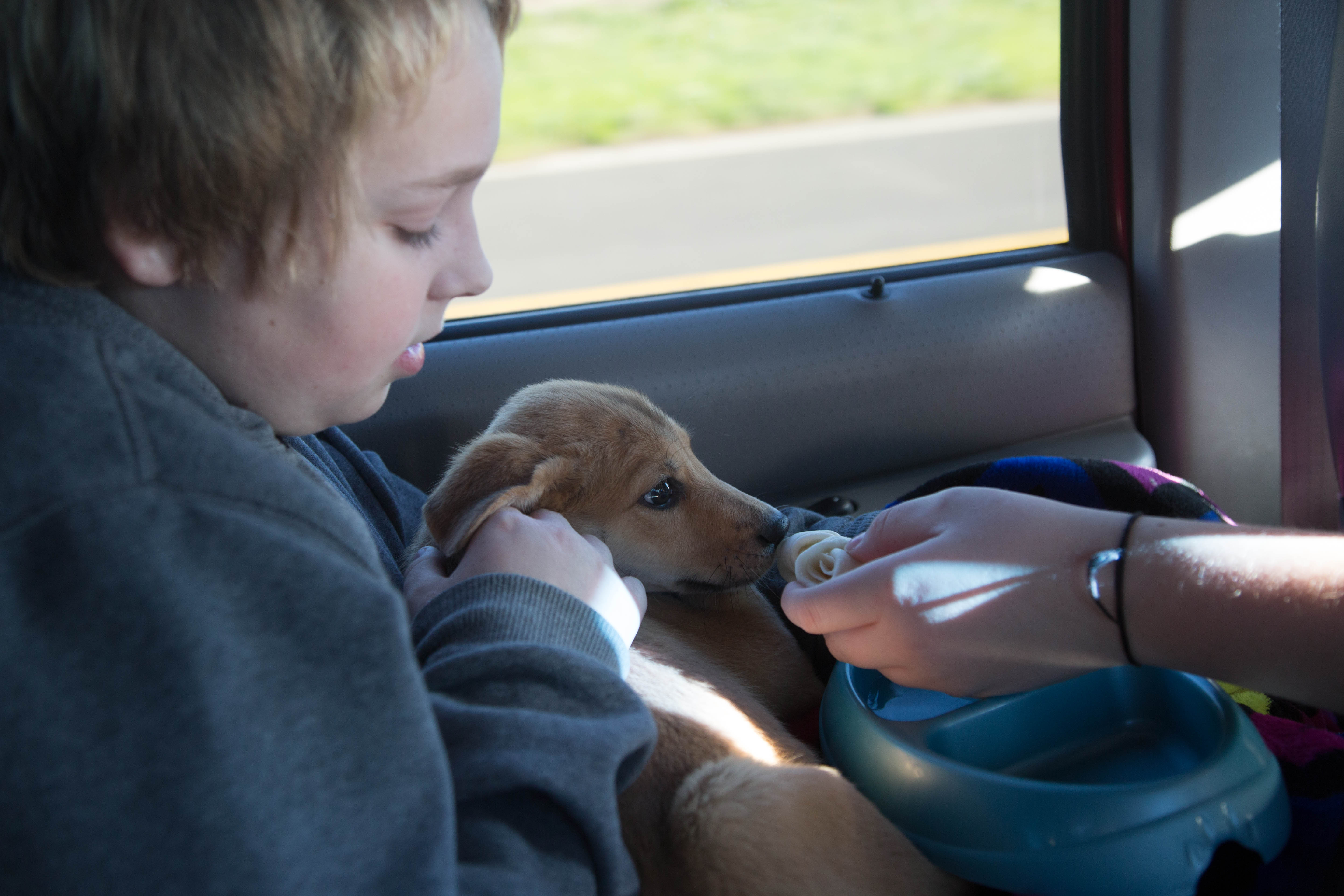
Gwenie sat huddled in Ed’s lap during the drive home. He stroked her head gently and sang to her. His voice did the trick. Soon she was sound asleep in his arms as we rolled down I-5 for our little Oregon town.

In the days that followed, Gwenie’s transition was probably a bit harsher than we had intended. I do a lot of writing up in the Cascade Mountains, and my plan was to take her up to the cabin I rent in the Willamette National Forest so the two of us could get to know each other. So, the day after she arrived, I put her on a blanket in the right seat of my Pontiac GTO and headed up into the mountains. Gwen was not sold on automobiles, and she quailed for much of the trip.
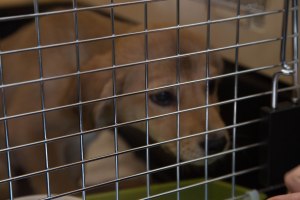
G86A8980

Our first view of Gwenie at the Portland Airport.

In Detroit, a tiny resort town that has about 75 permanent residents, I stopped to get food and give her a chance to stretch her legs. There was a bit of snow and ice in the parking lot, and Gwen was fascinated by what must have looked like white sand to her. She pawed a sheet of ice, recoiling as its cold registered on her pad. She sniffed it, then backed away frightened. For a dog that had known little but heat and desert, this was totally new territory for her, and she was not happy. She eagerly climbed back into the GTO, then realized that she hated that too. So, as I climbed back into the driver’s seat, I had a seriously homesick and miserable pup sitting beside me.

That seat she was taking up had once belonged to Volunteers, my bad-ass warrior-rescued feline who was the one good thing to come out of my experience in post-Katrina New Orleans. He loved the GTO, loved exploring Oregon with me, and wherever we went, we made friends. Gwenie was the exact opposite: a dog destined to be at least 60 lbs whose fear dominated her. Volley knew no fear and lived life on fire 24/7.  More than anything, I wanted to pull Gwenie out of that place and draw her out into the world so we could go adventure in it together.
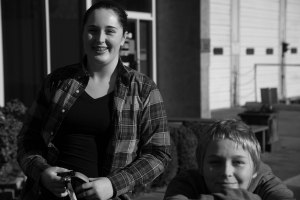
Ed and Renee, eager to go in and see the our new family member.

Ed and Renee, eager to go in and see the our new family member.

Well, we drove up to the cabin as I started to worry about the amount of snow on either side of the main highway. The pavement was clear, but I’d not seen any news about snowfall in the area. The GTO is a fair weather car, and I had no chains for it.

We turned off the main highway and started up into the Willamette National Forest. Snow and ice covered the road. I inched the GTO along, feeling it slide around.  The last stretch to the cabin included a steep grade to a gate. I made it up the grade, but when I stopped to punch in the key code to open the gate, the GTO lost traction and wouldn’t go any further. I backed down the hill and tried again, with the same result. A third effort found me sliding toward a drainage ditch, so I put the Pontiac in park, grabbed my gear and Gwenie, and hiked the quarter mile to the cabin.

G86A9011

Renee during a pit stop on the way home from PDX. Gwenie weighed about 12 lbs when she reached us. As of Feb 2, she weighs 33.

Gwen padded along beside me, unsure of the environment and very unhappy with the leash I’d put on her. She stayed close to my legs, and a few times she actually tried to jump into my arms as something scared her.  But we made it to the cabin, and I hustled her inside so we could get warm. I got a fire going, turned on the power and prepared to settle in. Then I remembered I needed to turn the water on. Outside I went, found the valve and opened it. With Gwenie standing in the snow next to me, the valve burst and sprayed water over both of us before I had to shut it off from the road.

So now, dusk was approaching. It was probably 25 degrees or so, and I was wet, Gwenie was wet, and the cabin was non-useable without water. We went back inside, and sure enough, the fire I’d started in the wood stove had gone out.
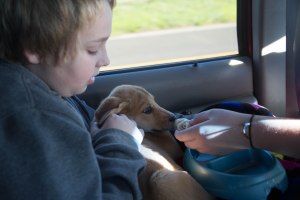
G86A8992

Gwenie snuggles with Ed on the way home from the airport.

Time for plan B. I decided we needed to close up the cabin and get back out onto the main highway before dark. I grabbed all my gear and headed back for the car. As we hiked back down to the GTO, Gwenie was clearly getting into the whole concept of snow. I let her off the leash, and she raced around, making circles around me. Periodically she’d stop to dig furiously, then would bound off at Mach 1, tearing through the snow like a desert-colored blur.

We made it to the car, I loaded it back up and got Gwenie settled.  But, when I tried to back down the hill, the Goat wouldn’t move. I was stuck fast.

IMG_1318

Our Katrina rescue, Volley with the GTO at Camp Adair. The two of us went everywhere in the GTO for five years before Vol died of a heart attack while I was in Afghanistan.

For the next two hours, I tried to dig the car clear using boards as traction. I could move it a few feet, but each time, I risked sliding the car into the ditch. Finally, as the sun went down, I called for a tow truck and got the Goat pulled out to safety. Or so I thought.

Turns out, in trying to get the car clear, I had damaged the radiator. I hadn’t gone more than a mile when the engine overheated. I pulled over and called the tow truck again. By now, I was shivering cold and soaking wet. The outside temp had plunged, and with the engine off we had no heat. Gwenie was only about 10 weeks old, and I was worried the cold was going to really affect her. So, I kept her wrapped up in a blanket and a whoobie I’d been using since Katrina for my cabin trips. She settled down, stopped shivering and watched me with those big, doe eyes.

Before the tow truck arrived, I could feel myself getting sluggish and confused. I was having a hard time making decisions, and I realized I’d probably become mildly hypothermic. By the time the truck arrived, I was in a pretty unhappy state. The tow truck driver took one look at Gwenie and I and ordered us into his cab. We climbed aboard, and he blasted the heater full bore at us until I dried off and warmed up. Gwenie sat in my lap and snuggled against me.

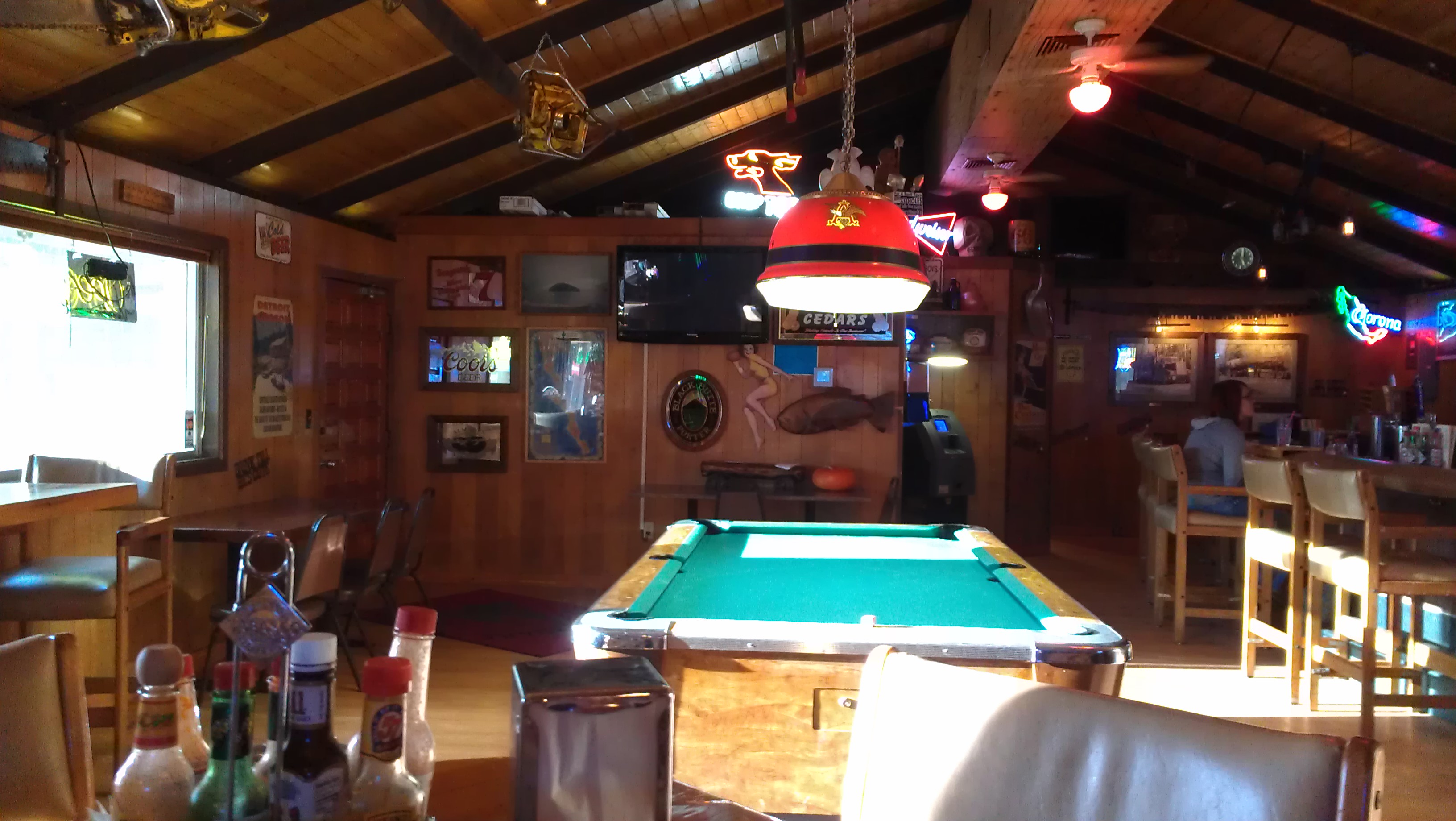
The Cedars, the only place open that night when Gwenie and I sought refuge from the cold.

The Cedars, the only place open that night when Gwenie and I sought refuge from the cold.

The driver towed the GTO to Detroit, where we left the car and went to the one bar in town. Pup and writer drank soup together as some of the locals shot pool and snatched sidelong glances at us. We were a sorry sight. An hour and a half later, Jenn Bruning came up and rescued us. The GTO was towed another 70 miles home the next morning, where it received a brand new radiator. The first one had lasted 112,000 miles and had been in almost twenty states during my various road trips, so I’m hoping this one will last as long. 🙂

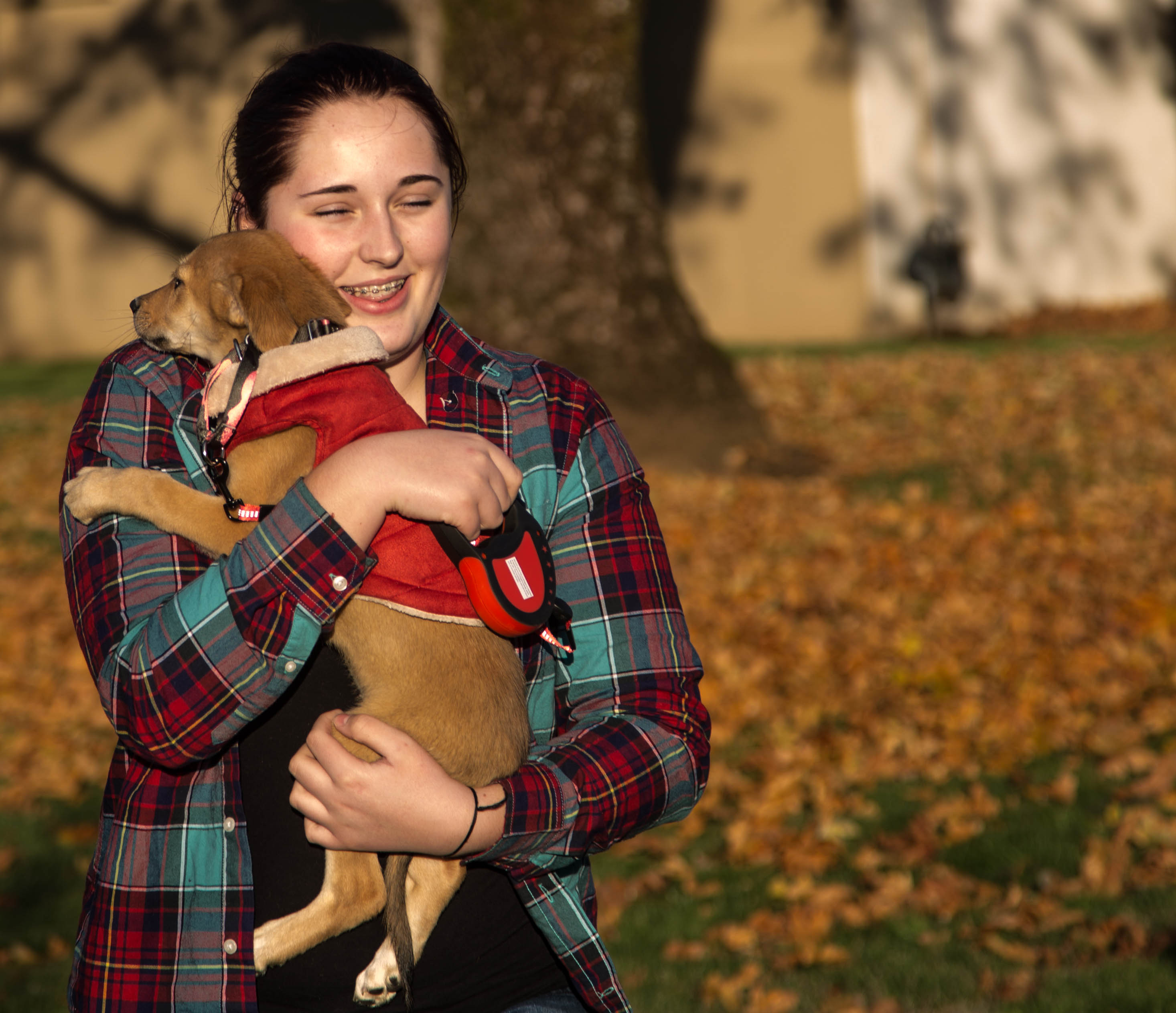
Gwenie on her first walk at Camp Adair, Oregon. I took this a few days after we got back from our aborted cabin trip.

Gwenie on her first walk at Camp Adair, Oregon. I took this a few days after we got back from our aborted cabin trip. Unfortunately, I didn’t get any photos of our adventure in the mountains–I was too cold and miserable to document it!

Through all the craziness, my Jordanian pup and I bonded. That night, as I slipped into bed, Gwenie jumped up beside me and curled up, her warm fur a comfort in the darkness. she slept with her head on my pillow and a paw across my face. The next morning, as I got up to get my day started, she would not leave my side. We’d gone up into the mountains as strangers, but we’d come home as something unique in my life. I was her human now, and she was my dog.


Please check out http://www.puppyrescuemission.com/. The dedicated volunteers there are doing incredible things for our service men and women.

IMG_4134


Categories: Gwenie's Story | 4 Comments

MAG-45’s War in the Pacific Backwaters

The strip at Falalop Island, Ulithi Atoll, home to Marine Air Group-45. This photo was taken at the end of April 1945. In the photo can be seen several F6F-5N night fighters, a line of TBM Avengers, a few SBD Dauntless dive bombers, an SB2C Helldiver, and an unusual array of Culver TD2C Turkey target drones (at right)

The strip at Falalop Island, Ulithi Atoll, home to Marine Air Group-45. This photo was taken at the end of April 1945. In the photo can be seen several F6F-5N night fighters, a line of TBM Avengers, a few SBD Dauntless dive bombers, an SB2C Helldiver, and an unusual array of Culver TD2C Turkey target drones (at right)

In the fall of 1944, Marine Air Group-45 set up shop at Ulithi Atoll and received the task of suppressing the bypassed Japanese bases in the Carolines. MAG-45’s biggest and most important target was Yap, which included a large airfield capable of handling twin-engine bombers. The air group’s Avenger squadron, initially VMTB-232 and later VMSB-245, also provided anti-submarine patrols around the fleet anchorage at Ulithi. In November, two Japanese submarines launched five midget subs which succeeded in sinking a U.S. Navy oiler. Marine Avengers sank two of the midget subs.

In the months that followed, the air group flew night intercept operations with VMF (N)-542’s F6F-5N Hellcats, carried out ceaseless attacks on Yap, Fais and Sorol Islands. Though they encountered only occasional Japanese aircraft, the flak over these targets was often intense and so dangerous the crews were told not to drop below six thousand feet during their attack runs.

USMC Series WWII MAG-45 vmsb-245 ii Ulithi Atoll 040445 -1

VMSB-245’s parking area in May 1945. ‘245 arrived at Ulithi in March and flew until the end of the war. It had previously flown a tour from Midway and a second in the Marshall Islands prior to arriving at Ulithi. TBM Avengers, SB2C Helldivers, F6F-5N Hellcats can be seen along with what looks like a USN variant of the Beech 18 and an air rescue float plane.

MAG-45’s job was a thankless one, their efforts and missions lost to the American people as the tide of war advanced ever closer to the shores of the Japanese Homeland. Yet, it was in these grinding, attritional missions that the Marine aviators demonstrated a supreme level of dedication to their craft and cause. Day in and day out, the struck the same targets to ensure the strips at Yap could not be used to launch surprise raids against the U.S. warships at anchor in Ulithi, which had become a key forward replenishing base for the fast carrier task forces. There was little chance to participate in a major battle that could make headlines and history, and almost no opportunity for the fighter pilots to score aerial kills. Yet they were steadfast and carried out their missions with deadly effectiveness until the Japanese surrender in August 1945.

In honor of their all-but unknown efforts, here are some photographs from that backwater campaign.

VMSB-245 crews receive a target briefing prior to a mission against Yap Island on May 1, 1945.

VMSB-245 crews receive a target briefing prior to a mission against Yap Island on May 1, 1945.

USMC Series WWII MAG-45 Pilots Mangrum Ulithi Atoll 042845-1

LT. Col. Hurst and Colonel Robert Mangum chat with and congratulate two young fighter pilots, Lt. Hill and Lt. Hungtington, after they shot down a Japanese plane. April 28, 1945.


Categories: World War II in the Pacific | Tags: , , , , , , , , , , , , , , , , | Leave a comment

Ulithi Interlude

USMC Series WWII MAG-45 gunners and monkey vmsb-245 Ulithi Atoll 05145-1

Memo: Before bombing Yap Island, always remember to feed your monkey.


Categories: World War II in the Pacific | Tags: , , , , , , , | Leave a comment

Blog at WordPress.com.