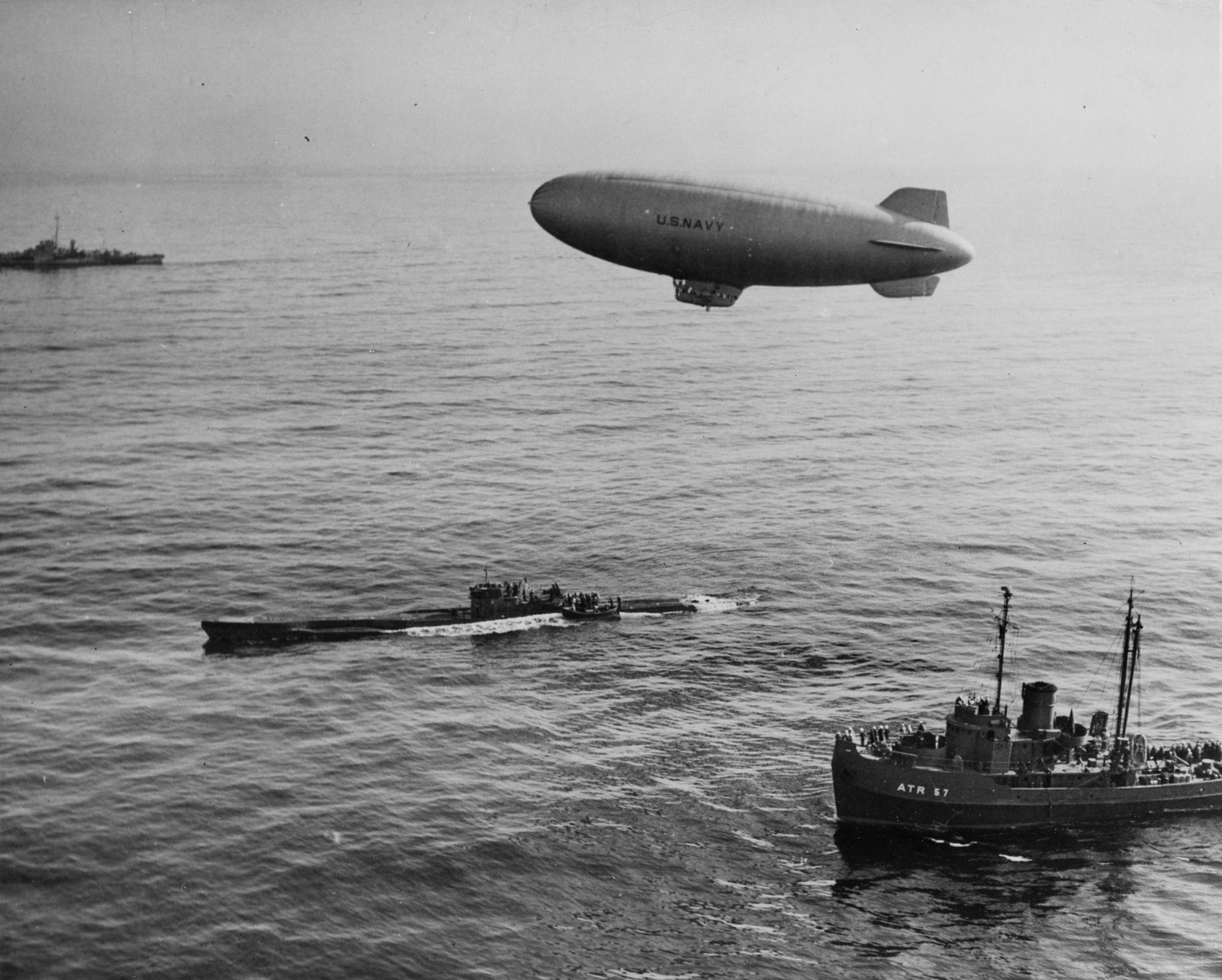
U-858, under close escort, steams for Delaware after surrendering off Cape May in May 1945.
In the final weeks of the War in Europe, the German Navy sought to repeat the successes of 1942’s Operation Drumbeat by sending U-boats to intercept and sink merchant shipping along the American eastern seaboard. Kapitanleutnant Thilo Bode and the crew of U-858 was assigned a role in this operation. U-858 was a Type IXC/40 submarine that had only one previous war patrol to its credit. Bode’s crew had not sunk or damaged any Allied vessels in that initial patrol, and even getting to the East Coast was a tremendous gamble, given the depth and power of the Allied anti-submarine defenses in the North Atlantic by 1945.
Bode was an intelligent officer, a tall Bavarian who stayed clean shaven while the rest of his crew grew beards. When he left on this last desperate mission, he knew Germany was doomed to defeat. For six weeks, he played cat-and-mouse games with Allied anti-submarine patrols, but failed to attack any vessels.
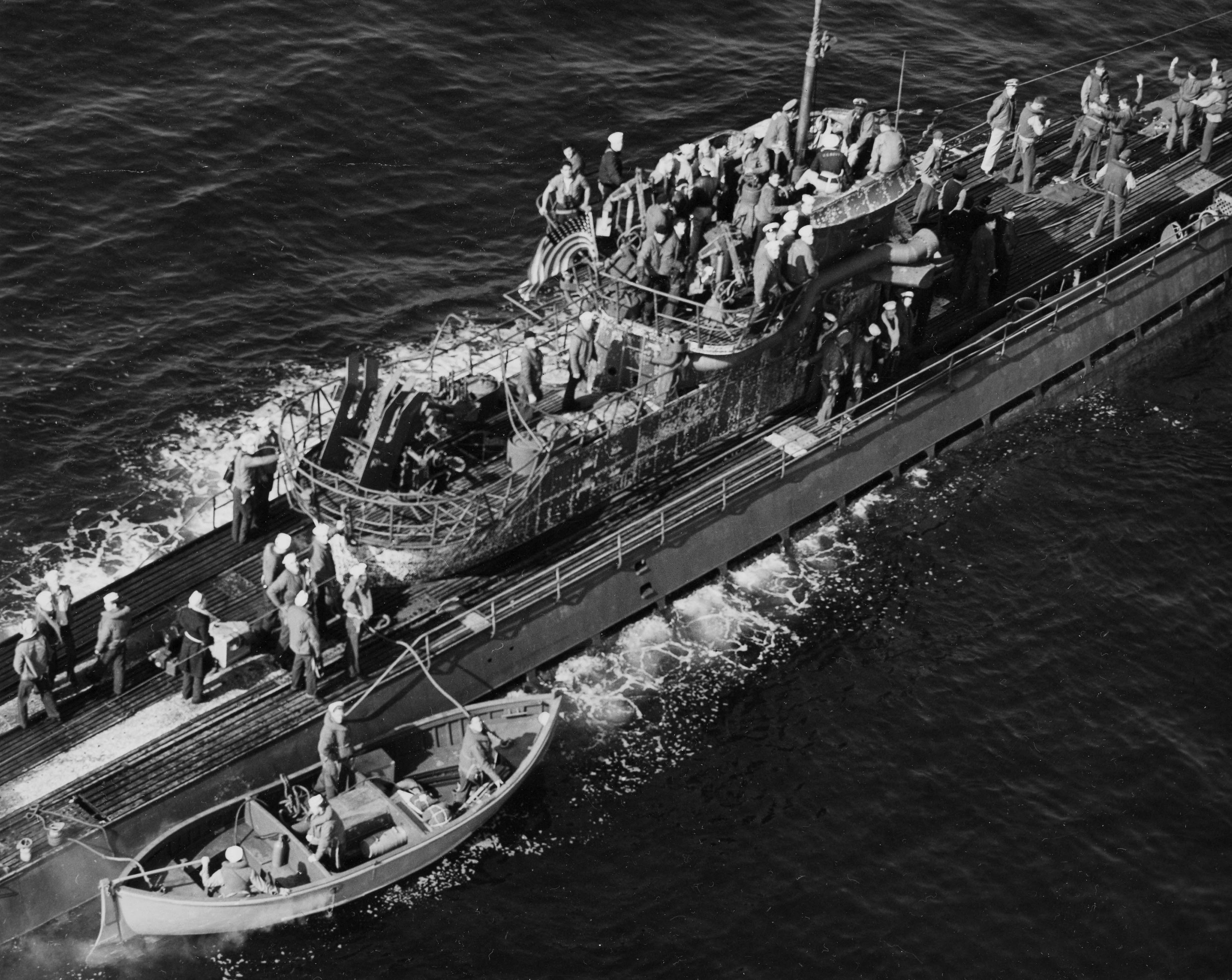
The Pillsbury’s boarding party aboard U-858.
On May 14, 1945, after receiving a radio message from Germany ordering all warships to stand down and surrender, he and his crew surrendered to the destroyer escort, U.S.S. Pillsbury off Cape May, New Jersey. An American boarding party went aboard and took control of the U-boat, raising the Stars & Stripes over her conning tower. Bode and most of the crew were then taken off the U-boat, but a few were kept aboard as prisoners, just to ensure there had been no effort to sabotage the vessel with timed charges.
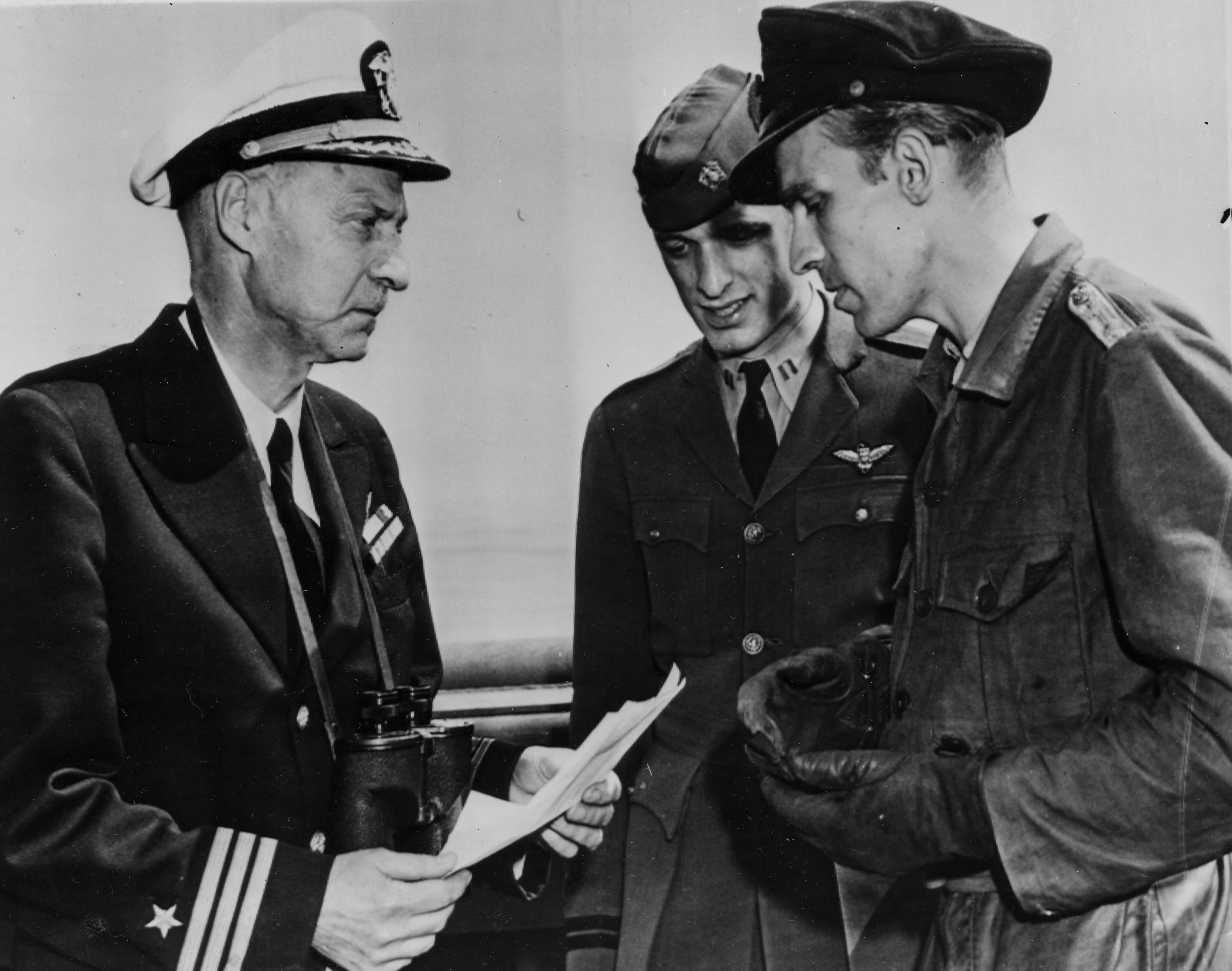
U-858 became a celebrated prize of war in the United States. She was taken to Fort Miles, Delaware, where Bode officially surrendered his command to the United States Navy in a ceremony that has subsequently been recreated on the event’s anniversary by local reenactors.
After the surrender, Bode offered to take his U-boat and join the U.S. Navy’s fight against Japan in the Pacific. The U.S. Navy refused, and the boat was to never see combat again. In 1947, it was sunk during a live fire torpedo exercise by the USN submarine, Sirago.
Commander J.P. Norfleet (left) (USN), accepts 27 year old Captain-Lieutenant Bode’s surrender on May 14, 1945.
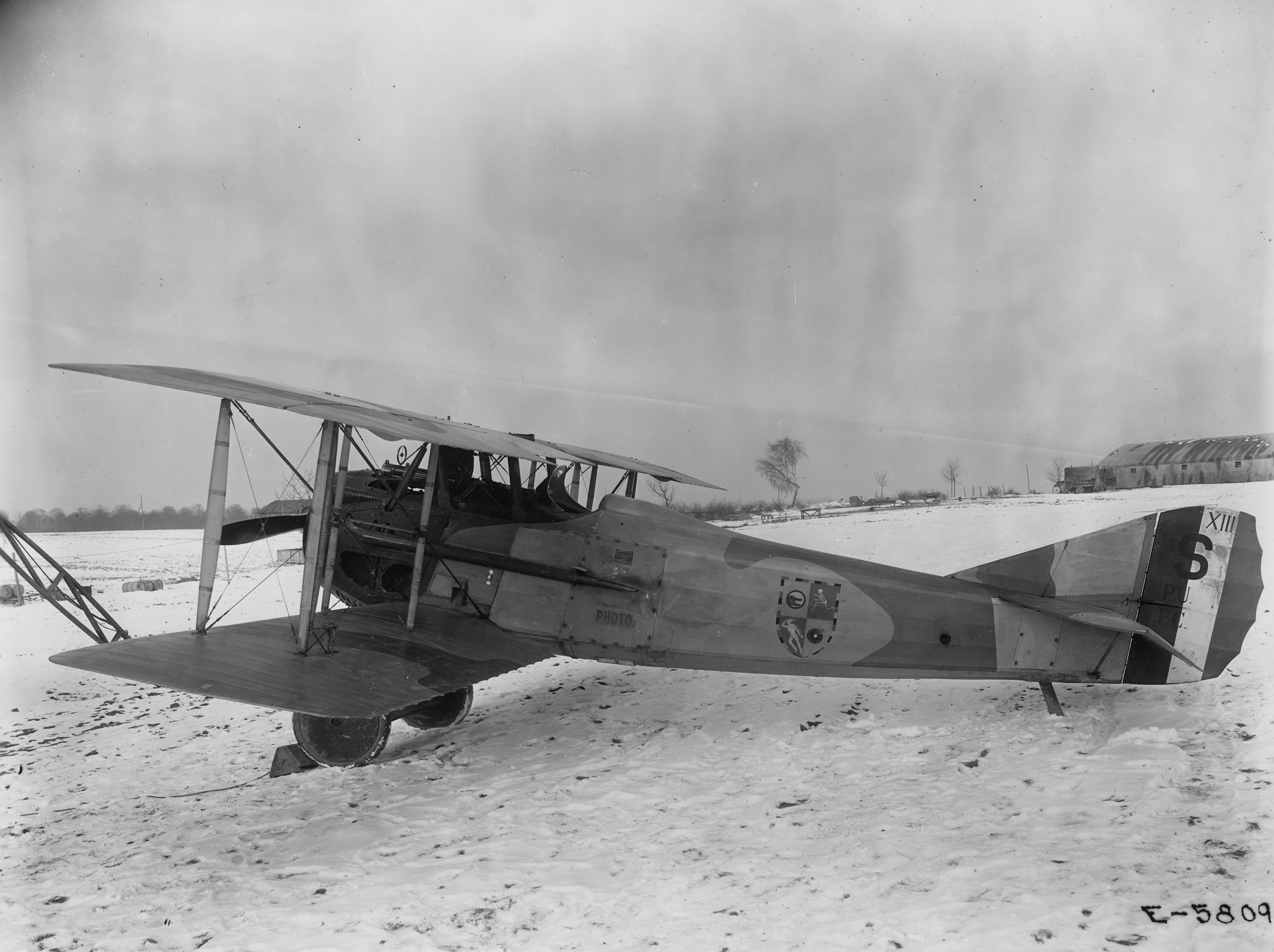
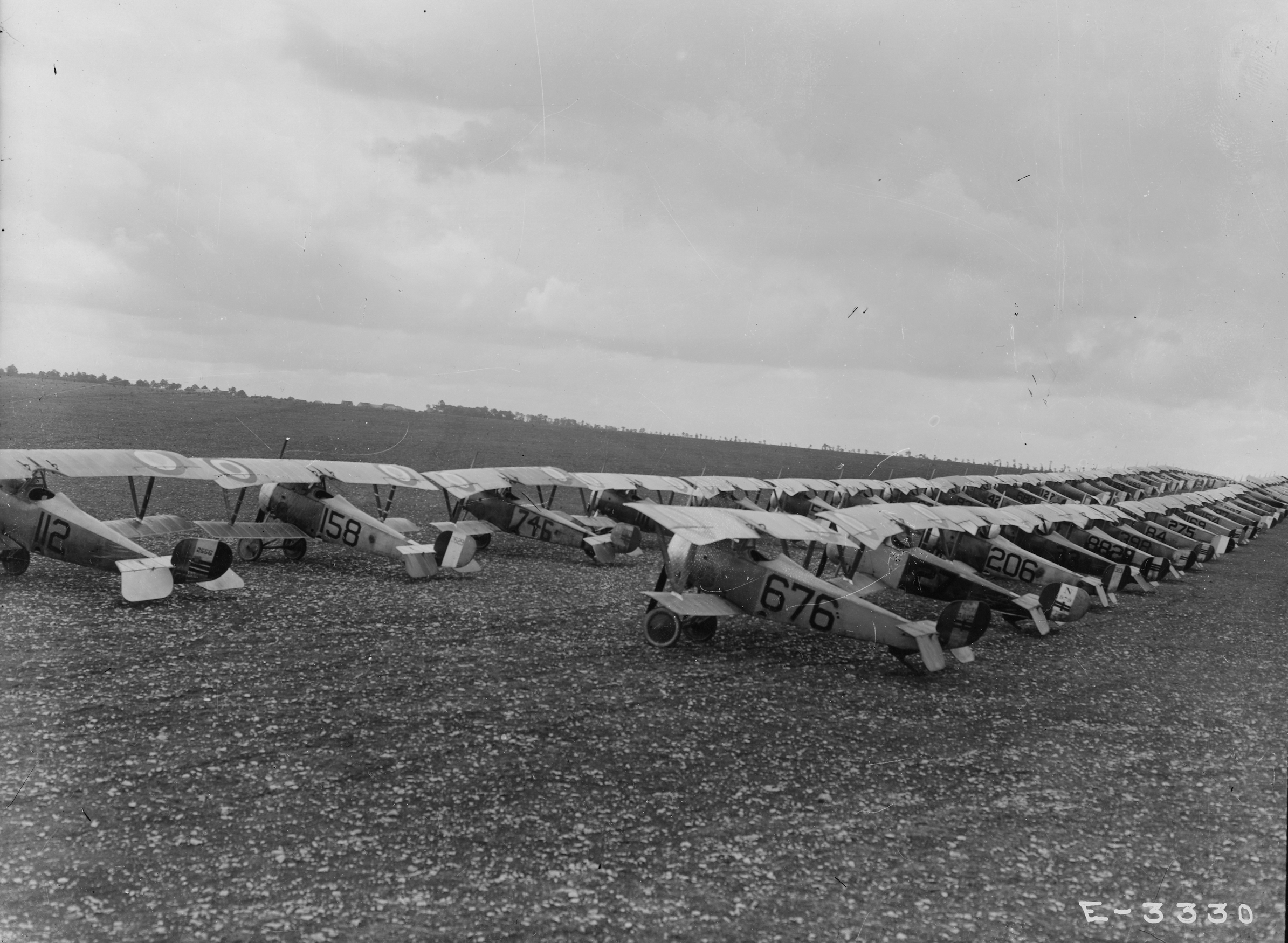
By the fall of 1918, most of the U.S. combat fighter squadrons flew the French-made Spad XIII in battle.
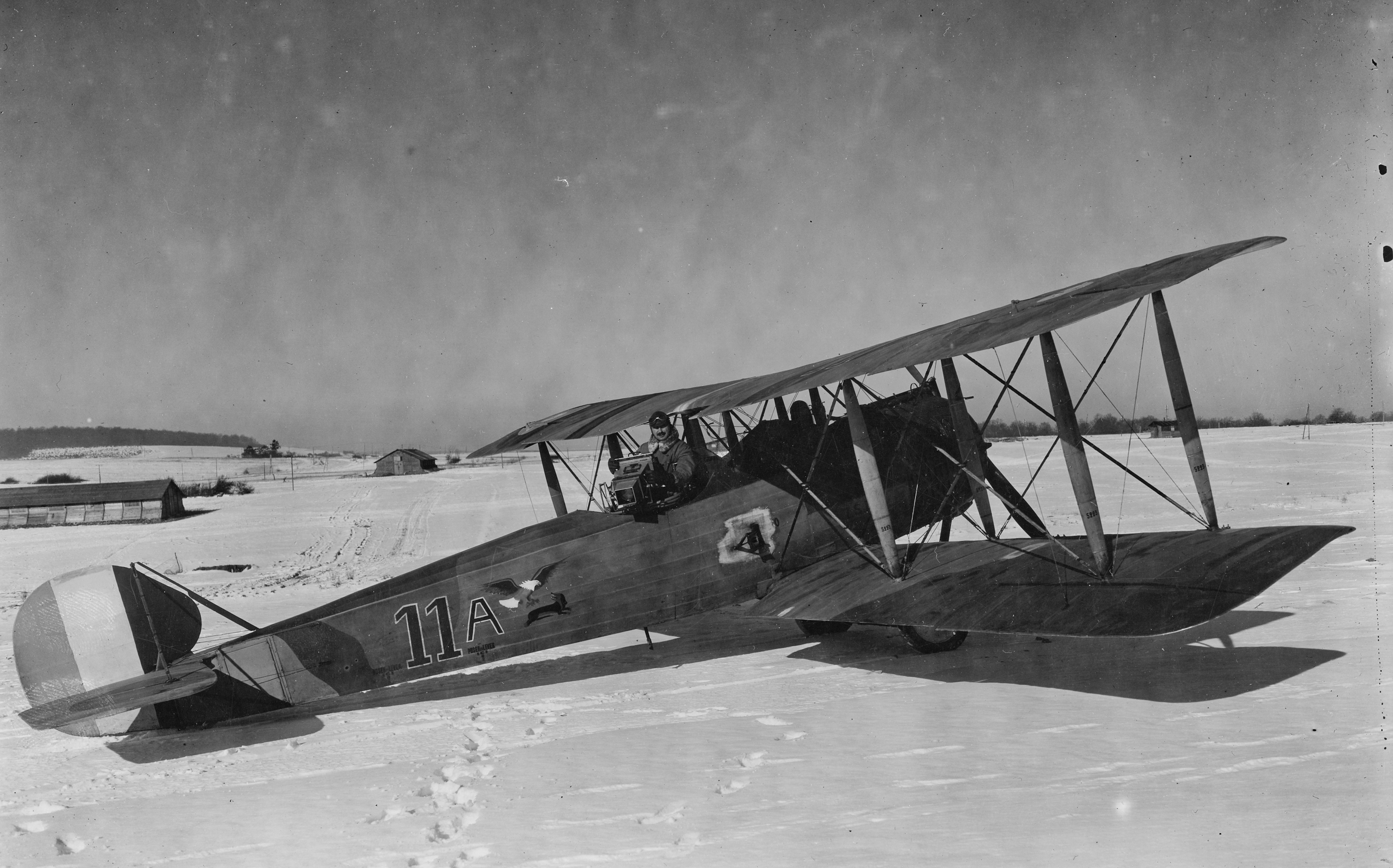
In 1917, when the United States entered the Great War, the Army Air Service was a tiny, primitive and incapable force. In the span of a year, the AAS went from backwards and poorly equipped to a state of the art, modern organization that went toe to toe with the best aviators and aircraft in the world during the final months of the war. That incredible transformation only happened because of massive French assistance. The French helped train American aviators, provided advisors and equipped most of the USAAS squadrons that saw combat on the Western Front. That free-flow of knowledge, experience and material support laid the foundations for American air power.
French Nieuport 17’s trained America’s first generation of fighter pilots.
In the early 1930’s, French military aviation was considered to be the most advanced in the world. But in the span of about five years, all that changed. The Great Depression hammered budgets, and poor policy decisions on the part of the French government played havoc with the French aircraft industry. Production rates plummeted. Suppliers and contractors to the major aviation companies went out of business. Construction techniques became outdated, and factories were not modernized.
French ground crews re-arm an American-built Hawk 75.
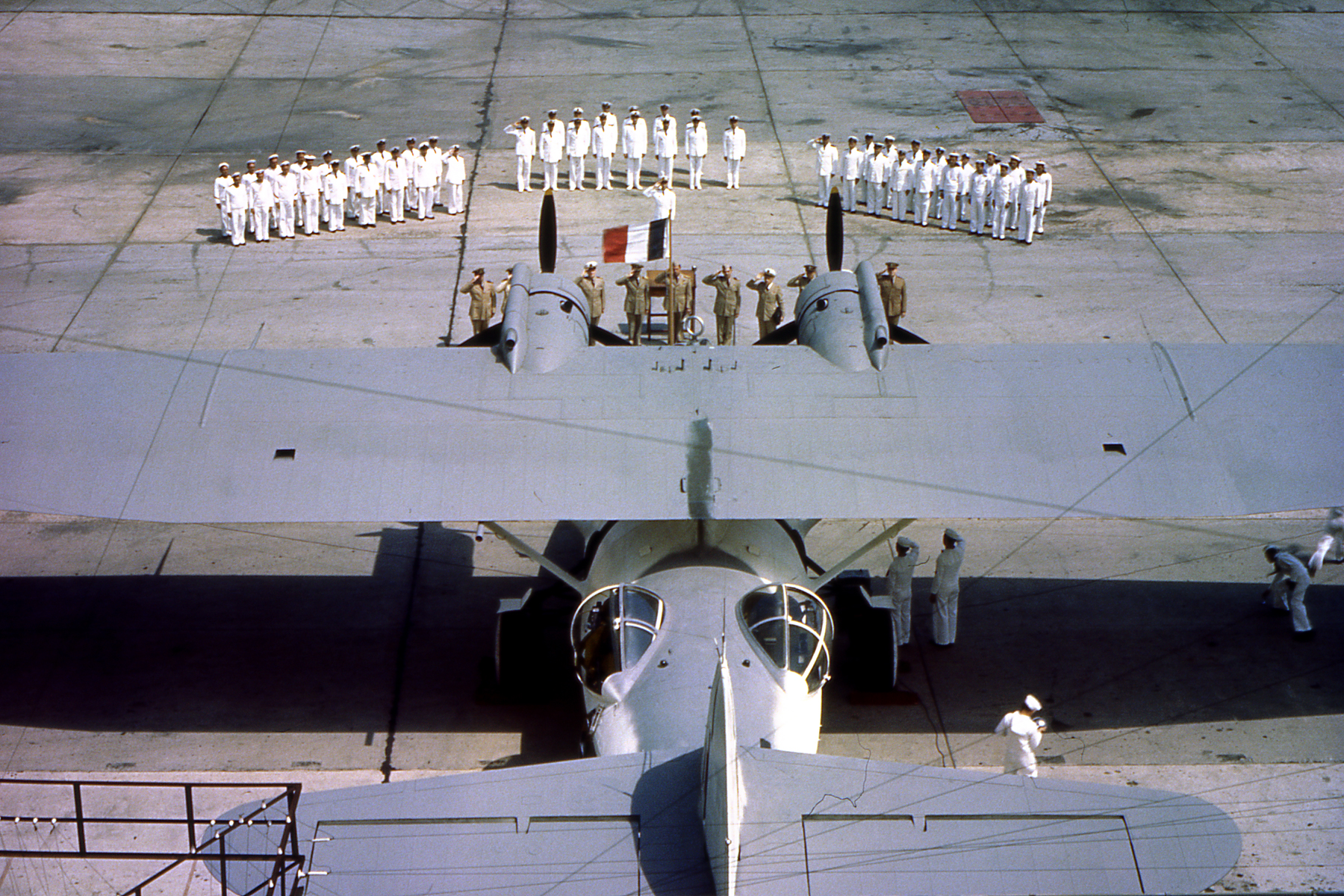
A French naval air force ceremony in front of an American-made Consolidated PBY Catalina.
As the threat from Nazi Germany grew, the French made a furious effort to modernize and catch up in 38-39 after watching many nations surpass their once great L’Armee De L’Air. While the nation initiated a crash effort to modernize and increase production of a new and formidable generation of aircraft, including the LEO 451 and the D.520, France turned to the United States to help fill the gap. American firms began churning out aircraft for the L’Armee de L’Air, including the Curtiss Hawk 75, the Martin 167 Maryland bomber, and the Douglas DB-7 (A-20 Havoc). The Hawk 75’s and Martin 167’s saw combat in 1940 with the French, but most of the DB-7’s ended up with the RAF after the Fall of France.
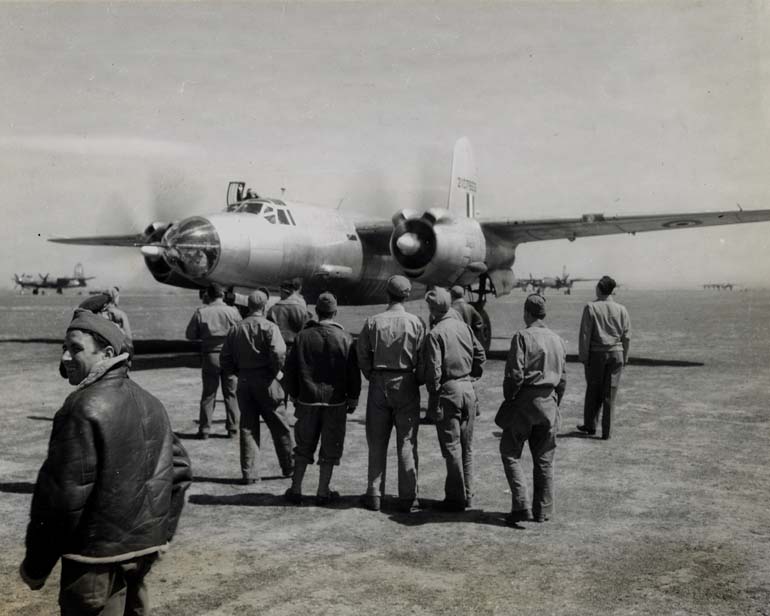
A French Martin B-26 Marauder. Several medium bomb squadrons flew these in both the MTO and ETO.
In 1942, the U.S. began supplying the Free French with a whole new generation of fighters and bombers. French squadrons went into combat in the MTO and ETO in American-made Martin B-26 Marauders, Bell P-39 Airacobras and Republic P-47 Thunderbolts.
French ground crews working on a P-47 Thunderbolt during the winter of ’44-45.
After the war, as the French sought to rebuild their military as the Cold War intensified, American designs once again played a crucial role in the L’Armee de L’Air until France’s aviation industry could get back on its feet. American F8F Bearcats, B-26 Invaders and jets such as the F-84 carried the French cockade through the late 1940’s and early 1950’s. That support helped establish post-war French air power.
In the years since, French and American combat aviators have served alongside each other over Iraq, over Serbia and Afghanistan, carrying the hundred year aerial alliance into a new century against new and pernicious threats. I was fortunate to see the French in action while I was in Afghanistan in 2010. I remember watching two of their Eurofighters take off from Kandahar and thinking, The spirits of all those Spad and Thunderbolt pilots rides on their shoulders.
The birth of America’s bomber force was greatly assisted by the French. Here, a Breuget 14 serves with one of the first bomber squadrons to see service with the USAAS.
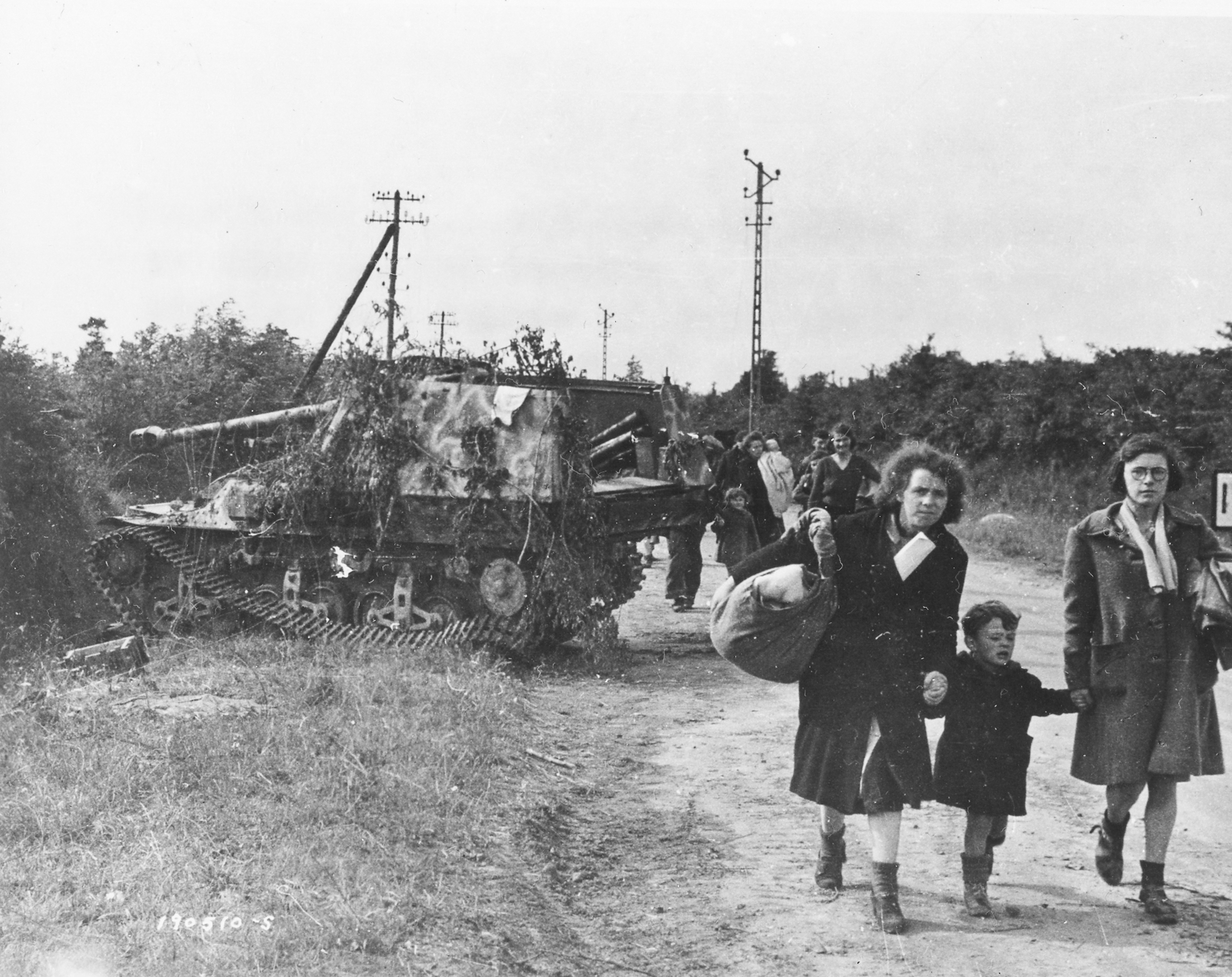
French refugees pass a wrecked German panzer jaeger Marder II as they flee the fighting in Normandy in the summer of 1944.
The American experience of World War II is inextricably linked to the experience of the French. From the outset of the war, when the United States provided aircraft and arms to France through the raising and
Free French Moroccan infantry in Siena, Italy on July 3, 1944.
equipping of the Free French Army, to the shared moments on battlefields from the Bocage country to the Colmar Pocket, the people of the United States and France built a common history and heritage together. And in that adversity rose a bond that exists in few other places between few other people. These photos show, in microcosm, how that bond was cemented.
A U.S. tanker with a group of parentless French children at a Displaced Persons center in Hoyen, France on September 18, 1944.
A French Foreign Legion communications team during an amphibious assault exercise in North Africa, spring 1943.
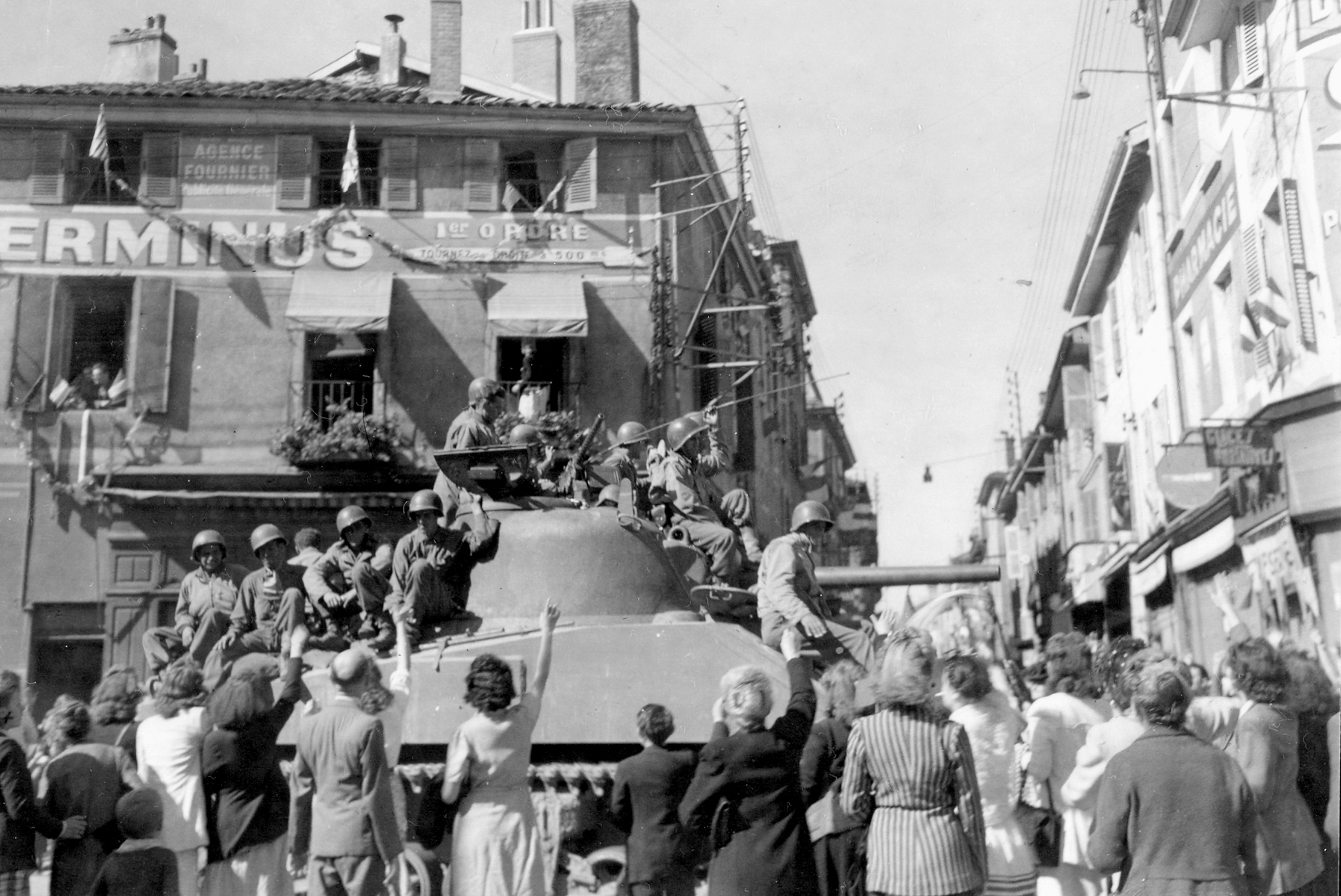
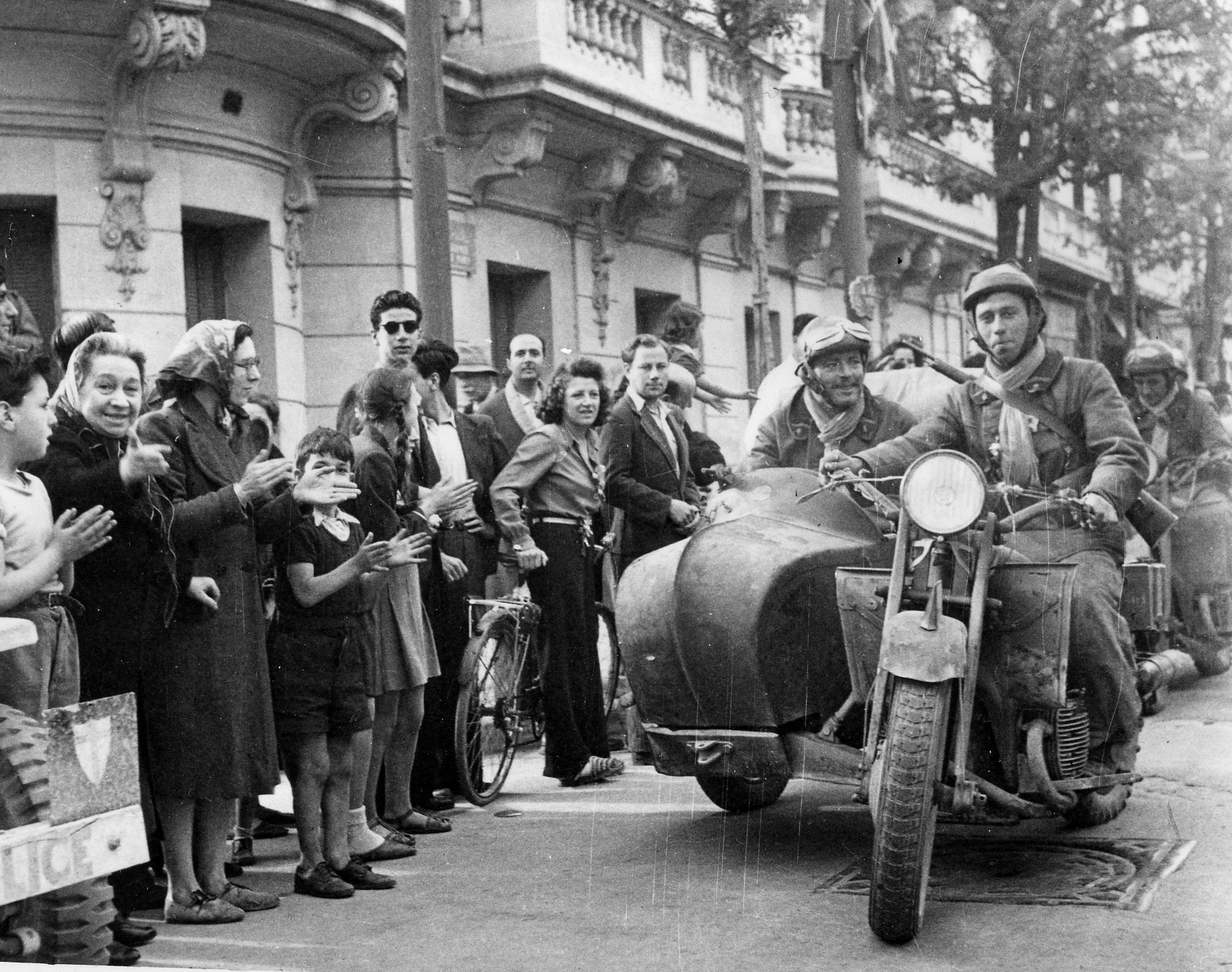
Liberation Day in a French town, care of the 45th Infantry Division. September 1944.
American medics from the 79th Infantry Division frantically work to save the life of a French woman who had just stepped on a German anti-tank mine. The blast severed both of her legs. Normandy, July 8, 1944.
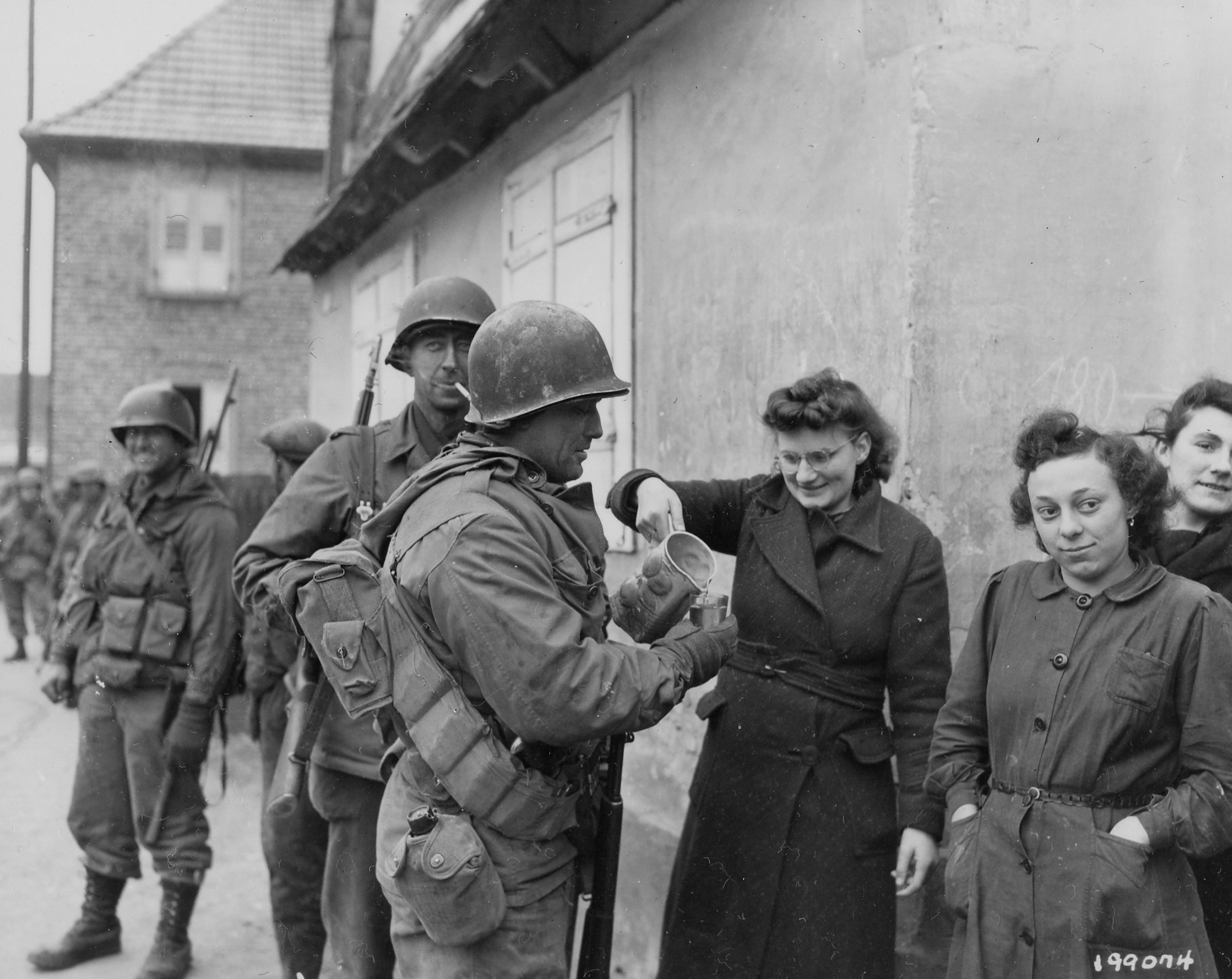
American Soldiers from the 79th Infantry Division receive wine from French civilians during a lull in the fighting around Drusenheim, France on January 6, 1945.
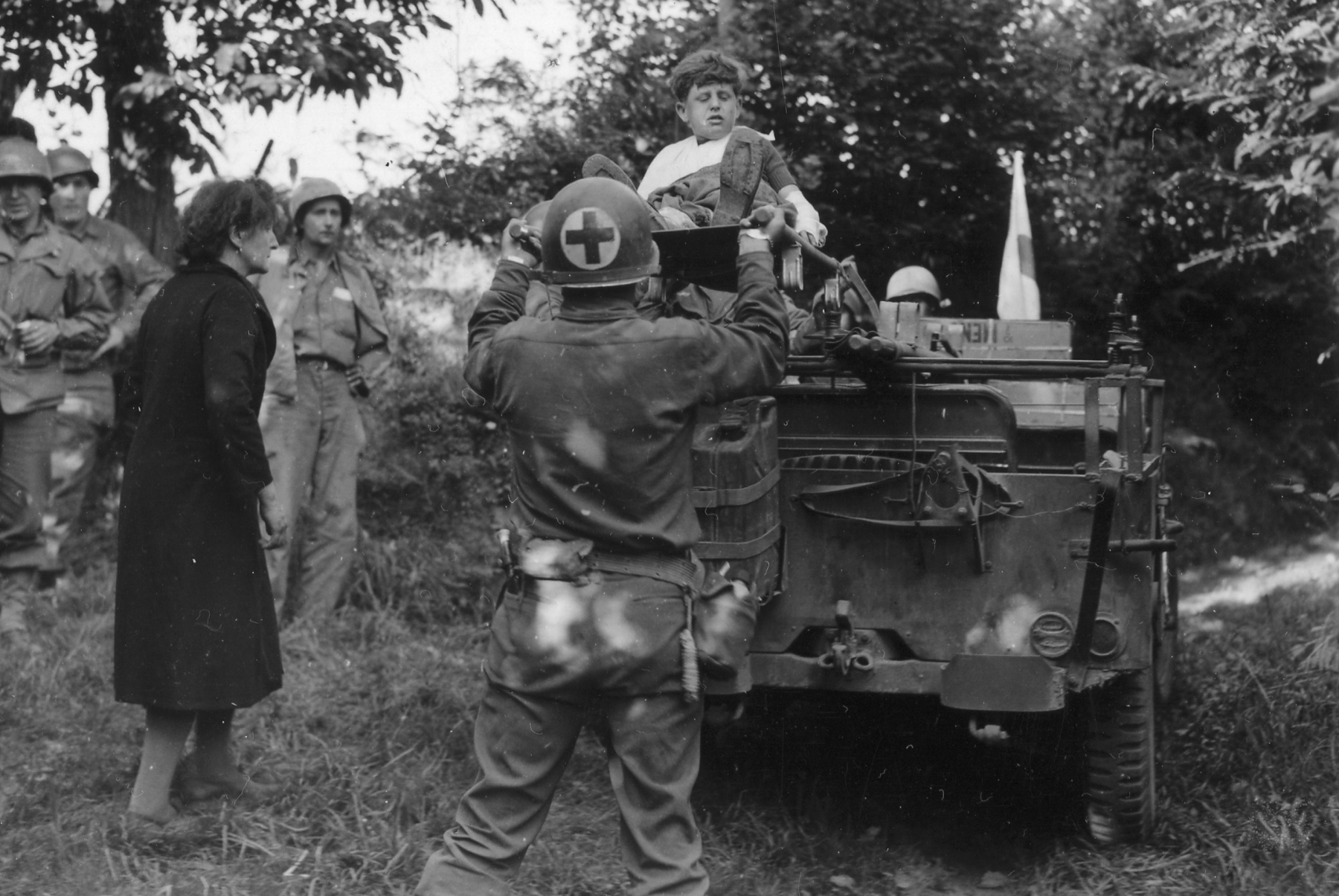
American medics gingerly evacuate a badly wounded French boy on August 2, 1944. He was hiding in a barn when the Germans set fire to it. He escaped with critical burns, but was found by advancing American troops and immediately MEDEVAC’d to the nearest aid station.
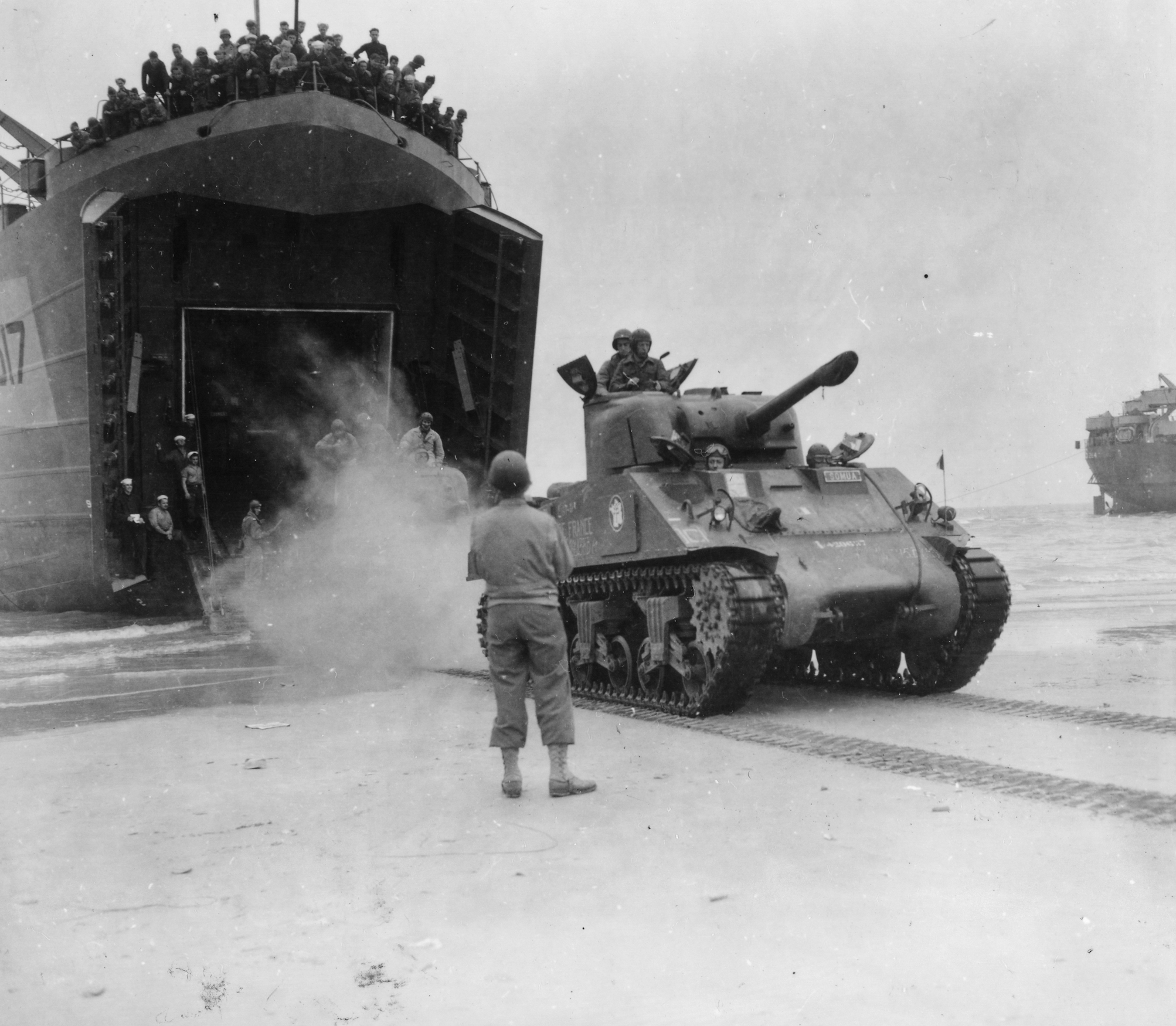
The 2nd Free French Armored Division comes ashore at Utah Beach.
Perhaps no French unit achieved the level of fame during World War II that the 2nd Free French Armored Division did. Formed from about 15,000 men from different Free French units that had been fighting in North Africa since 1940, the 2nd included some 3,600 Colonial troops, primarily Moroccans and Algerians, along with a contingent of Spanish Republican volunteers. The rest of the division was drawn from French troops and citizens who had escaped France proper during the German invasion, or who had been out of the nation when the 3rd Republic sued for peace in June 1940.
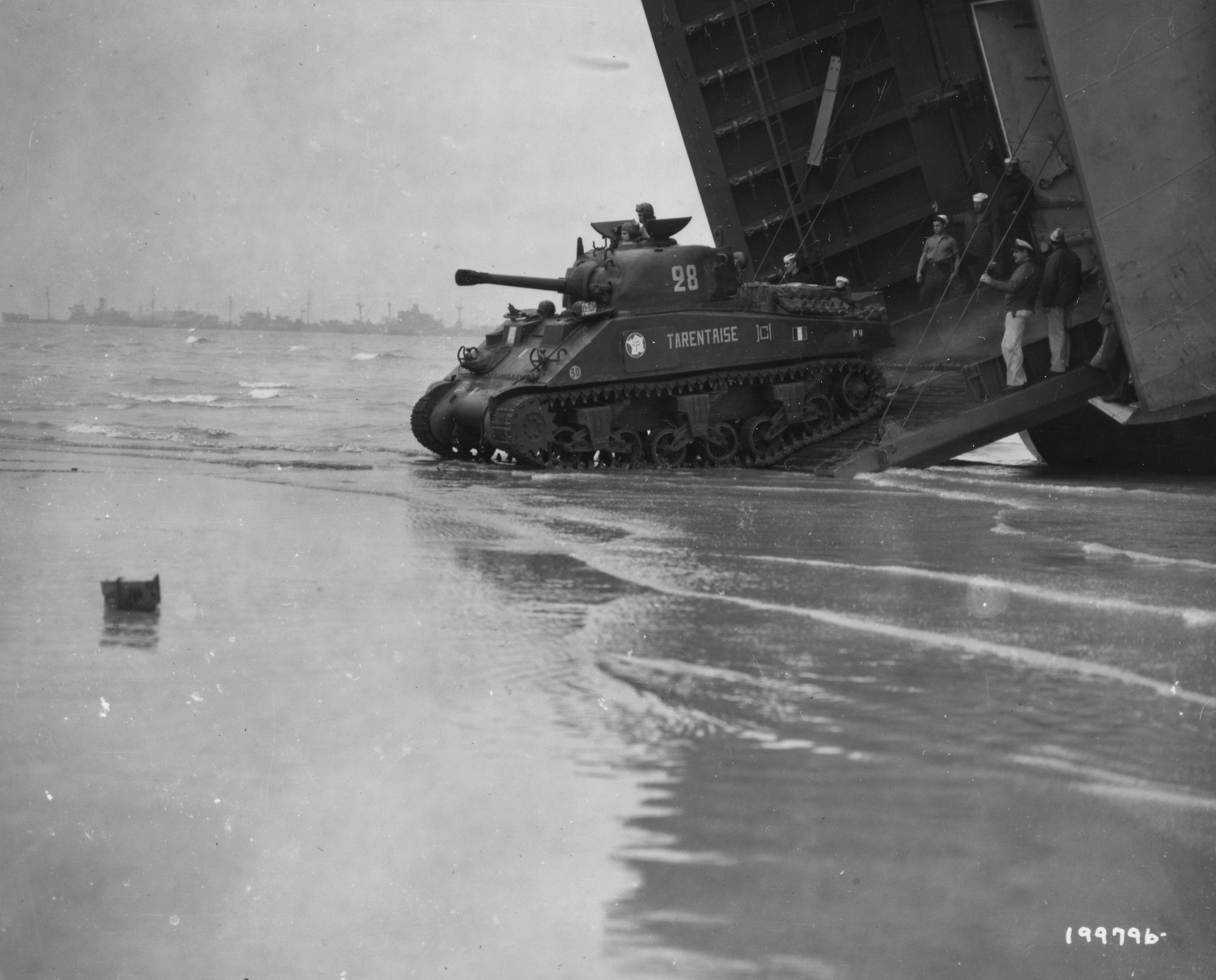
Organized and equipped like a U.S. Army armored division, the 2nd included three tank regiments, a tank destroyer regiment and three mechanized infantry regiments, along with engineers, artillery, truck and logistical support units. The division employed M4 Sherman tanks, American halftracks, M8 75mm motor gun carriages and other American vehicles. The Soldiers were equipped with standard U.S. Army gear, including M1 rifles, M1919 light machine guns, etc.
The division rejoined the fight in July 1944 when it landed at Utah Beach. The 2nd was thrown straight into the fray and ended up in the middle of the Falaise Pocket battle, forming the crucial hinge between Canadian and American units. During the fighting that August, the French tankers and armored infantry all but destroyed the remnants of the German 9th Panzer Division, knocking out over a hundred armored vehicles and taking almost nine thousand prisoners. But by the end of the battle, the 2nd had paid a steep price–about a thousand killed, wounded and missing.
Another shot of the division’s M4 Shermans coming ashore at Utah.
At the end of the month, General Philippe LeClerc, the divisional commander, was ordered to drive on Paris with the U.S. 4th Infantry DIvision. What followed was the unit’s most lasting moment. Fighting side by side with American troops, the Free French could sense their hour of redemption was at hand. They fought like banshees, pushing toward their capital with impassioned fury, taking heavy losses at times. Some five hundred more men from the 2nd were killed and wounded, but the division forced its way into Paris and accepted the German surrender. The moment triggered a national catharsis, with French citizens celebrating in the streets and showering the Allied troops with tokens of their appreciation. France’s national honor had been restored, but much fighting lay ahead.
The 2nd pushed on East, destroying the 112th Panzer Brigade the following month in a chaotic battle at Dompaire. They liberated parts of the Vosges Mountains and wrested Strasbourg from German control at the end of November 1944 in daring actions that later led the division to be awarded an American Presidential Unit Citation. During this phase of its combat career, the 2nd fell under the U.S. Army’s XV Corps.
Paris, August 26, 1944. The 2nd Free French Armored DIvision’s most famous hour.
An M10 Wolverine tank destroyer from the Régiment Blindé de Fusiliers Marins, 2nd Free French Armored Division, outside Halloville, France on November 13, 1944.
After Strasbourg, the 2nd was shifted west to clear out German pocket of resistance along the coast, but it was transferred back to the main front in April 1945 in time to strike deep into the heart of the 3rd Reich. Soldiers of the 2nd were among the first Allied troops to reach Hitler’s Eagles Nest, and ended the war in Bavaria.
From July 1944 through May 1945, the division suffered about six thousand casualties out of approximately 15,000 men. It was deactivated in 1946 after serving France and the cause of Freedom with great and courageous distinction.
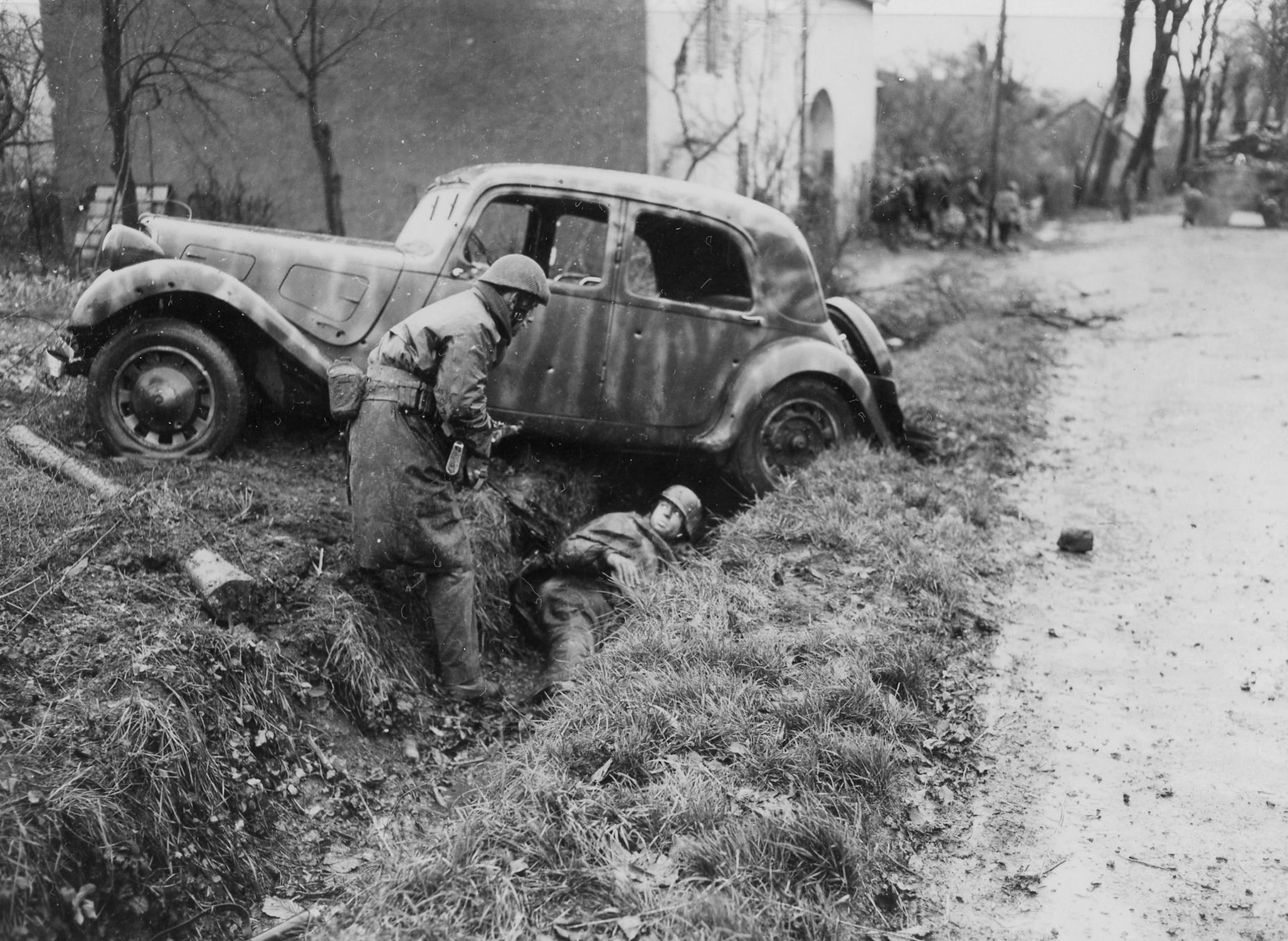
A Soldier of the 2nd Battalion de Choc, French Commandos, takes a German prisoner behind a shattered staff car during a firefight in Belfort, France on November 20, 1944.
In February 1916, the German Army unleashed a surprise offensive against the French defenders in the Verdun sector of the Western Front. Verdun was one of the fortress cities built by the French after the 1871 war. In the rolling hills around the town, a series of reinforced concrete and underground forts had been built. Heavily protected, extremely well armed with such innovations as retracting gun turrets, the Verdun forts were supposed to break up any German offensive, or at least stall it long enough for the army to counter-attack.
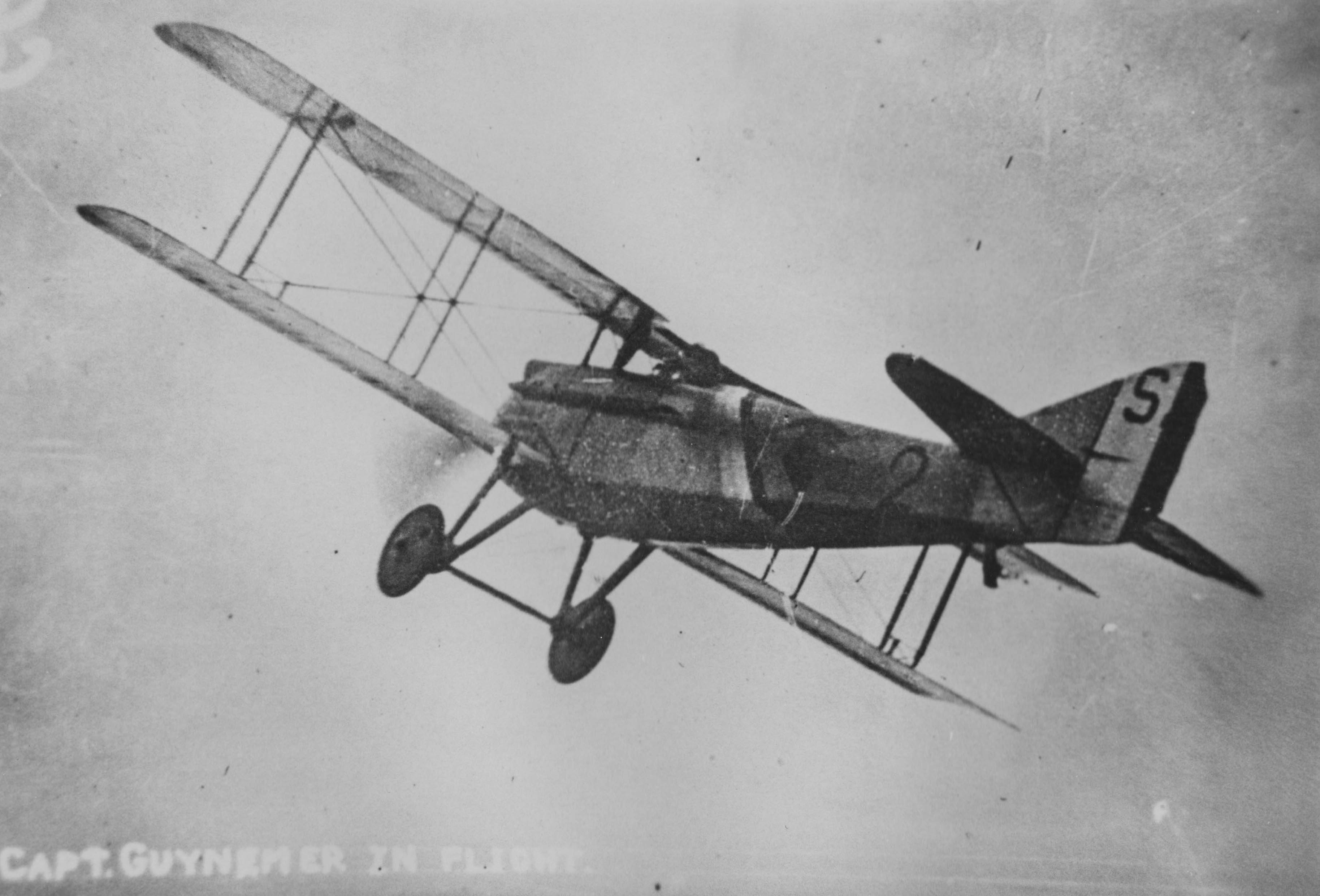
French military aviation came of age at Verdun, and the fighting there produced such fighter legends as Jean Navarre and Charles Guynemer.
But after the Germans took out the Belgian forts at Liege so quickly in 1914, the French Army assumed the day of the massive concrete fort had come and gone. Now, thanks to modern heavy artillery, almost any defensive structure could be pummeled to ruins before any troops had to be sent in to occupy it. As a result of that conclusion, the French stripped the forts around Verdun, sending the garrisons and much of the artillery into the front lines elsewhere on the Western Front.
Nevertheless, the forts remained a source of considerable national pride, something that the Germans were counting on that February. The idea behind the German offensive was not necessarily to capture ground, but rather to force the French Army to defend a region considered vital to France’s national morale. If the vaunted impregnable fortress Verdun could fall, how could the Germans be stopped? So, the Germans counted on the French throwing everything they could spare into the defense of Verdun, and when they did, they would bleed the Gaulic army white with massed artillery bombardments, gas attacks and limited infantry assaults, heavily supported by machine guns and the new flamethrowers just arriving in the front line German units.
That was the rational anyway.
The German offensive began with one of the most intense artillery barrages in human history. The French front lines were almost totally destroyed by the shelling, and the initial waves of German infantry pushed deep into French territory. But as the French Army reacted and threw in reinforcements, the lines gradually hardened again. Repeated French counter-attacks slowed the Germans, but came at such a cost that some divisions lasted only a few days in the battle before they had to be pulled out and reformed. Losses ran over sixty percent in those units, and in others, entire companies were swallowed up in the inferno.
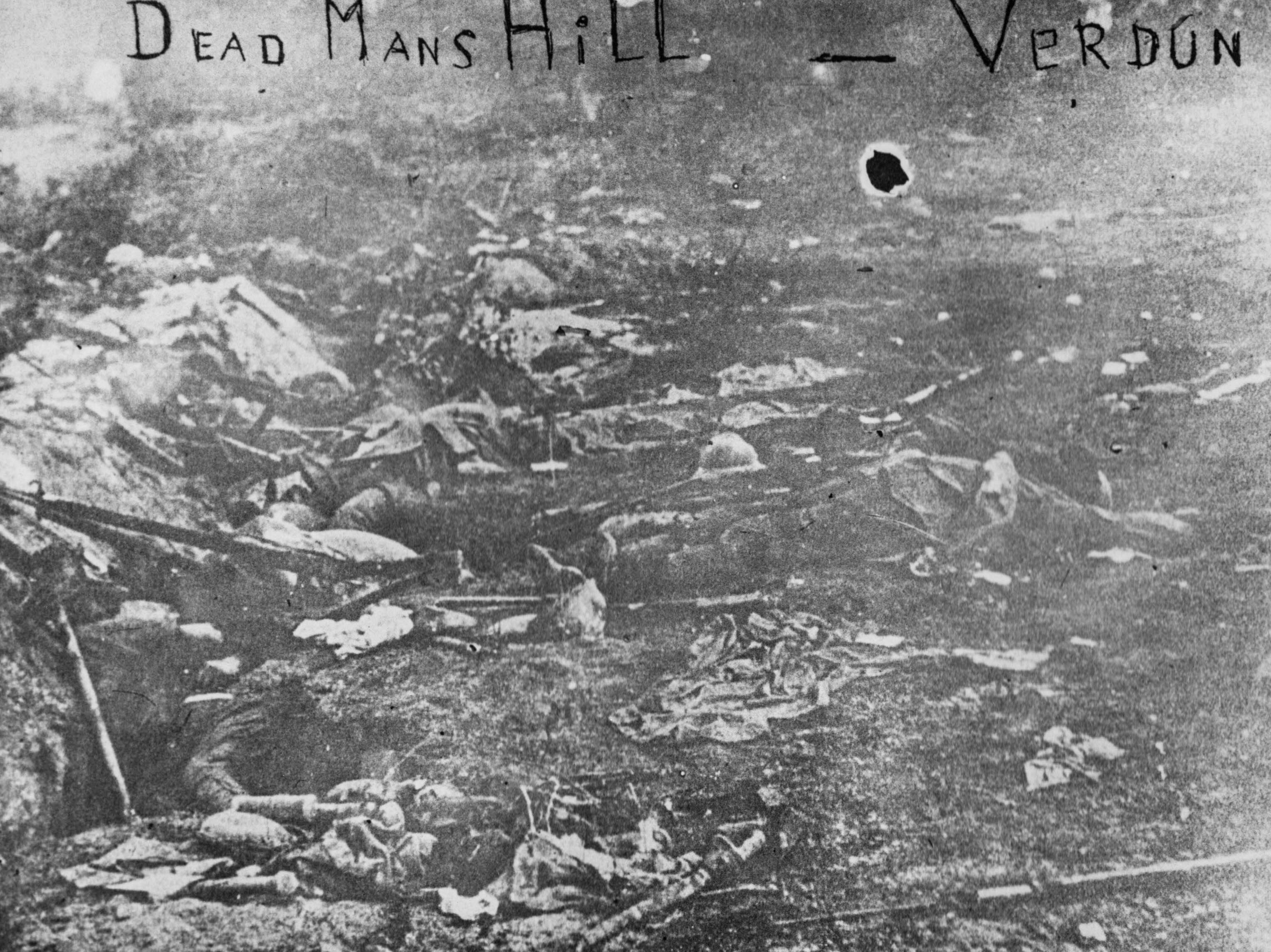
The Morte Homme, a small hill and ridge that was the scene of heavy fighting, became one of the symbolic points of French resistance at Verdun.
The Germans scored a huge propaganda victory when a small group of their soldiers captured the most modern of the Verdun Forts, Douaumont, by a coup de main. The truth was, there was only a tiny French garrison left inside the fort, and once the Germans found a way inside, the place was doomed to fall. But, lesson learned. After that, the French Army resupplied and reinforced the remaining forts.
The offensive continued with both sides throwing fresh troops into the fray. The battle became less about the ground and more about the spirit and resolve of each nation. Both sides and staked their prestige and national pride on the outcome, though ultimately Verdun had much more importance in the French psyche than the German. Ultimately, an offensive designed with one objective: kill as many French soldiers as possible, became a test of national will.
The French committed an entire generation of its young men to the defense of Verdun. Well over half of the French Army passed through the salient during the 1916 campaign, and more than any other WWI battle, it left an indelible mark on France’s soldiers. They fought in mud and water-filled trenches and shell craters, living among the rotting remains of the dead. Scavengers–birds, rats, feral dogs–fed off those remains in No Man’s Land, and veterans later wrote how the corpses splayed between the lines would sometimes twitch and jerk as animals ate them from the inside out.
Battered Douaumont.
The medical logistical system never kept pace with the flow of wounded. Men writhed for hours, sometimes days unattended where they fell as they waited for stretcher bearers to come relieve their suffering. But even then, they faced hours of travel to the nearest aid station, where the wounded were laid out often without protection from the elements as overwhelmed surgeons did what they could. Gas gangrene, infection, pneumonia and shock claimed countless victims. Those who survived were scarred forever by the sights, smells and sounds of those facilities.
As Verdun became a carnival of horrors, the vitality of the French Army was pulverized in its killing grounds. And yet, the French troops continued to fight with near suicidal determination. In July, 1916, the Germans surrounded Fort Vaux, one of the last of the remaining fixed emplacements defending Verdun. For a week, Fort Vaux’s defenders held out against staggering odds. They fought the Germans corridor to corridor in darkened, underground passageways. The Germans used gas, bayonets and grenades to clear the fort gallery by gallery. The dead stacked up, and the French survivors took to drinking their own urine to slake their thirst after the Germans captured Vaux’s water supply. When the fort’s commander, Colonel Raynal, finally surrendered his battered force after a week of furious fighting, the Germans were so taken by his stout defense that they allowed him to carry his sword into captivity.
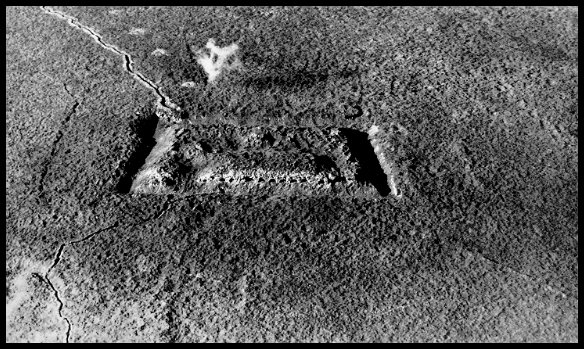
Aerial view of Fort Vaux and the thousands of shell craters that pockmarked the terrain around it.
By late summer, the German offensives had played out, and they could not devote anymore troops to the Verdun Sector as a result of the British offensive along the Somme River. The French mustered their reserves and wrested the initiative from the Germans with a series of bold attacks that recaptured almost all the ground lost earlier in the year. The French had won the Battle of Verdun, but it had cost them the soul of a generation. Men, no matter how motivated, well-trained and patriotic, will always have a breaking point, and the brutal losses and psychological trauma of Verdun pushed the French Army to the breaking point. After a failed offensive in April 1917, much of the French Army mutinied in their trenches. Order was restored by June, thanks to Marshal Petain, but the French Army would never be the same again.
To understand the French Army of World War II, Indo-China and Algeria, one first has to understand the impact Verdun had on the nation and its fighting men. They’d saved the Republic, but mortgaged the future to do it. And the land around Verdun reflected the damage done to the nation. Endless fields of shell craters, one atop the other, still bear silent testimony to the ferocity of the artillery bombardments. The shelling destroyed much of the top soil, and for years little would grow on those battlefields. It took a national reforestation program to change that.
Farmers still encounter human remains. Some are taken to the Ossuary at Verdun, where visitors can see through glass windows the bones of thousands of unknown soldiers–French, German and (later in 1918) American. I was there in 1984 and peered in through the glass. The sight changed my own life forever.
Something like 550,000 French Soldiers are known to have been killed or wounded, or went missing during the Battle of Verdun. The Germans lost at least 430,000. About eight million French males served in the army between 1914-18. Of those, almost 1.4 million were killed, and 4.2 million wounded severely. It has been estimated that 90% of all French men between the ages of 18 and 24 either died during the war, or came home with debilitating physical wounds.
A generation lost to the defense of a nation. America has never known such a complete and devastating sacrifice. Here is to hoping we never will.
If you read one book about World War I, read Alistar Horne’s treatment of Verdun called, The Price of Glory. It is one of the great works of military history. Find it here:
French troops and Maquis fighters, armed with British weapons including a Sten gun and a Bren light machine gun, cover a major intersection in Belfort, France during the battle to liberate the city on November 21, 1944.
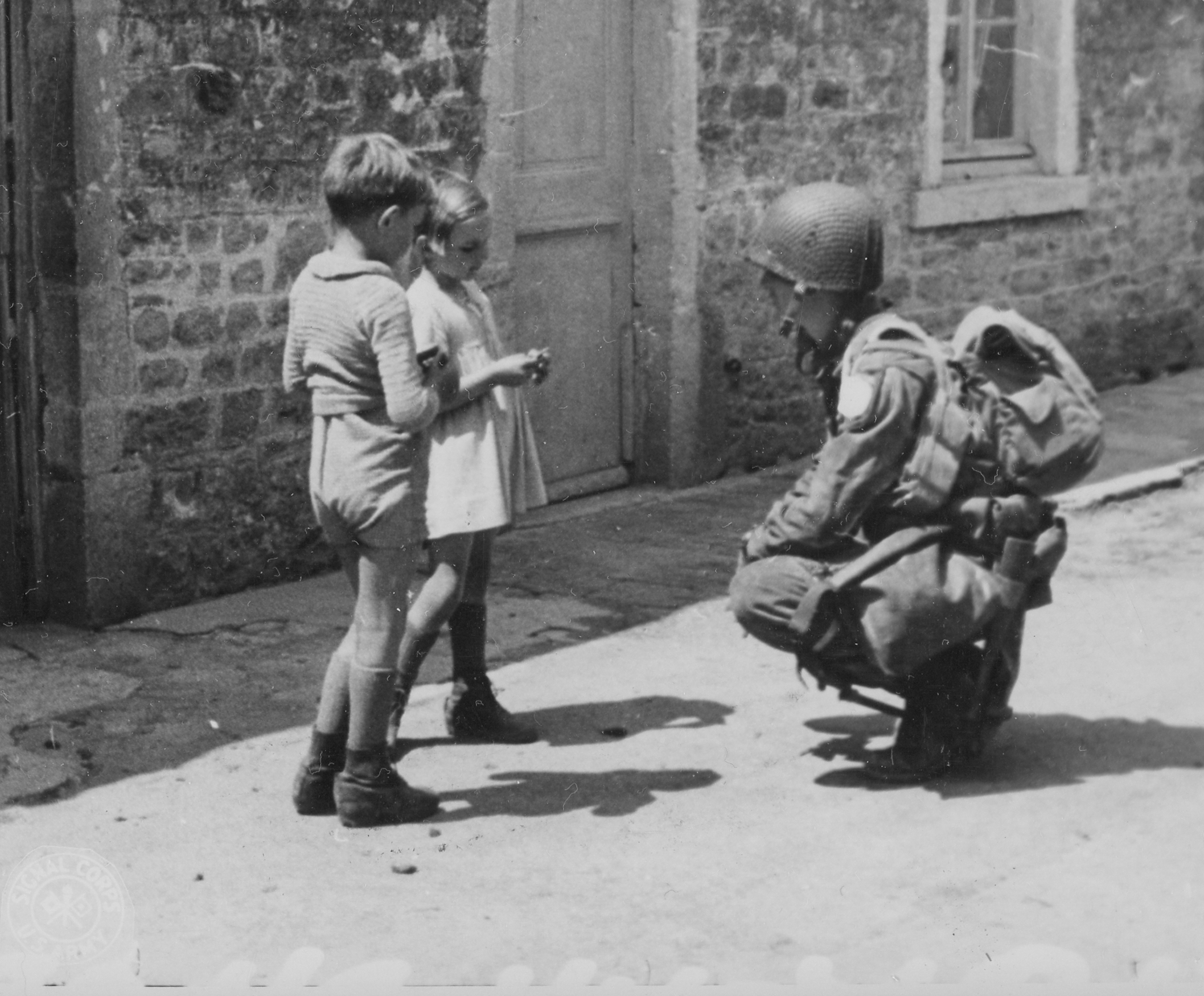
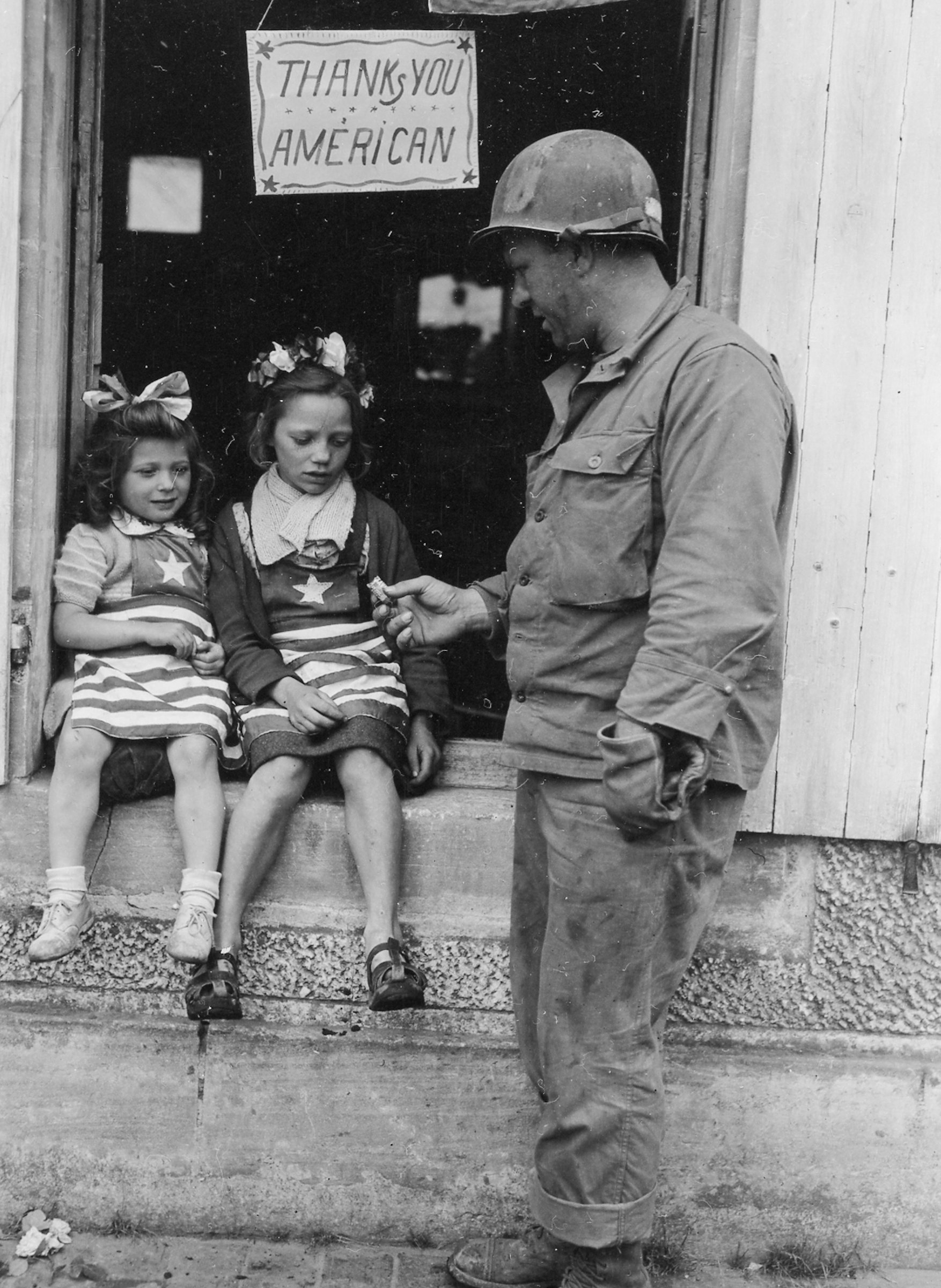
An American paratrooper in Normandy kneels down to chat with two French children. June 8, 1944.
To all my readers and friends in France:
The recent horrific attacks in Paris underscore the nature of the threat we in the West face today. Al Qaida has not been defeated. The forces of Terror continue to deliver barbaric and sanguine blows across the globe–from the streets of Europe to the Syrian desert, to the mountains in Afghanistan. Now, more than ever, the allies of Freedom need to stand together as one.
From the earliest days of the American Revolution, France has been a loyal and trusted ally of the United States. Two hundred years of friendship and mutual dependence on our security have forged a unique bond. We are Brothers and Sisters–a family. Sure there are fractious moments, sure there are disagreements as every family will have, but in the end, our nations have always been there for each other.
The bond between the United States and France has never been just about policy or diplomacy. It is a connection between two peoples, bound together by a common heritage that includes the pursuit of liberty and human rights.
I was in Texas when the march in Paris took place. I wish I could have been there, walking in solidarity with the millions who believed free expression was worth the risk of another mass casualty event.
As I watched leaders from around the world, arm and arm, leading the way through the Paris streets, I felt a profound sense of shame that my own country failed France so thoroughly. Our President should have been there as a symbol of our commitment to France. Nothing can compensate for that error, but do know that Americans stand with you, and we will always stand with you in your most desperate hours. Over the last two hundred years, we have shed too much blood for each other’s freedom to do anything else.
To honor our Alliance, next week’s stories and photographs will be dedicated to moments in our Alliance.
RTO Josh Cooper (right) talks to his platoon leader while an M240 Bravo machine gun team lays down simulated suppressing fire during an exercise at Gowen Field, Idaho in September 2008. Alpha Company, 2nd Battalion, 162nd Infantry, 41st Enhanced Brigade.
During the Initial weeks of Operation Barbarossa, the German Army, and its Allies, discovered the Red Army’s tank battalions included some truly formidable armored fighting vehicles. The heavy KV-1 and KV-2 tanks proved to extremely difficult to knock out with available 37mm and 50mm anti-armor weapons, and in one case a crippled KV-1 and its crew held up a German advance for several days until finally destroyed in a scene similar to the end sequences of the movie “Fury.”
The Russian T-34 proved to be one of the best tanks of the Second World War and saw service in the Korean War, and later on even in Afghanistan during the 79-89 war. When the Germans first encountered the T-34 on the Eastern Front in the summer of 1941, it came as a profound shock. Maneuverable, well-armed with a 76mm gun, and designed with thick, sloping armor, it was virtually impregnable to German anti-armor weapons smaller than the legendary 88mm.
This T-34 was one of the first thrown into battle against the German Army. On the opening day of Barbarossa,elements of Army Group North advanced east of the Njemen River in Lithuania and ran headlong into a T-34 unit. In a fierce action that saw the Germans deploy 88s and 105mm howitzers to put direct fire on the T-34’s, some 70 Russian vehicles were knocked out. This T-34, photographed a few days later on June 25, 1941, was one of them.
The T-34 would go on to play a pivotal role in the Allied victory on the Eastern Front, and variants are still in service throughout the world today.












 The American Warrior