Posts Tagged With: #Pacific War

The Lost, Last Letter

Guadalcanal SBD VMSB-231 4x6

A VMSB-231 SBD over Guadalcanal, late 1942.

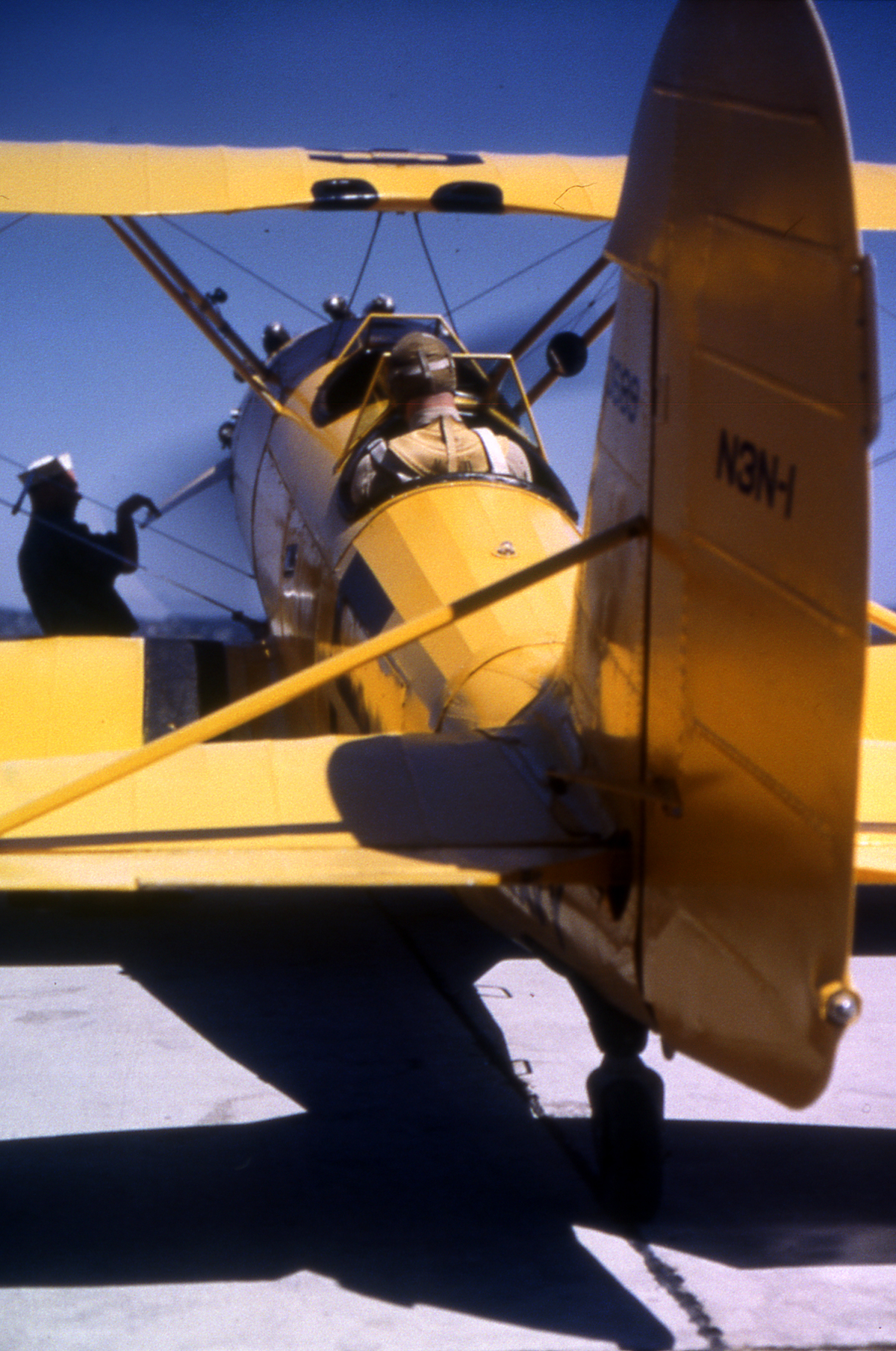
Frank Christen grew up on a Depression-Era farm just outside of tiny Jerseyville, Illinois, graduating from the high school there in 1938 at age 19. He scraped enough together to continue his education at Washington College in St. Louis, then transferred to the University of Texas at Austin. In June 1941, he enlisted in the USNR and was accepting into the flight training program. He learned to fly at Grand Prairie, Texas and graduated the following year from NAS Corpus Christi on May 20, 1942. He was commissioned a 2nd Lieutenant in the Marine Corps and assigned to VMSB-142, a Douglas SBD Dauntless dive bombing squadron.n3n corpus christi color 4x6
While at the University of Texas, Frank had met Ruth Clark of Corning, New York. He and Ruth were married on July 30, 1942 just before he was assigned to NAS Coronado in San Diego.  The couple lived together there in Southern California for a brief few months before Frank shipped out to the South Pacific in early November.

He reached Guadalcanal several weeks later with VMSB-142 while the fighting in the southern and central Solomons still raged fiercely. He twenty-three years old and flung to the farthest reaches of the planet, far from friends and family. Like the others in his squadron, he did his duty to the utmost.

Henderson Field

Guadalcanal.

On December 16, 1942, he was ordered to strike targets around Munda, New Georgia. Four SBD’s took off from Henderson Field, Guadalcanal at 2105 hours. This was Christen’s third combat mission in two days. He’d bombed Munda with his squadron the day before, and attacked a Japanese vessel early that day on the 16th. This was a mixed force of Dauntlesses from both VMSB-132 and VMSB-142.

During the flight through the growing darkness, the formation ran into a rain storm.  Christen and his section leader, Lt. Jackson Simpson, lost the rest of their flight. The other two SBD’s continued on and made a night bombing attack on the Japanese-held airfield at Munda.ijn dd under attack sbd palau 44 300 dpi c

Christen and Simpson discovered a Japanese destroyer in the waters off New Georgia. Christen made the initial run on the destroyer and illuminated it with flares. Fully alerted, the Japanese anti-aircraft crews poured fire up into the night. Simpson rolled in on the ship and scored a direct hit. Christen followed a moment later.

That was the last Simpson saw of the Jerseyville native’s SBD. It vanished in the attack.

Fourteen days later, a War Department telegram arrived at Ruth Clark’s place in Austin and delivered the news that Frank was missing in action. She packed up and headed straight for Frank’s family in Illinois to await further word. Weeks passed. Nothing. At the end of January, she returned to Austin for the next school term.

Months passed without any word. One can only imagine the family’s torment. In August, 1943 Ruth received a letter informing her that Frank had been awarded the Distinguished Flying Cross for his attack on the destroyer that night. After that, there was no further word.

sbds iv 300 dpi cin the fall of 1943, Ruth returned to Illinois and spent time with the Christens. Then she went home to Corning to see her own parents. Waiting for her in Texas was a letter from a stranger with an overseas APO address. The day she returned to Austin, she tore it open and read the words every devoted wife longed to read. The letter came from an American serviceman somewhere out in the Pacific who had tuned into a Japanese short wave radio broadcast. The announcer was reading in English the names of Americans captured in the South Pacific. Included in that list was Frank Christen and the Japanese even read out Ruth’s address during the broadcast.  Ruth called Frank’s family in Illinois and related the incredible news.

Three weeks later, the War Department declared him killed in action.

Frank Christen never returned home. His body was never located, and his fate was never learned. There is a plaque honoring him in the MIA section of the American cemetery in Manila, PI.
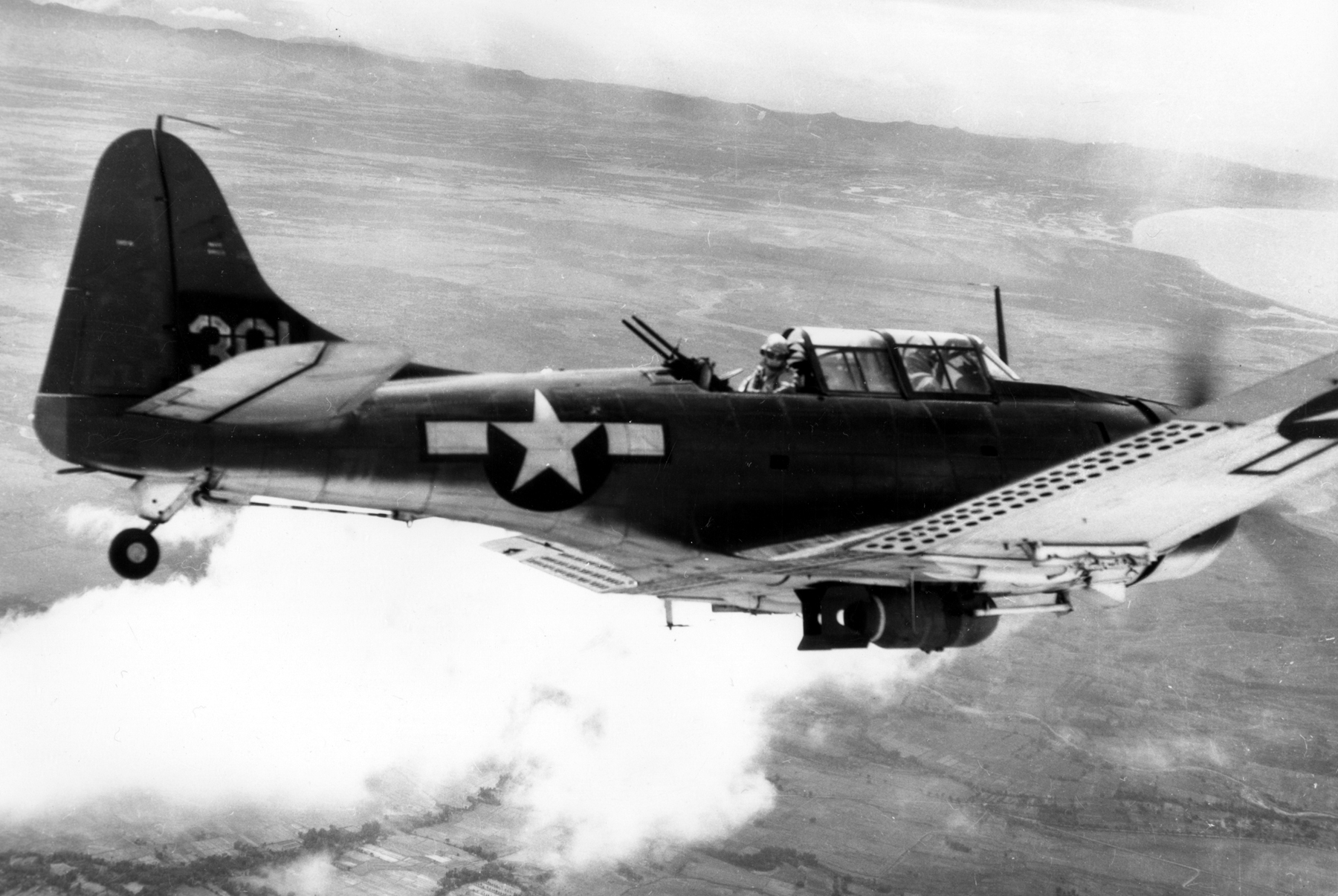
henderson field series sbd over guadalcanal 4x6

An SBD over Guadalcanal late 1942.


Today, I was sitting in a coffee shop in Dallas, Oregon and reading through a pile of documents in hopes of finding another story for this website. I tumbled across a translated Japanese report captured in Manchuria in May 1943. It included Frank Christen’s interrogation report. With considerable help from my Marine Corps historian friend, Mark Flowers, we identified Frank (his name was not included in the document, just his date of birth and educational background) and we were able to find out more about his life and last mission.

He’d been shot down during his bomb run over the Japanese destroyer. His SBD crashed into the water and his tail gunner, PFC Glenn Shattuck from Granby, CT, was killed. Though wounded by anti-aircraft shrapnel, Frank got out of the aircraft and discovered the plane’s life raft floating nearby. He inflated it, got in and began rowing toward the nearest island. It was 2300 hours, December 16, 1942.

sbds cent sol bulldog sqn 300 dpi c 8x10

Marine Dauntlesses over the Central Solomons.

He paddled ashore and looked for help. Calling out in the night, he failed to find any locals. Concluding that the island was uninhabited, he decided to keep moving.

He set out to sea again in his raft, intending to make it to another nearby island. For 18 hours he bobbed in the waves, paddling as his waning strength allowed. Finally, he made it on the afternoon of December 18th. He came ashore and found some coconuts to eat. Not long after, two Japanese soldiers walked out of the jungle and spotted him. They ordered him to surrender, but he bolted and ran.

A search ensued. Later that day, the Japanese found Frank high in a large tree next to the island’s jetty.

He surrendered and was taken to Rabaul, New Britain and interrogated. Christen was asked about his family–he had five brothers and two sisters–where he attended school, how he joined the Marine Corps and even what he thought of African-American military personnel.

The interrogation was thorough and probably brutal. He was asked about the number of aircraft at Guadalcanal, the performance and bomb loads of his SBD Dauntless. He was asked about the resentment between Marines and the Army, and about the morale of the forces on Guadalcanal in general. He answered the questions.

At one point, his captors wanted to know what Americans thought of the Japanese. He answered honestly: that he and his comrades had little understand or knowledge of Japan before the war. After Pearl Harbor, they had no doubt the United States would prevail. But then, in the South Pacific, they discovered the true strength of the Japanese. He felt that America had completely underestimated the power and capabilities of the Japanese Navy.

5th af b25 raid rabaul mar 5 44 4x6

Rabaul under 5th Air Force B-25 attack, March 1944. Most of the POW’s at Rabaul did not survive the war.

Toward the end of the interrogation, Frank was asked if he’d seen any Japanese prisoners of war himself while on Guadalcanal. He told them that there were a few kept near Lunga Point. One Japanese soldier was captured after he’d been badly wounded. The Marines had taken him to an aid station, where a doctor had been working on him. The soldier had not been properly searched, and while on the table, he pulled out a grenade and detonated it, killing himself and the doctor trying to tend to his wound. The interrogation report added, “In general as soon as a Japanese soldier is captured, he commits suicide. For this reason, it seems that there are only a few PW’s.”

After the pulled all the information they could out of Frank Christen, he asked if he could write a letter home to his wife. His captors agreed and promised him they would deliver it.

It never reached Ruth.

I read the brief letter today seventy-three years after this scared, traumatized young American wrote it and I wondered if there is still anyone out there who loved him and would want to see it. So, in case there is, here it is.  The last letter home of an American doomed to die as a prisoner of war somewhere in the South Pacific.

To My Beloved Wife,

I am writing you a short note to let you know that I am a Prisoner of War. They (The Japanese Army) are hoping that this letter will be able to reach you, and I of course am hoping this reaches you. Please let my mother know as soon as possible. You can send me packages through the International Red Cross.

They (The Japanese Army) are very kind to me. You will undoubtedly hear many things, but don’t ever believe them. I was injured by shrapnel but it was mostly a case of fright.

I must close now. I love you. I will be able to return when this war is over. My love for you will never change.

Frank


sbds ii 300 dpi c

Please forward this story far and wide. Share it on as many forums and sites you can think of so, if Ruth is still alive, we can get her Frank’s final words.


Thank you,


John R Bruning


Categories: The Missing, World War II in the Pacific | Tags: , , , , , , , , , , , , , , , , , , , , , , , , , , , , | 17 Comments

The Toy Salesman

JS 7 Chinese Troops

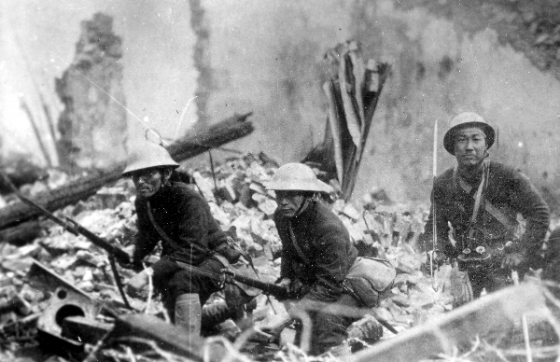
Chinese troops in action against the Japanese Army. The fighting had raged in China for almost five years when Prisoner 529 joined his cavalry brigade there.

On July 7, 1944, an emaciated, fever-wracked twenty-three year old Japanese aviator crept into an Allied camp near Maffin, New Guinea in search of food.  He’d been part of about three thousand survivors of the 6th Flying Division, based at Hollandia who had tried to escape the Allied cordon through a torturous overland retreat to Sarmi. For most who set out on this desperate bid for survival, the trek became a death march. Disease, starvation and hostile New Guineans thinned the ranks, and the weak were left behind.

Though his name has been lost to history–we’ll call him Prisoner #529, the five foot four native of Okayama-Ken was one of the lucky few who fell into American hands and survived that crucible in the jungle.

Grateful for food and decent treatment, he spoke freely to the Japanese-Americans who interrogated him after his capture. 529 had been fortunate to have finished twelve years of education, the last three at a commercial school that proved to be a stepping-stone to his first career. He became a wholesale toy salesman until he was conscripted into the Japanese Army at age 20. AS he was leaving to report for duty, his mother wished him farewell with one final order: at all costs, do not allow yourself to be captured.

chinese troops314

Chinese troops man a .30 caliber machine gun.

He was called up at Osaka, where with several hundred other conscripts, he was put on a ship and sent to Korea. From there, they were put on trains to northern China and assigned to the Sakuma Cavalry school for basic training. The cavalry was considered one of the elite arms of the Japanese Army, and Prisoner #529’s intelligence and education probably earned him that coveted slot.

It was hard transition going from the toy business to the cavalry, to say the least. The training was brutal and very intense. He was beaten almost every day, and once his jaw was so badly injured he could barely move it for a week. Another time, three of his squad mates were caught violating rules and the entire squad was assembled and forced to beat each other. Prisoner #529 was slapped by officers, hammered across the back with a wooden cane, whipped with belts and beaten with shoes. Most of the time, 529 felt the punishments were wanton, cruel and unjust. He and his fellow recruits were beaten whether they had did anything wrong or not. Sometimes, infractions were fabricated to justify otherwise inexcusable beatings.

After he told his interrogators about the physical abuse, he added that at times it did work. After all, it “knocked the sloppiness” of the men.

Later that spring, he was assigned to the 1st Cavalry Brigade’s Koike Regiment. One day, #529 and twenty-four other fresh-faced replacements reported for bayonet training near Kitoku, China. When they assembled, five Chinese prisoners were led out to the training ground. Hands bound and blindfolded, their Japanese guards gave them each a drink of water and a cigarette.

Then Colonel Koike ordered the new recruits to bayonet the prisoners.

bayonetting prisoners

Bayonet training with live Chinese POW’s was not uncommon during the war. Some twelve million Chinese were killed between 1937-45.

529 had never killed before. He watched as his fellow replacements took turns bayoneting the Chinese prisoners and was deeply moved by the stoic calm of their victims. They didn’t scream, and remained steady and courageous until the end. And the end was not always very fast. Those who survived the initial bayonetings were stabbed repeatedly as each replacement took his turn. The Toy Salesman took his turn with the bayonet, too. Later, he told his interrogators that no Japanese Soldier could have match the quiet resolve of the five Chinese prisoners killed that day.

That moment in Kitoku was a turning point for 529. His quiet life back home spent trying to bring a little happiness into the lives of children was forever behind him. In the months ahead, he watched as his unit and others beheaded and bayoneted Chinese prisoners and those suspected of anti-Japanese activities. Such episodes were common.

In January 1943, he transferred out of the cavalry brigade and joined the 41st Division at Soken (still in Northern China). He remained there for only a short time before being ordered to New Guinea.  On May 1, 1943, he reached Wewak in the Zuisho Maru (which would be torpedoed and sunk a few months later off the Borneo coast by the American submarine Ray).

ki48 clark field 300 dpi c

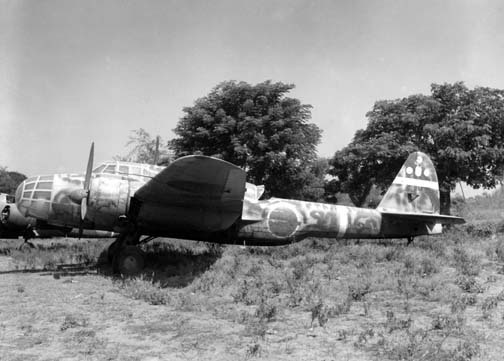
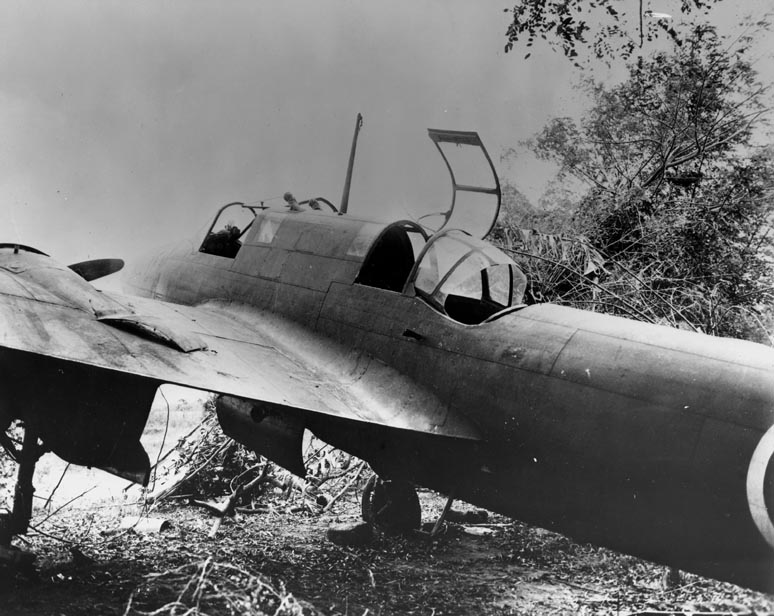
A Kawasaki Ki-48 “Lilly” found at Clark Field, Philippines, spring 1945.

From the cavalry to the infantry and now in New Guinea, Prisoner 529 became an aerial gunner. He went through a crash, ten week course at Hollandia before joined the 208th Sentai, a Kawasaki Ki-48 “Lilly” medium bomber regiment.

It was at Hollandia he came to realize the hopelessness of Japan’s situation in New Guinea. He’d gone to China, an eager and willing recruit. who viewed the war as a titanic clash between races. He was anxious to prove himself and serve his country in this epochal moment in history. Even the atrocities to which he bore witness and participated in during his time in China did not diminish that sentiment. When he received orders to the Southwest Pacific Area, he looked forward to carrying his nation’s flag to new, exciting and distant places.

ki48 nose filipino inside clark field551 5x7

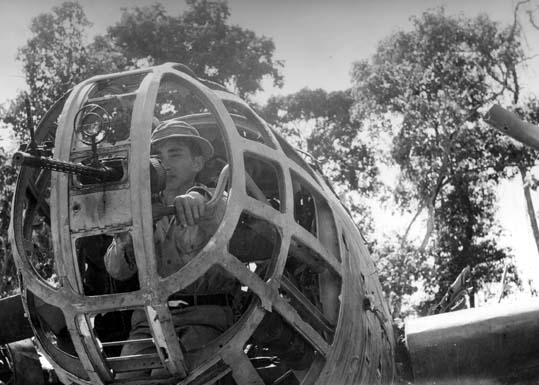
The nose gun mount in a Ki-48. Prisoner 529 told his interrogator that the mount was so restrictive that it only had a 45 degree field of fire.

In New Guinea, the constant air attacks, the lack of supplies and rare mail deliveries drove that eagerness out of him. The war devolved into a bitter struggle for survival on an alien island while increasingly surrounded by Allied forces. Disease became an ever present enemy. The men cleared brush from around their quarters in hopes of deterring insects and slept under mosquito nets at night. During Allied air raids, they would take to their bomb shelters wearing nets over their heads and gloves. To stave off malaria, the men took daily doses of both quinine and atebrin. Despite their best efforts, the men were plagued by tropical infections and fungus. By early 1944, almost everyone in 529’s squadron suffered from ringworm and other skin diseases.

529’s squadron included fifteen Ki-48 Lilly’s, fifteen pilots and radio operators, sixty gunners and about a hundred and twenty ground crewmen. The regiment had forty planes total, half of which were destroyed in a series of Allied raids in the spring of 1944 at both Wewak and Hollandia.

ki48 nose filipino inside clark field552 8x10

The dorsal gunner’s position in a Ki-48.

While other Ki-48 units had new models with heavier armament, the 208th’s planes were equipped with only five machine guns–one 7.9mm in the nose, another in the ventral position, a pair of 7.7mm waist guns and a single 13mm for the dorsal gunner. That latter position was a tricky one, and the gunners had gone through extra training for it since it was very easy to accidentally shoot the tail off. Prisoner 529 had been told cautionary tales of dorsal gunners who sawed their vertical fins and rudders off in their eagerness to hit an incoming enemy fighter. The result was usually fatal.

During daylight missions, the 208th flew with five men in each aircraft: a pilot (who also doubled as navigator), a radio operator, waist gunner, nose and dorsal gunners. The radioman also manned the ventral gun. At night, they left the waist gunner on the airfield and flew with four. They had no trained bombardiers ala the USAAF. Usually, either the pilot or the nose gunner would toggle the aircraft’s six 50 kg bombs that composed its normal load out. Exactly who did that was left to the individual crews to decide, but usually the senior or more experienced man got the job.

p39 shoots down a ki48 lilly gsap 4x6

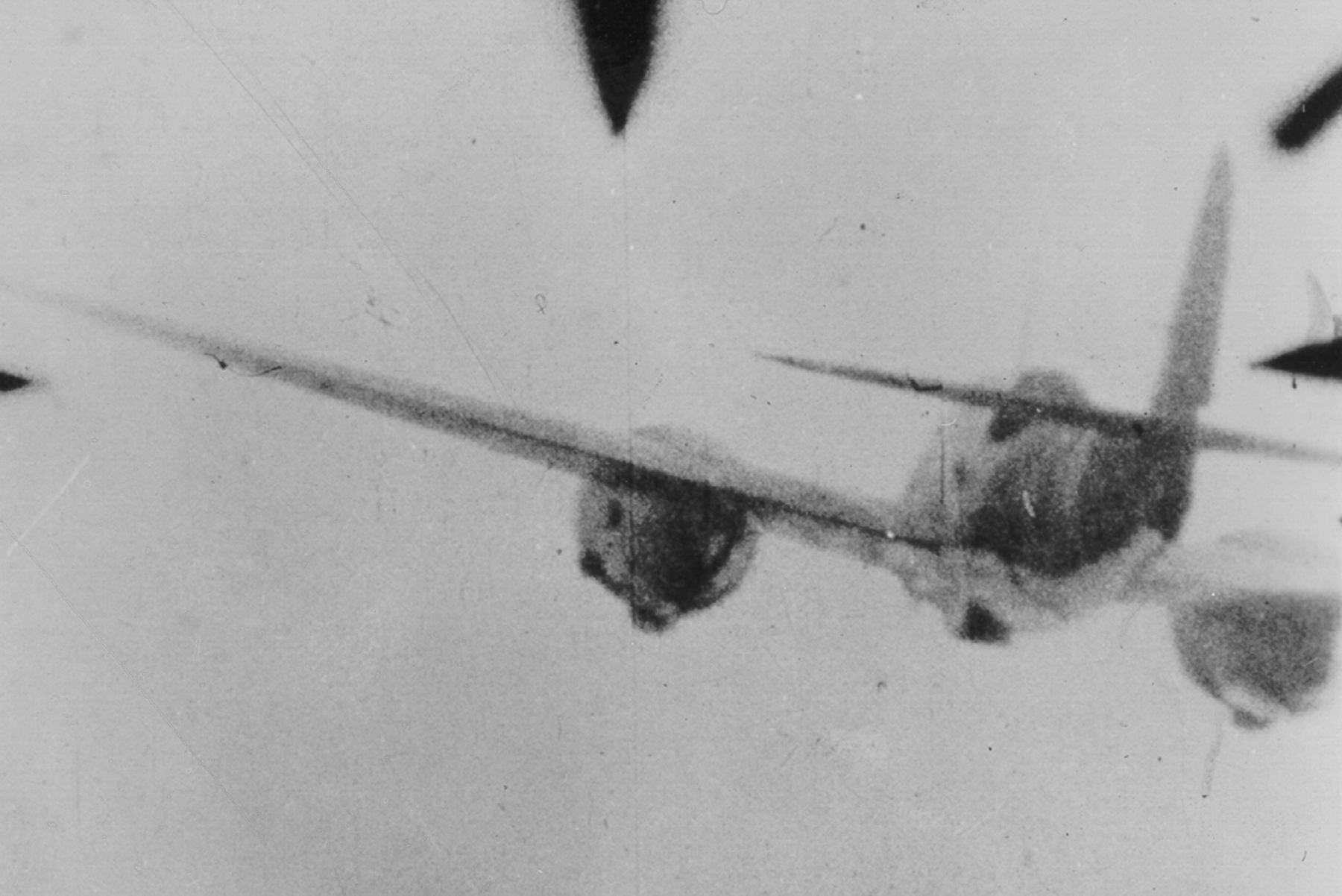
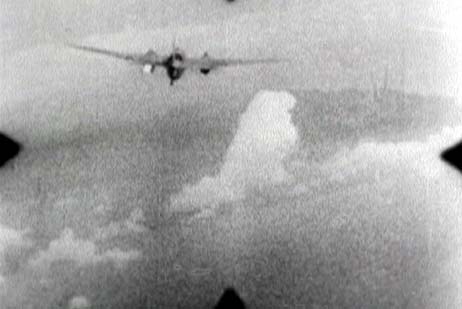
A 5th Air Force P-39’s gun camera film records the final moments of a KI-48. The radio operator’s ventral gun position can be seen under the fuselage.

To increase the Lilly’s range, the 208th Sentai’s bombers had an additional fuel tank mounted inside the fuselage in front of the radio operator’s seat. Three feet long, three feet high and about twenty inches wide, it was not armored and not self-sealing. This meant a single bullet strike could have ignited the tank, bathing the radio operator in flaming gasoline.

On missions, the 208th carried out most of its attacks at between ten and twelve thousand feet. On a few knuckle-biting ones, however, the crews used their Ki-48’s like dive bombers, nosing over and making steep angle descents to three thousand feet before pickling their loads.

Mission briefings were far more informal than in the USAAF. Usually, the squadron commander would select the aircraft and crews the night before the attack. In the morning, just before take-off, the aviators would be given the target, the approach to it and any special instructions specific to the mission. When they returned, each plane captain would give an oral report to the squadron commander.

Intelligence on the Allies was minimal and very restricted. Prisoner #529 rarely even saw a map while he was in New Guinea, as those were reserved for the officers. Most of the time, they did not even know what their targets looked like.

5th af raid on lilly bombers hollandia 44 4x6

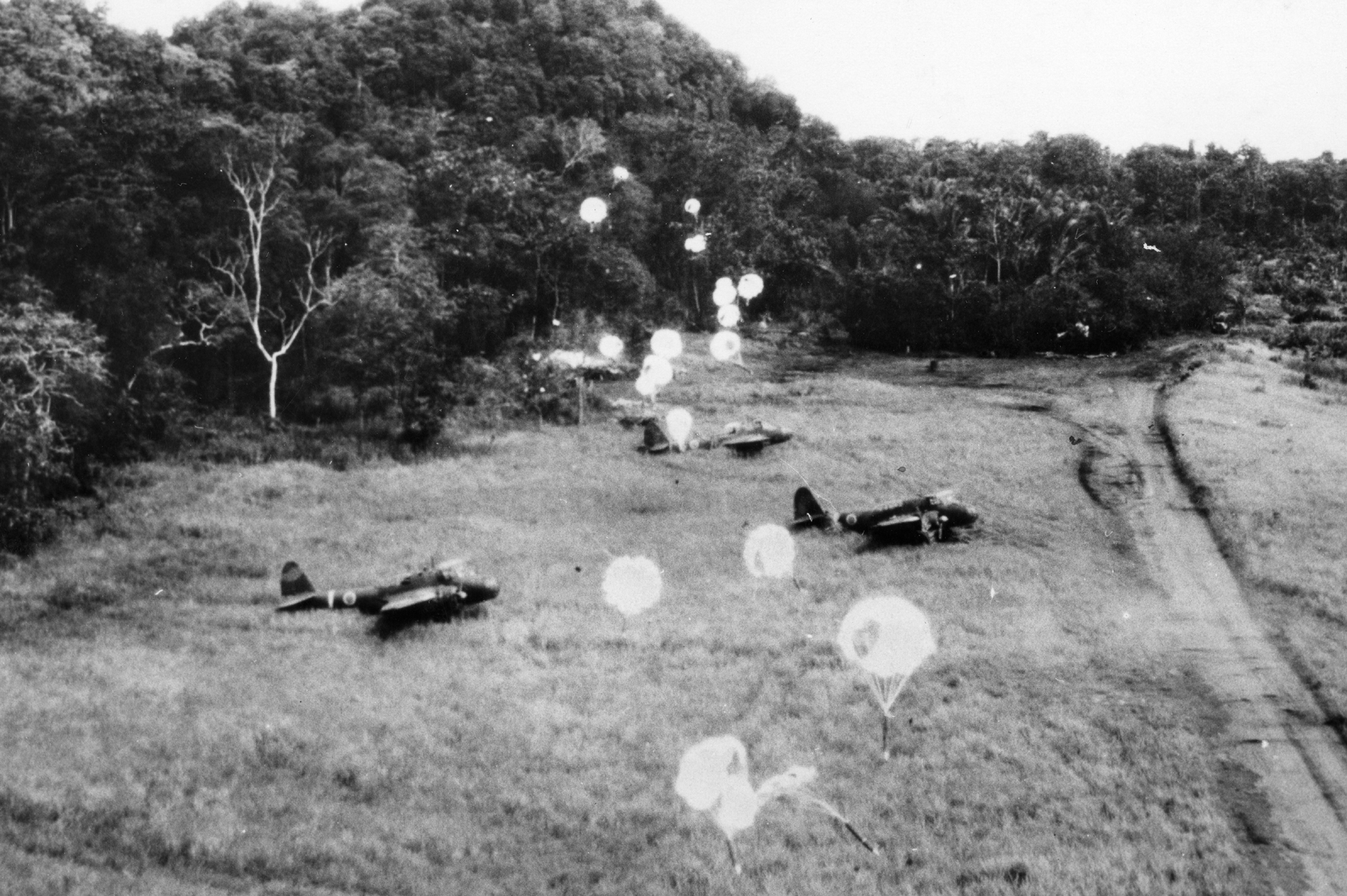
Ki-48’s under parafrag attack by 5th Air Force B-25’s. Hollandia, spring 1944.

To #529, defeat looked inevitable. Yet, he also believed that no matter what followed, the Japanese people would fight to the last man, and woman.

During the spring of 1944, Allied air attacks repeatedly struck the 208th airfields at both Hollandia and Wewak. At Hollandia, the raids seemed particularly accurate, as if the Allies knew the exact location of every building, revetment and aircraft. (Thanks to the 5th Air Force’s reconnaissance efforts, they did). By April, every facility on the strip at Hollandia had been bombed to splinters, though the 208th did not lose many men in these attacks thanks to the many shelters and slit trenches constructed for them.

The B-25 Mitchell was particularly feared.  Racing in at low altitude with their nose guns blazing, dropping parafrags in their wake, these American bombers destroyed fuel dumps, blew up grounded aircraft, wiped out anti-aircraft positions and terrified all those exposed to their strafing. With eight to twelve .50 caliber machine guns in the nose of each B-25, the gunships were devastating weapons.

sallies at hollandia

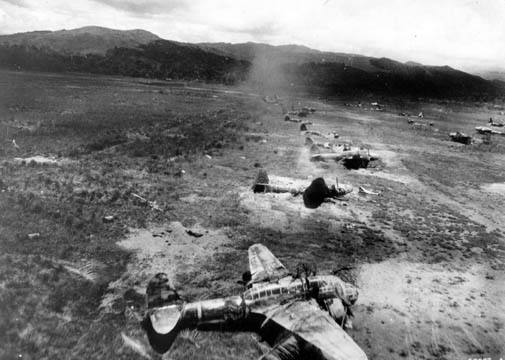
Another Ki-48, along with the wrecks of Ki-21 “Sally” bombers at Hollandia.

The 5th Air Force’s B-24’s were also greatly feared. Though they made their attacks from higher altitudes, their accuracy astonished the Japanese. The 208th concluded that the Liberators had to have had bomb sights far superior to what Japan had produced.

In April 1944, the Allies launched a surprise amphibious invasion at Hollandia. The  Oregon and Washington National Guard division, the 41st, quickly stormed ashore and secured the airfields there. There were few Japanese combat troops in the area, and Prisoner 529 fled into the jungle with the rest of his unit when the landings began.

Chased by American patrols, without food or good weapons or supplies of any kind, the three thousand survivors from 529’s air division attempted to make it to Sarmi, a small Japanese outpost on the coast, some one hundred fifty miles west of Hollandia. For months, the survivors plodded through the jungle, only to discover the Americans had outflanked them again at Wakde and Maffin Bay. The altogether, there were probably about twenty thousand Japanese on this trek for survival, including the remains of the 224th Infantry Regiment.

In mid-June, a battle raged for almost two weeks around a six thousand foot tall mountain overlooking Maffin Bay. Known as the Battle of Lone Tree Hill, the Japanese lost over a thousand men in direct combat with the Americans—and at least another eleven thousand to starvation. Afterwards, the Japanese retreating from Hollandia had little hope left. With Americans behind them, the ocean to their right flank, the inhospitable mountains on their left, they’d come through the jungle only to find the path ahead firmly in American hands.

5th af raid on hollandia april 44 4x6

The 5th Air Force raids on Wewak and Hollandia between August 1943 and the spring of 1944 broke the back of the Japanese Army Air Force. Most of its units in the SWPA were completely wiped out, with few of the air or ground crews escaping to fight another day.

The survivors scattered, breaking into small groups to forage for food and try to find some friendly garrison to join. Most died of disease or starvation. Some resorted to cannibalism, preying on other Japanese or on local New Guinea natives.

Prisoner #529 remained in the Maffin Bay area after Lone Tree Hill ended, hoping to steal food from an American encampment. Instead, he was caught and captured, a source of utter humiliation to him. He felt he’d let his mother down, and that if he were to ever return to Japan, he would be court-martialed for allowing himself to become a prisoner. To his surprise, he found Americans to be jovial and mostly friendly toward him. In training, he had been told the Americans would kill him if he ever surrendered. Instead, he found them “outgoing, liberal and happy.”

After reconciling himself with his situation, his sense of humiliation at his capture gradually drained away. He began to dream of life post-war, and he hoped that he could settle in Australia and become a farmer.

Of the 250,000 Japanese troops, aviators and sailors sent to New Guinea during the war, less than 15,000 survived the war and returned to Japan. In 1949, eight Japanese hold-outs were discovered living in a village a hundred miles from Madang, New Guinea. They surrendered and returned to Japan in February 1950, possibly the last survivors from the New Guinea campaign to do so.


Categories: America's Opponents; The View from the Other Side, World War II in the Pacific | Tags: , , , , , , , , , , , , , , , | 7 Comments

The Mysterious Major Stevenot

Stevenot (at right) in 1917 with the son of the first Philippine President.

On Sunday December 7, 1941, a dapper, fiftysomething American businessman climbed into Philippine Air Lines’ only Beech Staggerwing for an unusual charter flight from Manila’s Nieslon Field to a remote jungle airstrip in southeastern Luzon.  Joseph Stevenot was a legend in the Philippines by this time. Born in 1888, he played a pioneering role in the development of aviation in the Philippines just after the Great War. He’d served in the National Guard and ran the Army’s aviation section on Luzon. Later, he became Curtiss’ tech rep in the Far East and established a flying school under the company’s auspices. He and one other American trained the first Filipino military aviators, flew the first aircraft into Cebu (it was a mail run) and pioneered many other aspects of aviation in the Philippines.

wsu_tms408.9.factory.5

The box the PAL Staggerwing came in. It had been Andres Sorianos’ private aircraft through the 1930’s, and Paul Gunn had come out to Manila to be his personal pilot in 1939. Later, Sorianos and his business partners established Philippine Air Lines, and Paul Gunn was hired to be its operations manager.

In the 1920’s, he helped consolidate the many different telephone companies in the Philippines into one corporation, and he became the vice president of operations for Philippine Long Distance Telephone and Telegraph (PLTD). He made many friends in high places, and his family’s connections back in California also played a role in his many successful business ventures, including a mine operation company he started in the 1930’s. He hailed from one of the wealthiest families of the Sunshine State, where one of his brothers was perhaps the most successful hotel owner of his era and another was a senior executive with Bank of America.

He was known as a bon vivant, charming and charismatic. He moved easily through Manila’s high society, where his comings and goings were reported by the local press. In 1936, he was one of seven men who officially established the Boy Scouts of the Philippines, and he took an interest in scouting through the next five years.

PAL

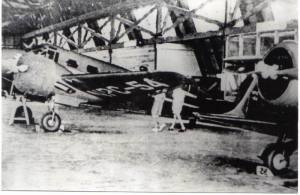
The PAL hangar at Nielson Field, the Staggerwing at right.

In July 1941, Stevenot was back in Washington D.C., and he met with Secretary of War Henry Stimson to urge him to build a closer relationship with the commanders in the Philippines. He advocated for a higher defense budget for the islands as well on other occasions.

Through all his entrepreneurial efforts, he remained an Army reservist. He’d been a major for almost twenty years as he built out his life in Manila.

In the fall of 1941, Stevenot and PLTD played a key role in the development of the USAAF’s air defenses in the Philippines. Radar sets had just started arriving in the the islands, but it would be months before radar coverage would be anywhere near adequate. To spot incoming Japanese aircraft, a broad network of aerial observers was established, similar to what the British had during the Battle of Britain in 1940. These posts were scattered all over Luzon and manned mainly by Filipinos. Stevenot oversaw the construction of the phone lines that tied all this vital network into the air plotting center that had just been built at Nielson Field that fall.

On December 7th, Stevenot flew in the PAL Beech to a tiny jungle airstrip right on the water at Paracale, a tiny mining community a hundred and twenty miles southeast of Manila. Paul “P.I.” Gunn piloted the Staggerwing that day right into a raging storm that had turned the Paracale area into a sea of mud. When they touched down there, the Beech was damaged beyond local repair. Parts were later brought out to it, the plane repaired and flown back to Manila.

The next morning, Monday December 8, 1941, Paul Gunn learned of the attack on Pearl Harbor and made an epic trek back to Manila by boat, train and bus in order to be with his family. But Stevenot stayed behind at Paracale for almost a week.

What was the sixtysomething businessman doing out there on the coast that was so important Paul Gunn had to fly him through a near-monsoon to get him there?macarthur in the philippines just before pearl harbor867 8x10

As I’ve been writing the initial chapters of Indestructible, my biography of Paul “Pappy” Gunn, Stevenot’s trip has both fascinated and  frustrated me. His letters archived at the University of the Pacific in Stockton, CA., make no reference to that trip. He just wrote his family that he was doing interesting stuff that he couldn’t talk about.

There were a series of gold mines at Paracale that I thought may have been the reason for the trip out there. The PAL Beech made weekly runs to the strip there to carry out about 125 lbs of gold per flight, but making that trip on a Sunday in terrible weather seemed unlikely . Perhaps Stevenot had a crisis he needed to handle at one of the mines his company operated? Nope. I tracked down the ownership and operating companies of those mines and discovered that none of them were run or owned by Stevenot’s corporation. His mining operations were all further south.

Bataan 1942783Then I made a startling discovery. The USAAF had sent a detachment from an early warning company out to Paracale, by ship to establish two radar sites in the area. One was supposed to be a permanent facility using an SCR-271 radar that had arrived in the Philippines that October. The other was a mobile set similar to the one seen in the movie Tora Tora Tora.
The men in that detachment were unhappy campers. When they reached Paracale, there were no facilities of any kind for them. They’d basically been thrown out on the edge of nowhere without any logistical support, or even a place to stay. The NCO’s were able to find a partially empty warehouse, and the men ended up calling that home for the next several weeks. Meanwhile, the det commander, a brilliant electronics specialist named Lt. Jack Rogers, bunked down in one of the mining company’s club houses. That was relative luxury compared to what the men were dealing with, and that caused a lot of internal rancor that lingered for decades.

Stevenot was not only a telephone and telegraph expert, but he’d overseen the construction of teletype networks and radio telephone facilities all over the Philippines. He’d set up the first trans-Pacific phone line to the the United States, and in the early 30’s he’d made headlines when he and eleven of his  family members carried on a party line phone conversation from all over California and Manila.

In short, Stevenot was an expert in modern communication systems.

Rogers’ air warning det had taken the mobile radar set, an SCR-270, and dragged it up the side of steep mountain overlooking the water outside of Paracale. They’d set it up and got it running on December 6th, but only Rogers knew anything about how to use it. The men were so untrained that later they missed the signature of a B-17 coming over them en route to Legaspi. Only when it buzzed right over their heads did they learn of its presence in their airspace. They’d also had no time to calibrate the fussy electronics, which made it virtually useless even with operators who knew how to make it work.SCR-270-NavalPostGrad-

There was no phone lines tying the mobile site to the plotting center at Nielson. All communication from Paracale to their chain of command back around Manila was conducted by radio, which problematical thanks to the rugged mountains in the area.

The SCR-271 set was supposed to be the basis of a permanent air warning site, but it had not been uncrated by December 8th when the Japanese attacks began. But, all the sites were supposed to be tied into Nielson via the same sort of phone adn teletype network the observer stations and other bases used.

Paracale did have phone service, so Stevenot was probably out there on December 7th to check out the new det and figure out ways to get better commo to their mountainous post.

Of course, it was too little, too late. The Japanese bombed Pearl Harbor that Monday Philippines time, and by lunch, Clark Field lay under a towering cloud of smoke and flames. Stevenot stayed at Paracale and even reported (by phone) sighting a Japanese invasion force off shore on December 13th.

Lt. Rogers’ det was ordered back to Manila after the Japanese landed in Southern Luzon. Much of the equipment was lost–abandoned or blown up as the Japanese approached, and several members of the det were either killed in action or were separated from their brothers and ended up fighting on as guerrillas. The rest made it back to Manila in time to retreat into Bataan. Those who survived the next four months endured the Death March, captivity and the Hell Ships. bataan death march326

Stevenot returned to MacArthur’s headquarters and retreated to Corregidor with the general’s staff at the end of December. He arrived on the Rock with a big box labeled “Signal Corps Tubes.” Actually, the box was full of good hooch, which General Charles Willoughby never forgot. In his post-war memoirs, Willoughby wrote about Stevenot busting out shots of his good stuff whenever morale was down or the FilAmerican Army had suffered another bad day.

Meanwhile, Stevenot kept a direct line open from the Manila switchboard to the yacht basin on the Rock. He would go down there and talk to his fearless employee, a female operator, who used the line as a way to eavesdrop on Japanese military conversations. After taking Manila, the senior Japanese officers used the phone system like anyone else, and those conversations yielded a gold mine of intelligence until February 1942. By then, word of how the Japanese were treating the local Filipino population had reached MacArthur’s staff, and Stevenot decided he couldn’t keep endangering his employee. He’d learned that a niece of his in Manila had been seized and tortured by the Japanese in an effort to get her to reveal Stevenot’s location, and that might have contributed to his caution in this case.

Bataan us troops surrendered 4x6Stevenot remained on the Rock until almost the very end. But after MacArthur made it to Australia, he personally ordered Stevenot out on one of the last submarines to reach Manila Bay. He was evacuated just before the Japanese landed on Corregidor in May.
He served through 1942 and the spring of 1943 throughout the SWPA, never revealing to his family what role he was playing on behalf of MacArthur’s GHQ. He was promoted to LTC then full bird colonel. In June 1943, he died in a plane crash in the New Hebrides Islands. MacArthur wrote a personal letter of condolence to his widow.

Despite searching through the GHQ records at the MacArthur Memorial, I’ve been unable to determine exactly what Colonel Joseph Stevenot was doing for the U.S. Army in 1941-43. Lists of officers and their official positions do not include him. Yet, the Japanese knew who he was and were anxious to find him. Whether it was for his role as a civilian senior executive, or for his military role remains a mystery, as does so much of his last two years of life. Whatever the case, MacArthur deemed him an essential officer who could not be allowed to fall into Japanese hands. And the Japanese considered him so important they tortured at least one woman to try and locate him.

So, I thought I’d do this: If anyone has any further information on Joseph Stevenot, I would love to hear from you. While he is just a passing character in the book I’m writing, his fascinating life and accomplishments have become of great interest to me. In the meantime, he’ll remain the mysterious major of Indestructible‘s early chapters.

John R. Bruning

Categories: World War II in the Pacific | Tags: , , , , , , , , , , , , , , , , | 9 Comments

348th Fighter Group Air-to-Air Kills Over New Britain 1943

348th fg val 12 27 43 arawe 4x6

An Aichi D3A Val under the guns of a 348th Fighter Group P-47 pilot over Arawe, New Britain, December 27, 1943.

348th fg robert sutcliffe gloucester 12 26 43 ki 49 4x6

Robert Sutcliffe, a Thunderbolt pilot assigned to the 348th Fighter Group, makes a pass on a formation of Japanese bombers over Cape Gloucester, New Britain on Boxing Day 1943.

348th fg robert sutcliffe gloucester 12 26 43 ki 43 4x6

Sutcliffe cripples a Japanese Army Air Force Ki-43 over Cape Gloucester on December 26, 1943.

348th fg lawrence oneil bombers gloucester 12 26 51 4x6

Lawrence O’Neil, another 348th Fighter Group P-47 pilot, making a low side pass on the same bomber formation Sutcliffe attacked on December 26, 1943.

348th fg george orr bombers gloucester 12 26 47 4x6

George Orr, 348th FG, making a stern attack on a Japanese bomber over Cape Gloucester, December 26, 1943.


Categories: World War II in the Pacific | Tags: , , , , , , , , , , , , | Leave a comment

The Cumberland Clerk of Clark Field

Confession: Part of the perils of conducting archival research far from home is that I get easily distracted. I’ll be plowing through piles of government documents looking for nuggets relevant to my next book, then I’ll stumble across an insanely cool story that I can’t help but to track down. This was the case this week while working at the MacArthur Memorial archives in search of material related to Paul “Pappy” Gunn. There I was, digging around in the collection when I came across a debriefing document related to a clerk named Corporal Joseph Boyland. So I love stories about unlikely folks who step up in moments of great turmoil and crisis to become bigger characters than their rank and role might lead you to believe. In Afghanistan in 2010, I met a quartermaster named Captain Andrew Alvord–who happened to be out commanding an air assault platoon composed of support troops like fuelers and clerks. He led the platoon on many patrols, fought several sharp engagements during Taliban ambushes, and made friends out of local villagers. That is the kind of American who makes our nation great.

Which leads me back seventy years to a Cumberland, Maryland factory worker who, in the throes of the Depression, sought service in the Army Air Corps as a way out of his small town circumstances. Enlisting in 1937, he trained as a clerk and was sent to the Philippines in 1941 to be a paper-pusher in the newly established V Bomber Command Headquarters. In four years, promotion had come slowly for him, and when  Japanese aircraft  appeared over Clark Field on December 8, Boyland was a corporal.  He was at Clark when the attack came and destroyed most of MacArthur’s air force on the ground, and in the chaotic days that followed, he was culled from the HQ element and sent to the 192nd Tank Battalion, where he trained as an M3 Stuart gunner for six weeks at the start of the Bataan Campaign.

In February, he received a week’s worth of infantry training, then was posted at Cabcaben Airfield, where he manned a .50 caliber anti-aircraft machine gun. Between standing watch over the field, he participated in dismounted patrols around Mariveles, and did such an impressive job that he received a spot commission to 2nd Lieutenant by the 31st Infantry’s Major Miller. Along with most of the other marooned FEAF ground and air personnel, he served in combat with the 71st Infantry Division (Philippine Army) until malaria and dysentery knocked him out of action.

As the situation on Bataan began to collapse in early April 1942, he was ordered to Corregidor, but the FilAmerican Army surrendered while he was trying to find passage to the Rock. The Japanese captured him at Mariveles. With twenty other American POW’s, he was pressed into service as a truck driver for the Japanese. Under guard, he drove around Bataan, Guagua, and Pampanga, forced to do whatever the Japanese demanded of him. Yet, his experience was easy compared to what thousands of other half-starved, sick POW’s faced on the Death March. Boyland and his crew of truck drivers often were allowed to go into Manila to purchase food and even alcohol. This comparatively easy life changed later that spring when and thirteen other American drivers were taken to Olongapo and crammed aboard a Japanese transport vessel. The ship took them to Negros Island, where he and his fellow POW’s drove and repaired trucks for the next year.

On Negros, Boyland experienced the opposite extreme of the Japanese occupation. In the months that followed, beatings became increasingly frequent, and he bore witness to the full horrors inflicted on the Filipino population, especially after the Kempeitai showed up on Negros. One Kempeitai Lieutenant in particular terrorized the inhabitants of Bacolod, killing civilians with his sidearm.

Towns suspected of supporting the growing guerrilla movement were dealt with harshly. Several times, Boyland witnessed Japanese troops pour into this villages and massacre the residents with machine guns and bayonets. Other times, the Japanese would capture a group of Filipino males, tie them up and spend days torturing them. They’d be left in the sun without food and water, burned with cigarettes, and mutilated with scissors. Afterwards, Boyland and his fellow Americans would be ordered to bury the bodies.

Sometimes, the Japanese made clumsy attempts to connect with the Filipino population. In April 1943, Boyland was ordered to drive in a two truck convoy. In back, instead of just bayonet-armed Japanese Soldiers, he and the other driver transported a brass band, a singing trio, two Filipino nurses and a couple of doctors. With music merrily playing, they rolled through the countryside, visiting hamlets around Bago. They would stop, hand out candy, cigarettes and donated clothing to the impoverished populace while the medical staff tended to the sick. Sometimes, they’d host dances and games, complete with prizes.

The pistol-fond Kempeitai lieutenant went along on the sojourns, keeping a watchful eye on the spectacle. The Japanese called these Peace and Relief Missions.

Such tactics couldn’t sway the Filipinos, who remained fiercely loyal to the United States despite the reign of terror unleash on them behind the facade of brass bands and free shirts. That point was driven home to Boyland once day when his truck broke down during a Peace and Relief run to Ponte Verde. As he worked to repair it, the locals came out to him, and when the Japanese weren’t looking slipped him fresh fruit and eggs. The mayor even gave him some money.

Enough was enough. Beaten almost every day for months, bearing witness to horrific atrocities then burying the victims, all while driving around a traveling road show with the sadistic Kempeitai officer was too much for Joe Boyland. In April 1943, a Japanese officer smacked him across the face and that humiliation became the final straw.

The next day, he was in the market place at Bago, paused between runs in his truck. His Japanese guard walked across the street to buy cigarettes, and Boyland saw his chance. He slipped into a nearby shop and bolted out the back door. He linked up with a local guerrilla cell, which took him up into the mountains to escape the Japanese.

For most of the next year, Joe lived the life of an American insurgent, operating with the guerrillas of Northern Negros. They carried out ambushes, sometimes attacking the very trucks that he’d been driving. By July, all but two of the American drivers he’d been with had escaped and linked up with various guerrilla groups as well.

Boyland soon found the shadow war on Negros had an ugly underbelly. The Filipinos in the movement hated the local Spanish aristocracy. They represented the elite of the old colonial order, and they took out centuries of pent-up resentment on them through midnight raids and violence. The Spanish left their outlying properties and moved to Bacolod where the Japanese could better protect them, and many openly collaborated with the occupation force as a result.

Martinez Godinez was an exception. He and Boyland had become friends after Martinez provided food, whiskey and safe places to crash. He was officially the Spanish Consul for Negros, and despite his nation’s neutrality in the war, he played an important role in keeping Boyland’s guerrilla cell in the fight. Despite this, other insurgent groups considered him an enemy, and they marked him for death. Boyland protected him as much as he could, but eventually convinced Martinez to send his family to Manila, where they would be (at least for the time) safer.

Then there were the anti-American guerrillas. The most notorious, at least to Boyland, was a former sergeant in the army named De Asis. Reputed to have gone on a blood-feud killing frenzy that claimed the lives of some twenty-seven Filipinos, De Asis was all about settling scores and exercising grudges. He had a deep seated hatred of Americans, and was rumored to have killed several. In January 1944, Boyland went in search of De Asis, probably to try and halt his depredations, but he proved elusive and Joe never found him.

Bacolod, the largest city on the island, teamed with intrigue. Plenty of the locals supported the guerrillas, but there were always fifth columnists, spies and sympathizers working with the Japanese. A German named Weber was one of the most aggressive pro-Japanese civilian in the city. He would strut through the streets in shorts, armed with a pistol and would “arrest” anyone he suspected of supporting the insurgency, then turn them over to the Japanese authorities.

In February 1944, after months of shadowy operations, ambushes, near misses with Japanese patrols and rival guerrillas, Boyland was evacuated off Negros and taken to Australia, where he was debriefed then sent home to Maryland.  When he returned to Cumberland, he learned that one of his brothers had joined the Navy and was serving in England. He later took part in D-Day as part of a landing craft crew.

Joe was given a hero’s welcome in his hometown. So few had escaped from the Philippines that the local papers celebrated his arrival, but noted repeatedly that he wouldn’t talk about his experiences. It later came out that he’d been thoroughly interrogated at the Pentagon after his return from the Philippines. Once he was given 30 day leave and came home to Cumberland, the Secret Service kept him under constant surveillance to ensure he did not speak of what was happening in the Philippines. That level of paranoia was also experienced by other escapees, including the legendary Ed Dyess.

Boyland went to OCS and stayed in the military after the war, learning to fly and serving as a pilot in the Air For Parce before finally retiring as a lieutenant colonel. In December 1975, his car got stuck in soft mud on the side of Route 301 in North Carolina, outside of Rocky Mount. While walking along the shoulder to a nearby gas station to get help, he was hit by a passing car and tragically killed, a terrible end for the warrior clerk.

He never spoke to the press about his wartime experiences in detail, honoring the order given to him during his Pentagon debriefing to keep his mouth shut. But he did tell his hometown paper once of a poignant moment after he was captured that haunted him through his captivity.

While being taken to a POW camp, he spotted a billboard on the side of the road advertising Kelly-Springfield tires.  Cumberland was home to an 88 acre Kelly-Springfield factory, completed in 1921 when Joe was just four years old. The company employed much of the town, and was a pride of the city until it was purchased by Goodyear the year Joe graduated from high school.

The billboard brought him back to his hometown, and as he watched the advertisement pass by, he was filled with memories of City Hall Plaza, Bedford street and all the little shops in downtown Cumberland. As it slipped past his truck, the billboard served as a reminder to all he’d lost, and all he’d fight to regain in the difficult years to come.


Categories: American Warriors, World War II in the Pacific | Tags: , , , , , , , , , , , , | 6 Comments

Most. Unusual Distinguished Flying Cross. Ever.

The Philippine Air Lines hangar at Nielson Field in 1941. PAL flew Beech 18's and a Staggerwing (at right).

The Philippine Air Lines hangar at Nielson Field in 1941. PAL flew Beech 18’s and a Staggerwing (at right).

When the Pacific War broke out in December 1941, thirty-three year old Harold Slingsby was employed as a pilot with Philippine Air Lines, working for the legendary Paul “Pappy” Gunn from the company’s hub at Nielson Field outside of Manila. Far Eastern Air Forces had no transport force in 1941, and in those dark December days, the huge hole that left in MacArthur’s air capabilities was keenly felt. With no way to move personnel or supplies around by air, General Louis Brereton drafted Philippine Air Lines’ pilots and aircraft into the USAAF. Slingsby became an instant captain.*

At the end of December, it was decided to move General Brereton’s headquarters to Australia. Key staff officers were ordered out of the Philippines to help establish the new HQ. Slingsby was one of the pilots who flew those officers to Northern Australia. Upon arrival, he was pulled into the nascent Air Transport Command as part of the 21st Troop Carrier Squadron (the only cargo squadron in theater at that point) and spent much of the rest of 1942 flying the PAL Beech 18’s, Lockheed Lodestars and C-47’s around from base to base before returning to the States in early 1943.

The 5th Air Force was just being set up, and things were pretty chaotic in Australia in early 1942, so these transport missions were often anything but routine. On February 23, 1942, he was tasked with flying to Brisbane to haul back to Batchelor FIeld the intact wing of a Boeing B-17 Flying Fortress. Pappy Gunn, who commanded the 21st, was probably on this flight with “Buzz” Slingsby and took photos of this remarkable salvage job. They arrived at Brisbane and somehow shoehorned the wing under the fuselage of their transport. Exactly what aircraft Slingsby was flying is unknown, but it was probably an ancient B-17D the ATC pilots had been using since it had been flown out of the Philippines. The  B-17 wing was lashed to the underside of the fuselage, and they took off the following night to get it back up to Northern Australia where ground crews were waiting to pair the salvaged wing with another damaged Fort so it could be returned to service.

In times of great peril, the men of the 5th Air Force rose to the occasion and figured out a way to stay in the fight without adequate supplies, spare parts or aircraft. If Buzz and Pappy had been flying the old 19th Bomb Group B-17D’s that day, and nothing else in theater could have handled such a load, they were piloting an aircraft whose engines were so worn out and unreliable that the 19th had cast it off as uncombat worthy at a time when they were desperate for flyable bombers. Every minute in the air must have been a gut-check for them, but Slingsby made three landings and take-offs with the heavy, awkward load and got the vital wing up to the Darwin area.

For this incredible feet of ingenuity, Pappy put Slingsby in for a DFC. Here is his award citation:

G86A5185


*Kenney’s book, The Saga of Pappy Gunn states that Slingsby was a Consolidated employee ferrying PBY Catalina flying boats to the Dutch East Indies when the war broke out, but other sources state he was an employee of PAL in December 1941.

Categories: World War II in the Pacific | Tags: , , , , , , , , , , , , , , | 21 Comments

MAG-45’s War in the Pacific Backwaters

The strip at Falalop Island, Ulithi Atoll, home to Marine Air Group-45. This photo was taken at the end of April 1945. In the photo can be seen several F6F-5N night fighters, a line of TBM Avengers, a few SBD Dauntless dive bombers, an SB2C Helldiver, and an unusual array of Culver TD2C Turkey target drones (at right)

The strip at Falalop Island, Ulithi Atoll, home to Marine Air Group-45. This photo was taken at the end of April 1945. In the photo can be seen several F6F-5N night fighters, a line of TBM Avengers, a few SBD Dauntless dive bombers, an SB2C Helldiver, and an unusual array of Culver TD2C Turkey target drones (at right)

In the fall of 1944, Marine Air Group-45 set up shop at Ulithi Atoll and received the task of suppressing the bypassed Japanese bases in the Carolines. MAG-45’s biggest and most important target was Yap, which included a large airfield capable of handling twin-engine bombers. The air group’s Avenger squadron, initially VMTB-232 and later VMSB-245, also provided anti-submarine patrols around the fleet anchorage at Ulithi. In November, two Japanese submarines launched five midget subs which succeeded in sinking a U.S. Navy oiler. Marine Avengers sank two of the midget subs.

In the months that followed, the air group flew night intercept operations with VMF (N)-542’s F6F-5N Hellcats, carried out ceaseless attacks on Yap, Fais and Sorol Islands. Though they encountered only occasional Japanese aircraft, the flak over these targets was often intense and so dangerous the crews were told not to drop below six thousand feet during their attack runs.

USMC Series WWII MAG-45 vmsb-245 ii Ulithi Atoll 040445 -1

VMSB-245’s parking area in May 1945. ‘245 arrived at Ulithi in March and flew until the end of the war. It had previously flown a tour from Midway and a second in the Marshall Islands prior to arriving at Ulithi. TBM Avengers, SB2C Helldivers, F6F-5N Hellcats can be seen along with what looks like a USN variant of the Beech 18 and an air rescue float plane.

MAG-45’s job was a thankless one, their efforts and missions lost to the American people as the tide of war advanced ever closer to the shores of the Japanese Homeland. Yet, it was in these grinding, attritional missions that the Marine aviators demonstrated a supreme level of dedication to their craft and cause. Day in and day out, the struck the same targets to ensure the strips at Yap could not be used to launch surprise raids against the U.S. warships at anchor in Ulithi, which had become a key forward replenishing base for the fast carrier task forces. There was little chance to participate in a major battle that could make headlines and history, and almost no opportunity for the fighter pilots to score aerial kills. Yet they were steadfast and carried out their missions with deadly effectiveness until the Japanese surrender in August 1945.

In honor of their all-but unknown efforts, here are some photographs from that backwater campaign.

VMSB-245 crews receive a target briefing prior to a mission against Yap Island on May 1, 1945.

VMSB-245 crews receive a target briefing prior to a mission against Yap Island on May 1, 1945.

USMC Series WWII MAG-45 Pilots Mangrum Ulithi Atoll 042845-1

LT. Col. Hurst and Colonel Robert Mangum chat with and congratulate two young fighter pilots, Lt. Hill and Lt. Hungtington, after they shot down a Japanese plane. April 28, 1945.


Categories: World War II in the Pacific | Tags: , , , , , , , , , , , , , , , , | Leave a comment

Ulithi Interlude

USMC Series WWII MAG-45 gunners and monkey vmsb-245 Ulithi Atoll 05145-1

Memo: Before bombing Yap Island, always remember to feed your monkey.


Categories: World War II in the Pacific | Tags: , , , , , , , | Leave a comment

The Fate of the Oklahoma

raising the oklahoma257

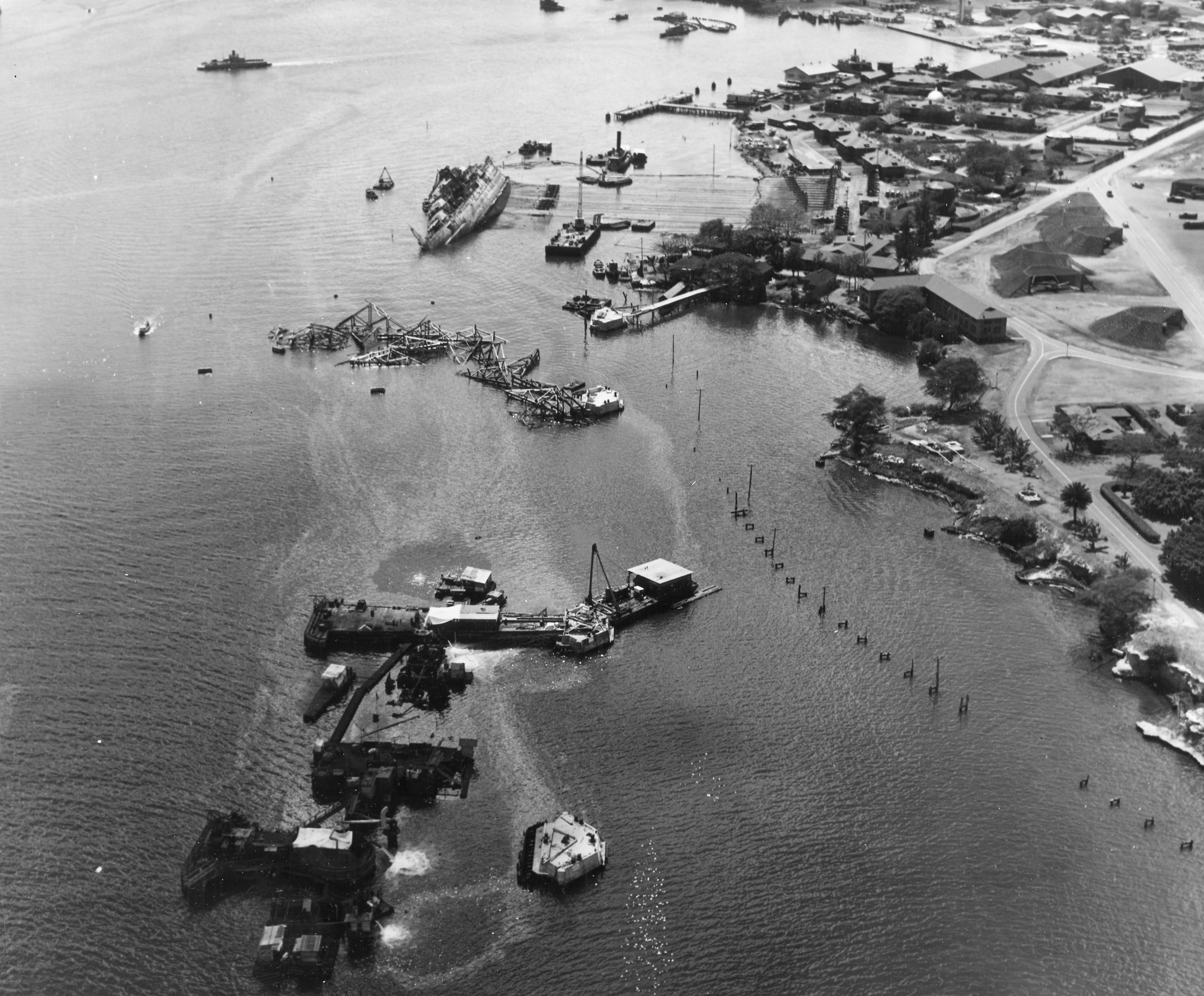
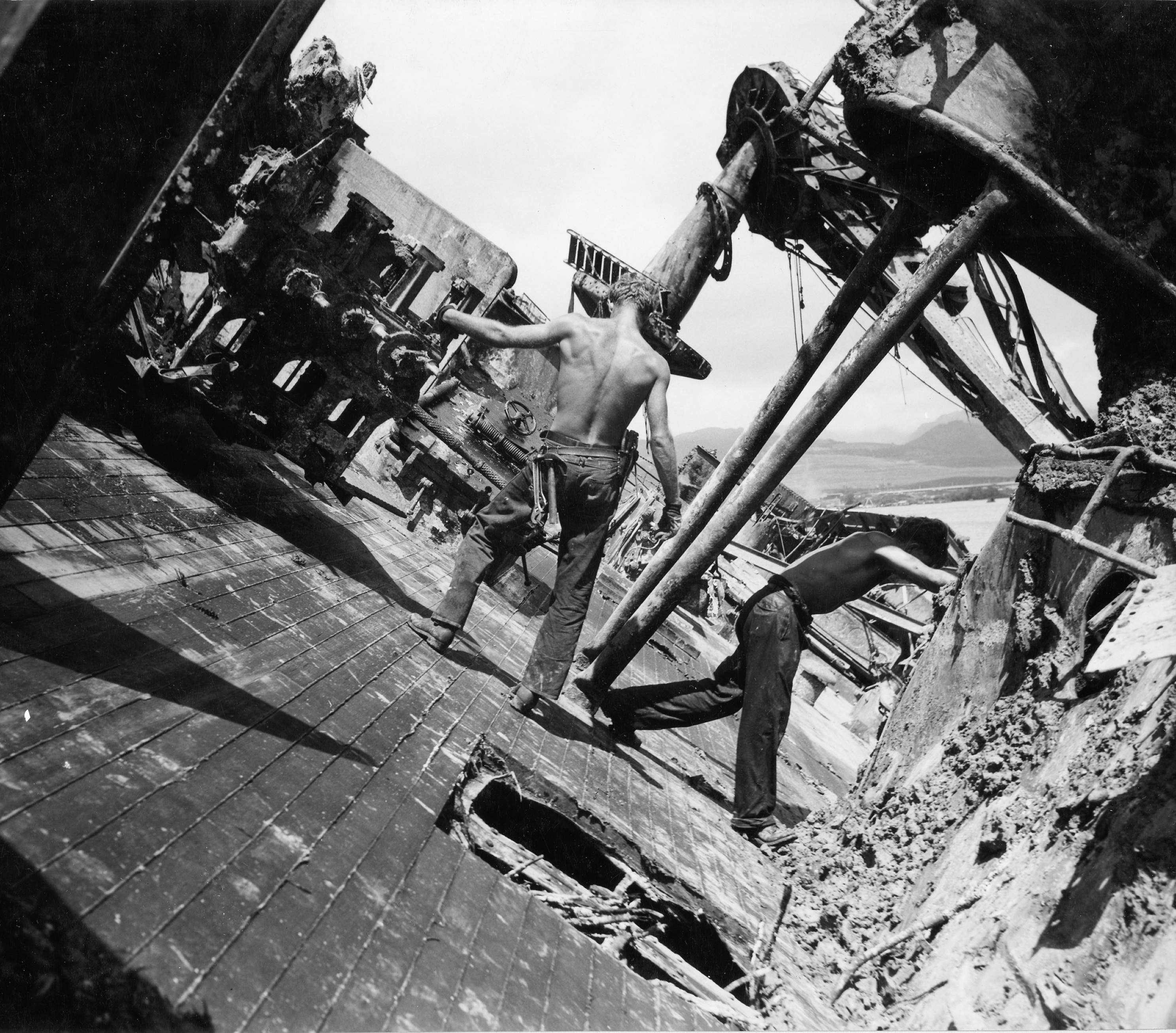
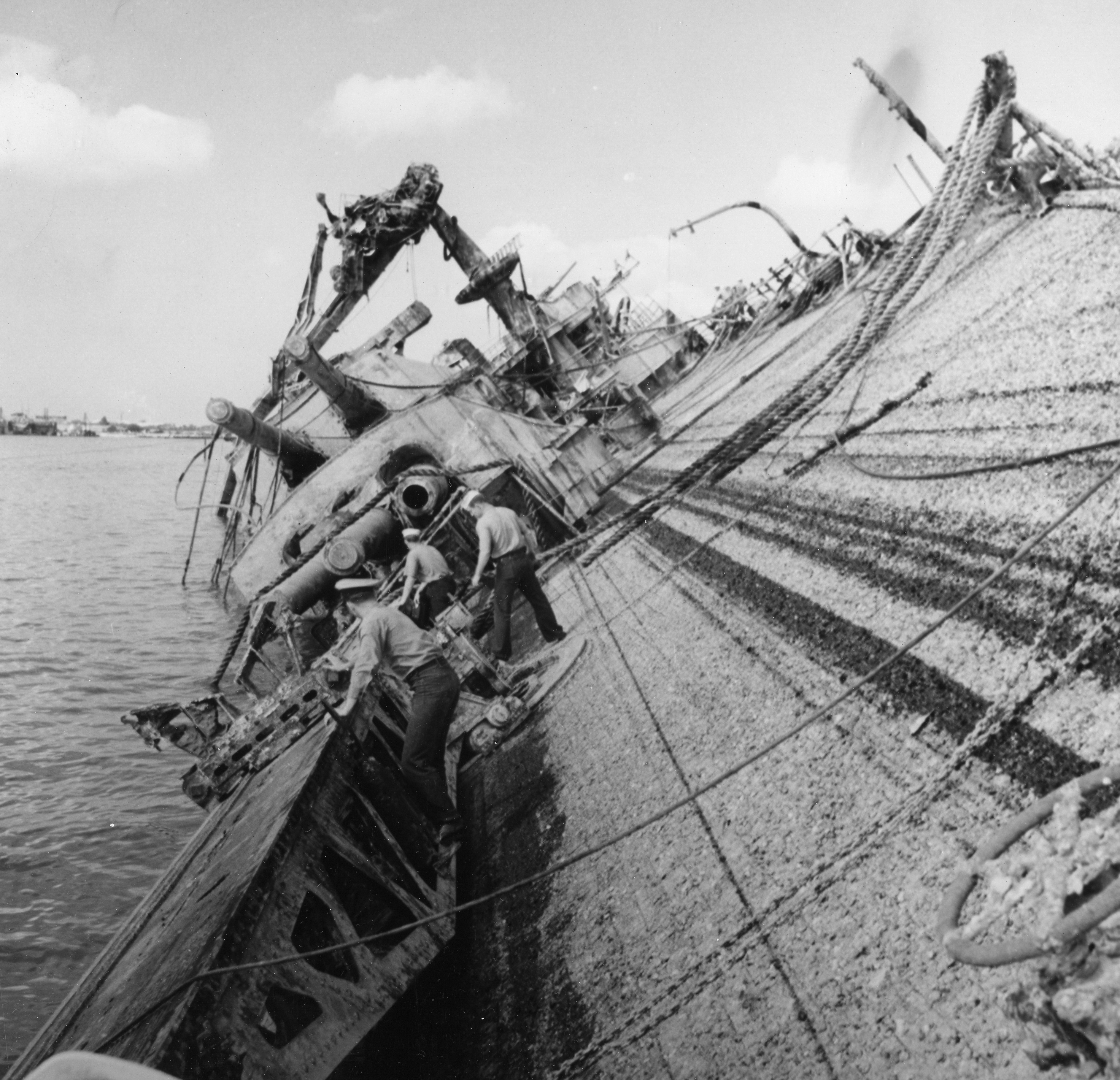
Righting the Oklahoma took almost 3 months. At bottom of the photo is the wreck of the Arizona, still leaking fuel. May 1943

During the Pearl Harbor attack on December 7, 1941, Japanese B5N “Kate” bombers scored five torpedo hits on the USS Oklahoma’s port side. The massive damage to this aged battleship prompted her to begin listing to port. Within minutes, she had turned turtle, trapping hundreds of sailors in her hull. In the hours and days after the attack, civilian shipyard workers and other sailors worked furiously to cut openings in the Oklahoma’s exposed keel in order to rescue the men still alive inside the ship. The effort saved thirty-two men. Stephen Young, one of those rescued, later wrote a gripping account of what he and his fellow sailors endured during those horrific hours after the ship turned turtle. Find his book here:

raising the oklahoma249

The cable system employed to right the Oklahoma had to be reset every few days as the ship began to roll. It was slow work and took months to complete.

Four hundred and twenty-nine men died aboard the Oklahoma. Only the Arizona‘s destruction cost more American lives on December 7th. Most of those sailors died within her hull, and as salvage work began on her in mid-1942, one of the first tasks was to recover those remains. For the sailors, divers and civilian contractors assigned to the vessel, the work was gruesome, dangerous and emotionally taxing to the utmost.


raising the oklahoma258

From the spring of 1942 to the summer of 1943, the salvage operation continued. Patches needed to be welded to the hull to cover the torpedo damage and make the ship watertight again. Teams of divers and workers cleared out ammunition, cut away damage and pumped out the thousands of gallons of fuel still remaining in the battleship’s tanks. As that work continued, other teams emplaced twenty-one massive winches on Ford Island. The salvage team rigged cables between the ship and the winches, and these were used to gradually pull the Oklahoma upright. It was a slow task that required intricate engineering work. After three agonizing months, the winches finally righted the wrecked battleship.

Hawaiian Female Salvage Worker Pearl Harbor 43 943

A civilian salvage worker aboard the Oklahoma in 1943. This was grueling, dangerous work which included having to recover the remains of hundreds of fallen sailors who’d been trapped aboard the battleship when she turned turtle.

Oklahoma Salvage May 43 941

Almost righted, May 1943.

Once back on an even keel, the work to make her watertight was finished. Machinery, the rest of her ammunition and weaponry were pulled off and she was basically stripped to await scrapping. She was eventually towed to drydock where the work was finished. She spent the rest of the war moored in the harbor as a silent reminder of that terrible day in December 1941.Oklahoma Salvage May 43 937raising the oklahoma252

She was sold for scrap after the war, but while under tow to San Francisco in May 1947, she and her two tugs encountered a heavy storm. The battered old battlewagon couldn’t take the rough seas. She began to take on water, and a dangerous list developed. As she began to sink, the Oklahoma nearly dragged both tugs down with her. Fortunately, quick action on the part of the tugs’ crews prevented such a disaster. Oklahoma went to the bottom some five hundred miles east of Pearl Harbor. Her hull may lay in an anonymous Pacific grave, but her heart was torn out on Battleship Row in 1941.

raising the oklahoma254


Categories: World War II in the Pacific | Tags: , , , , , , , , , | 1 Comment

Warrior Adversary: Saburo Horita’s Story

Tone

The Imperial Japanese Navy heavy cruiser Tone. Saburo Horita was assigned to a 25mm anti-aircraft gun crew located near the ship’s bridge.

Saburo Horita grew up on a five acre plot of land his father farmed in Toyama prefecture on the west coast of Honshu. They were a poor family that included three sons (Saburo was the youngest). When Saburo was fourteen, his oldest brother died. Not long after, his mother died as well. He and remaining brother, who had been a porter in a Tokyo bath house until their mom’s death, worked the land together, raising vegetables and rice.

japanese cadet training652 4x6

Japanese pre-war flight training was among the most rigorous in the world, but as the war continued and losses mounted, the Japanese were forced to cut their program short in order to get pilots into the field as quickly as possible.

In June, 1939, Saburo joined the Imperial Japanese Navy, and after six months of training at Yokosuka, joined the complement of the heavy cruiser Tone. He served as a 25mm anti-aircraft gunner and part of the deck crew for the next year. In January 1941, he decided to try and become a naval aviator, hoping he’d be able to fly bombers someday. He passed his physical and all the necessary exams, and received orders sending him to flight school Kasumigaura. He learned to fly on the venerable Type 93 “Willow” biplane, and then later got stick time in a Type 95 “Dave” two-seat biplane.

After he graduated from flight training, the Imperial Navy sent Saburo to Takao, Formosa, where he joined the 3rd Air Group as a reserve pilot. He’d had no time in advanced fighters, so the group put him through an intensive, crash course on the Mitsubishi A6M2 “Zero” fighter they had been flying in combat against the USAAF units in the Philippines. Horita arrived in January 1942, just as air campaign over Luzon was drawing to a close.

Japanese Air Cadets Training 2

Saburo Horita trained on Type 93 and 95 biplanes before graduating to the legendary A6M2 Zero fighter, which he first flew when he arrived on Formosa in early 1942.

After ground instruction, he and his fellow replacement pilots were strapped into Zeroes and sent aloft to get familiar with the aircraft. On those early training flights, the fledglings were told to leave the landing gear down, as none had ever flown a craft with a retractable undercarriage. Saburo and others found the Zero tricky to land, and often they would “kangaroo” across the strip at Takao, bouncing the Zero on and off the runway as they tried to execute a touch-and-go.

Zero over Mt Fuji 8x10

A Mitsubishi A6M Zero fighter with Mt. Fuji in the background. When questioned on the Zero’s performance, Saburo told his Japanese-American interrogator that its top speed was 340 mph and could climb at 3,000 feet a minute.

After they worked through getting his Zero back on the ground consistently, Saburo underwent formation flying and aerobatics instruction with more senior 3rd Air Group pilots. But all too soon, the pressing need for combat pilots forced this first contingent of replacement pilots into battle. Along with six other aviators, Horita boarded a Type 96 “Nell” bomber in February 1942 and flew down to Mindanao. From there, they made the jump to Kendari Airdrome on the Celebes Island in the Dutch East Indies. From there, the 3rd Attack Group had been operating against the Allied air units fighting in the Java campaign. Once Java fell to the Japanese, the 3rd Air Group, based now on Timor, escorted G4M “Betty” bomber raids against northern Australia.

It was during those attacks that Saburo Horita first flew in combat. He took part in at least one raid on Port Darwin in June 1942 before being transferred to Rabaul in November 1942. At Rabaul, he joined the freshly redesignated 582nd Kokutai, which had been the 2nd Air Group up until that time. Before he had a chance to fly in the Guadalcanal campaign, he was stricken with malaria and spent about six weeks recovering. While in the hospital, some of his comrades were posted at Lae and thrown into the fight against the 5th Air Force while others stayed at Rabaul to fly missions against the Allies in the Southern Solomons.

After returning to flight status, Horita had between 300-400 hours in Zeroes, Type 93’s and 95’s. He’d been promoted to lead a three-plane formation, known as a Shotai. It was as a Shotai leader that he flew his final combat mission on January 31, 1943.

Sec 4 IC F A translated document detailing the Japannese side of the sinking of the USS Chicago in January 1943

A translated intercept of a Japanese message detailing the loss of the Chicago during the Battle of Rennell Island.

On that day, the 582nd received orders to escort a squadron of bombers against Allied warships at Tulagi Harbor. The previous two days had been furious ones over the Southern Solomons. Japanese airstrikes had sunk a destroyer and the heavy cruiser Chicago in a debacle later known as the “Battle of Rennell Island.” On the 31st, IJN reconnaissance had detected three warships near Tulagi, and they would be the raid’s primary targets.

nick philippines596

During his interrogation, Horita was shown a drawing of a new Japanese twin-engine fighter that the Allies knew little about. This was probably either the Kawasaki Ki-45 Toryu (Nick) (pictured here), or the Nakajima Gekko (Irving) night fighter. Horita had known nothing about the new plane, and while admiring the sketch he muttered that he would have liked to have had a chance to fly it.

Over the target area, the Japanese strike failed to locate any Allied ships. Without radios in their Zero fighters, the 582nd could not converse with the bomber crews, so they simply stayed with them and followed wherever they went. In this case, they began searching to the south of Tulagi and Guadalcanal. The search yielded results: two destroyers were soon sighted, and the bombers dove to the attack.

f4f usmc airborne 4037

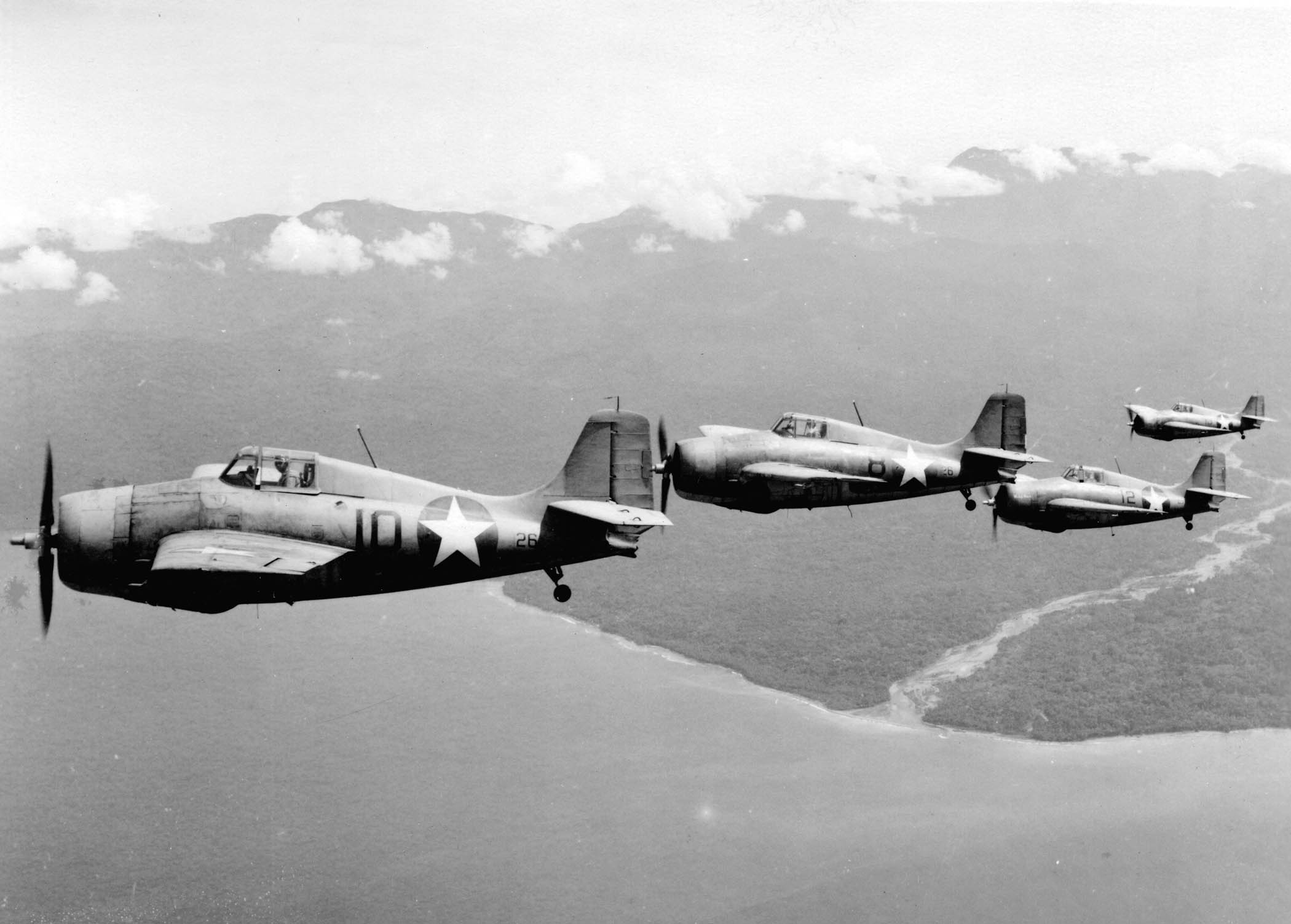
F4F Wildcats airborne over the Southern Solomon Islands. The F4F was the primary air defense aircraft during the bitter struggle for Guadalcanal 42-43.

A squadron of F4F Wildcats was overhead that day, protecting the Allied vessels. The 582nd locked horns with the American fighters, and a dogfight raged over the ships.  At fifteen hundred feet, Saburo’s Zero was attacked by four Wildcats and shot up. He turned north and limped his crippled Zero for home, but over Russell Island, his engine seized. He ditched the Mitsubishi in shallow water right off the beach and waded ashore. Five foot four, one hundred and twenty pounds, Saburo Horita was now hundreds of miles from home, with no way to get back to Japanese lines.

He thought through his situation, and concluded his only hope lay in trying to steal a boat or canoe from the local natives. Exactly what he hoped to do with it is unknown, but perhaps he thought he could paddle the 30 miles to Guadalcanal where he could link up with the Japanese garrison there before it was evacuated.

IMG0077 a6m zero cockpit from recovered from pearl harbor raid  8x10

Saburo Horita’s office–the cockpit of an A6M2 Zero. On long flights, he and his fellow pilots would carry a lunch composed of rice balls wrapped in seaweed.

Whatever his intent, he acquired a canoe from the natives at gunpoint, which earned him no friends. The natives eventually got the drop on him and took him prisoner. He was quickly delivered to Allied authorities, where he was interrogated by Colonel Sidney Mashbir’s  Allied Translator and Interpreter Section, SWPA (ATIS/SWPA). The Japanese-American who conducted the interrogation found Saburo Horita to be intelligent but poorly educated. His answers were cautious, and unlike many other POW’s, he was security conscious and did not reveal a lot of information. However, what he did say generally was believed to be accurate.


Categories: World War II in the Pacific | Tags: , , , , , , , , , , , , , , , , , | 2 Comments

Blog at WordPress.com.