Posts Tagged With: World War II

The Cumberland Clerk of Clark Field

Confession: Part of the perils of conducting archival research far from home is that I get easily distracted. I’ll be plowing through piles of government documents looking for nuggets relevant to my next book, then I’ll stumble across an insanely cool story that I can’t help but to track down. This was the case this week while working at the MacArthur Memorial archives in search of material related to Paul “Pappy” Gunn. There I was, digging around in the collection when I came across a debriefing document related to a clerk named Corporal Joseph Boyland. So I love stories about unlikely folks who step up in moments of great turmoil and crisis to become bigger characters than their rank and role might lead you to believe. In Afghanistan in 2010, I met a quartermaster named Captain Andrew Alvord–who happened to be out commanding an air assault platoon composed of support troops like fuelers and clerks. He led the platoon on many patrols, fought several sharp engagements during Taliban ambushes, and made friends out of local villagers. That is the kind of American who makes our nation great.

Which leads me back seventy years to a Cumberland, Maryland factory worker who, in the throes of the Depression, sought service in the Army Air Corps as a way out of his small town circumstances. Enlisting in 1937, he trained as a clerk and was sent to the Philippines in 1941 to be a paper-pusher in the newly established V Bomber Command Headquarters. In four years, promotion had come slowly for him, and when  Japanese aircraft  appeared over Clark Field on December 8, Boyland was a corporal.  He was at Clark when the attack came and destroyed most of MacArthur’s air force on the ground, and in the chaotic days that followed, he was culled from the HQ element and sent to the 192nd Tank Battalion, where he trained as an M3 Stuart gunner for six weeks at the start of the Bataan Campaign.

In February, he received a week’s worth of infantry training, then was posted at Cabcaben Airfield, where he manned a .50 caliber anti-aircraft machine gun. Between standing watch over the field, he participated in dismounted patrols around Mariveles, and did such an impressive job that he received a spot commission to 2nd Lieutenant by the 31st Infantry’s Major Miller. Along with most of the other marooned FEAF ground and air personnel, he served in combat with the 71st Infantry Division (Philippine Army) until malaria and dysentery knocked him out of action.

As the situation on Bataan began to collapse in early April 1942, he was ordered to Corregidor, but the FilAmerican Army surrendered while he was trying to find passage to the Rock. The Japanese captured him at Mariveles. With twenty other American POW’s, he was pressed into service as a truck driver for the Japanese. Under guard, he drove around Bataan, Guagua, and Pampanga, forced to do whatever the Japanese demanded of him. Yet, his experience was easy compared to what thousands of other half-starved, sick POW’s faced on the Death March. Boyland and his crew of truck drivers often were allowed to go into Manila to purchase food and even alcohol. This comparatively easy life changed later that spring when and thirteen other American drivers were taken to Olongapo and crammed aboard a Japanese transport vessel. The ship took them to Negros Island, where he and his fellow POW’s drove and repaired trucks for the next year.

On Negros, Boyland experienced the opposite extreme of the Japanese occupation. In the months that followed, beatings became increasingly frequent, and he bore witness to the full horrors inflicted on the Filipino population, especially after the Kempeitai showed up on Negros. One Kempeitai Lieutenant in particular terrorized the inhabitants of Bacolod, killing civilians with his sidearm.

Towns suspected of supporting the growing guerrilla movement were dealt with harshly. Several times, Boyland witnessed Japanese troops pour into this villages and massacre the residents with machine guns and bayonets. Other times, the Japanese would capture a group of Filipino males, tie them up and spend days torturing them. They’d be left in the sun without food and water, burned with cigarettes, and mutilated with scissors. Afterwards, Boyland and his fellow Americans would be ordered to bury the bodies.

Sometimes, the Japanese made clumsy attempts to connect with the Filipino population. In April 1943, Boyland was ordered to drive in a two truck convoy. In back, instead of just bayonet-armed Japanese Soldiers, he and the other driver transported a brass band, a singing trio, two Filipino nurses and a couple of doctors. With music merrily playing, they rolled through the countryside, visiting hamlets around Bago. They would stop, hand out candy, cigarettes and donated clothing to the impoverished populace while the medical staff tended to the sick. Sometimes, they’d host dances and games, complete with prizes.

The pistol-fond Kempeitai lieutenant went along on the sojourns, keeping a watchful eye on the spectacle. The Japanese called these Peace and Relief Missions.

Such tactics couldn’t sway the Filipinos, who remained fiercely loyal to the United States despite the reign of terror unleash on them behind the facade of brass bands and free shirts. That point was driven home to Boyland once day when his truck broke down during a Peace and Relief run to Ponte Verde. As he worked to repair it, the locals came out to him, and when the Japanese weren’t looking slipped him fresh fruit and eggs. The mayor even gave him some money.

Enough was enough. Beaten almost every day for months, bearing witness to horrific atrocities then burying the victims, all while driving around a traveling road show with the sadistic Kempeitai officer was too much for Joe Boyland. In April 1943, a Japanese officer smacked him across the face and that humiliation became the final straw.

The next day, he was in the market place at Bago, paused between runs in his truck. His Japanese guard walked across the street to buy cigarettes, and Boyland saw his chance. He slipped into a nearby shop and bolted out the back door. He linked up with a local guerrilla cell, which took him up into the mountains to escape the Japanese.

For most of the next year, Joe lived the life of an American insurgent, operating with the guerrillas of Northern Negros. They carried out ambushes, sometimes attacking the very trucks that he’d been driving. By July, all but two of the American drivers he’d been with had escaped and linked up with various guerrilla groups as well.

Boyland soon found the shadow war on Negros had an ugly underbelly. The Filipinos in the movement hated the local Spanish aristocracy. They represented the elite of the old colonial order, and they took out centuries of pent-up resentment on them through midnight raids and violence. The Spanish left their outlying properties and moved to Bacolod where the Japanese could better protect them, and many openly collaborated with the occupation force as a result.

Martinez Godinez was an exception. He and Boyland had become friends after Martinez provided food, whiskey and safe places to crash. He was officially the Spanish Consul for Negros, and despite his nation’s neutrality in the war, he played an important role in keeping Boyland’s guerrilla cell in the fight. Despite this, other insurgent groups considered him an enemy, and they marked him for death. Boyland protected him as much as he could, but eventually convinced Martinez to send his family to Manila, where they would be (at least for the time) safer.

Then there were the anti-American guerrillas. The most notorious, at least to Boyland, was a former sergeant in the army named De Asis. Reputed to have gone on a blood-feud killing frenzy that claimed the lives of some twenty-seven Filipinos, De Asis was all about settling scores and exercising grudges. He had a deep seated hatred of Americans, and was rumored to have killed several. In January 1944, Boyland went in search of De Asis, probably to try and halt his depredations, but he proved elusive and Joe never found him.

Bacolod, the largest city on the island, teamed with intrigue. Plenty of the locals supported the guerrillas, but there were always fifth columnists, spies and sympathizers working with the Japanese. A German named Weber was one of the most aggressive pro-Japanese civilian in the city. He would strut through the streets in shorts, armed with a pistol and would “arrest” anyone he suspected of supporting the insurgency, then turn them over to the Japanese authorities.

In February 1944, after months of shadowy operations, ambushes, near misses with Japanese patrols and rival guerrillas, Boyland was evacuated off Negros and taken to Australia, where he was debriefed then sent home to Maryland.  When he returned to Cumberland, he learned that one of his brothers had joined the Navy and was serving in England. He later took part in D-Day as part of a landing craft crew.

Joe was given a hero’s welcome in his hometown. So few had escaped from the Philippines that the local papers celebrated his arrival, but noted repeatedly that he wouldn’t talk about his experiences. It later came out that he’d been thoroughly interrogated at the Pentagon after his return from the Philippines. Once he was given 30 day leave and came home to Cumberland, the Secret Service kept him under constant surveillance to ensure he did not speak of what was happening in the Philippines. That level of paranoia was also experienced by other escapees, including the legendary Ed Dyess.

Boyland went to OCS and stayed in the military after the war, learning to fly and serving as a pilot in the Air For Parce before finally retiring as a lieutenant colonel. In December 1975, his car got stuck in soft mud on the side of Route 301 in North Carolina, outside of Rocky Mount. While walking along the shoulder to a nearby gas station to get help, he was hit by a passing car and tragically killed, a terrible end for the warrior clerk.

He never spoke to the press about his wartime experiences in detail, honoring the order given to him during his Pentagon debriefing to keep his mouth shut. But he did tell his hometown paper once of a poignant moment after he was captured that haunted him through his captivity.

While being taken to a POW camp, he spotted a billboard on the side of the road advertising Kelly-Springfield tires.  Cumberland was home to an 88 acre Kelly-Springfield factory, completed in 1921 when Joe was just four years old. The company employed much of the town, and was a pride of the city until it was purchased by Goodyear the year Joe graduated from high school.

The billboard brought him back to his hometown, and as he watched the advertisement pass by, he was filled with memories of City Hall Plaza, Bedford street and all the little shops in downtown Cumberland. As it slipped past his truck, the billboard served as a reminder to all he’d lost, and all he’d fight to regain in the difficult years to come.


Categories: American Warriors, World War II in the Pacific | Tags: , , , , , , , , , , , , | 6 Comments

Lend Lease Wings

A formation of Brewster Bermuda dive bombers on a training flight. The aircraft never saw widespread service as a result of its mediocre performance.

A formation of Brewster Bermuda dive bombers on a training flight. The aircraft never saw widespread service as a result of its mediocre performance.

During the Second World War, the United States produced thousands of aircraft, guns, artillery, vehicles and ships that its armed forces never used. Instead, these weapons from the great “Arsenal of Democracy” were sent to other Allied nations fighting desperately to stem the tide against the Axis Powers. Well known are the Bell P-39 Airacobras that reached Russia and performed excellent duty as ground attack aircraft. The P-51 Mustang, the F4U Corsair, Grumman F4F Wildcat, the TBM Avenger all served in with the British Fleet Air Arm or Royal Air Force, as well as in other Allied nations during the war.

But some lesser known types were sent overseas as part of the Lend Lease effort. Perhaps one of the more unusual was the Brewster SB2A Buccaneer. Designed before the war as a carrier-based dive bomber, the British and Dutch were so desperate for such an aircraft that they placed orders for it before the prototype even flew in 1941. When it finally did, the aircraft’s performance proved to be such a disappointment that the contracts were largely canceled. A few Brewsters, dubbed Bermudas by the FAA, saw limited service as training aircraft and target tugs, but its role as a combat dive bomber had been eclipsed by better aircraft.

208 aa for uboat series113

Number 88 Squadron became the first Douglas Boston unit in the RAF. It began flying anti-shipping and interdiction missions in February 1942.

The British also used the legendary Consolidated B-24 Liberator, though not primarily as a strategic bomber but as a long range anti-submarine aircraft. And after the Fall of France, the Douglas DB-7 Boston ended up in RAF service flying low altitude, short-ranged hit-and-run raids against German targets on the Continent. The Boston became a mainstay of the RAF’s light attack units in 1942-43, equipping about two dozen squadrons before ultimately being replaced by the DeHaviland Mosquito in the later stages of the war.

A badly damaged British Liberator, seen here back in England after it had been struck by a falling bomb dropped from a squadron mate in mid-flight. The British largely used their Liberators as long-range anti-submarine and maritime patrol aircraft.

A badly damaged British Liberator, seen here back in England after it had been struck by a falling bomb dropped from a squadron mate in mid-flight. The British largely used their Liberators as long-range anti-submarine and maritime patrol aircraft.

Categories: World War II Europe, World War II in Europe | Tags: , , , , , , , , , , , , | Leave a comment

Most. Unusual Distinguished Flying Cross. Ever.

The Philippine Air Lines hangar at Nielson Field in 1941. PAL flew Beech 18's and a Staggerwing (at right).

The Philippine Air Lines hangar at Nielson Field in 1941. PAL flew Beech 18’s and a Staggerwing (at right).

When the Pacific War broke out in December 1941, thirty-three year old Harold Slingsby was employed as a pilot with Philippine Air Lines, working for the legendary Paul “Pappy” Gunn from the company’s hub at Nielson Field outside of Manila. Far Eastern Air Forces had no transport force in 1941, and in those dark December days, the huge hole that left in MacArthur’s air capabilities was keenly felt. With no way to move personnel or supplies around by air, General Louis Brereton drafted Philippine Air Lines’ pilots and aircraft into the USAAF. Slingsby became an instant captain.*

At the end of December, it was decided to move General Brereton’s headquarters to Australia. Key staff officers were ordered out of the Philippines to help establish the new HQ. Slingsby was one of the pilots who flew those officers to Northern Australia. Upon arrival, he was pulled into the nascent Air Transport Command as part of the 21st Troop Carrier Squadron (the only cargo squadron in theater at that point) and spent much of the rest of 1942 flying the PAL Beech 18’s, Lockheed Lodestars and C-47’s around from base to base before returning to the States in early 1943.

The 5th Air Force was just being set up, and things were pretty chaotic in Australia in early 1942, so these transport missions were often anything but routine. On February 23, 1942, he was tasked with flying to Brisbane to haul back to Batchelor FIeld the intact wing of a Boeing B-17 Flying Fortress. Pappy Gunn, who commanded the 21st, was probably on this flight with “Buzz” Slingsby and took photos of this remarkable salvage job. They arrived at Brisbane and somehow shoehorned the wing under the fuselage of their transport. Exactly what aircraft Slingsby was flying is unknown, but it was probably an ancient B-17D the ATC pilots had been using since it had been flown out of the Philippines. The  B-17 wing was lashed to the underside of the fuselage, and they took off the following night to get it back up to Northern Australia where ground crews were waiting to pair the salvaged wing with another damaged Fort so it could be returned to service.

In times of great peril, the men of the 5th Air Force rose to the occasion and figured out a way to stay in the fight without adequate supplies, spare parts or aircraft. If Buzz and Pappy had been flying the old 19th Bomb Group B-17D’s that day, and nothing else in theater could have handled such a load, they were piloting an aircraft whose engines were so worn out and unreliable that the 19th had cast it off as uncombat worthy at a time when they were desperate for flyable bombers. Every minute in the air must have been a gut-check for them, but Slingsby made three landings and take-offs with the heavy, awkward load and got the vital wing up to the Darwin area.

For this incredible feet of ingenuity, Pappy put Slingsby in for a DFC. Here is his award citation:

G86A5185


*Kenney’s book, The Saga of Pappy Gunn states that Slingsby was a Consolidated employee ferrying PBY Catalina flying boats to the Dutch East Indies when the war broke out, but other sources state he was an employee of PAL in December 1941.

Categories: World War II in the Pacific | Tags: , , , , , , , , , , , , , , | 21 Comments

Joint Attack

US Army WWII Series M3 Stuart light tanks support Biritsh Army infantry Tunisia prolly 1943-1

Two American M3 Stuart light tanks support a company of British infantry during the fighting in Tunisia in early 1943.


Categories: Allies, World War II Europe, World War II in Europe | Tags: , , , , , | Leave a comment

MAG-45’s War in the Pacific Backwaters

The strip at Falalop Island, Ulithi Atoll, home to Marine Air Group-45. This photo was taken at the end of April 1945. In the photo can be seen several F6F-5N night fighters, a line of TBM Avengers, a few SBD Dauntless dive bombers, an SB2C Helldiver, and an unusual array of Culver TD2C Turkey target drones (at right)

The strip at Falalop Island, Ulithi Atoll, home to Marine Air Group-45. This photo was taken at the end of April 1945. In the photo can be seen several F6F-5N night fighters, a line of TBM Avengers, a few SBD Dauntless dive bombers, an SB2C Helldiver, and an unusual array of Culver TD2C Turkey target drones (at right)

In the fall of 1944, Marine Air Group-45 set up shop at Ulithi Atoll and received the task of suppressing the bypassed Japanese bases in the Carolines. MAG-45’s biggest and most important target was Yap, which included a large airfield capable of handling twin-engine bombers. The air group’s Avenger squadron, initially VMTB-232 and later VMSB-245, also provided anti-submarine patrols around the fleet anchorage at Ulithi. In November, two Japanese submarines launched five midget subs which succeeded in sinking a U.S. Navy oiler. Marine Avengers sank two of the midget subs.

In the months that followed, the air group flew night intercept operations with VMF (N)-542’s F6F-5N Hellcats, carried out ceaseless attacks on Yap, Fais and Sorol Islands. Though they encountered only occasional Japanese aircraft, the flak over these targets was often intense and so dangerous the crews were told not to drop below six thousand feet during their attack runs.

USMC Series WWII MAG-45 vmsb-245 ii Ulithi Atoll 040445 -1

VMSB-245’s parking area in May 1945. ‘245 arrived at Ulithi in March and flew until the end of the war. It had previously flown a tour from Midway and a second in the Marshall Islands prior to arriving at Ulithi. TBM Avengers, SB2C Helldivers, F6F-5N Hellcats can be seen along with what looks like a USN variant of the Beech 18 and an air rescue float plane.

MAG-45’s job was a thankless one, their efforts and missions lost to the American people as the tide of war advanced ever closer to the shores of the Japanese Homeland. Yet, it was in these grinding, attritional missions that the Marine aviators demonstrated a supreme level of dedication to their craft and cause. Day in and day out, the struck the same targets to ensure the strips at Yap could not be used to launch surprise raids against the U.S. warships at anchor in Ulithi, which had become a key forward replenishing base for the fast carrier task forces. There was little chance to participate in a major battle that could make headlines and history, and almost no opportunity for the fighter pilots to score aerial kills. Yet they were steadfast and carried out their missions with deadly effectiveness until the Japanese surrender in August 1945.

In honor of their all-but unknown efforts, here are some photographs from that backwater campaign.

VMSB-245 crews receive a target briefing prior to a mission against Yap Island on May 1, 1945.

VMSB-245 crews receive a target briefing prior to a mission against Yap Island on May 1, 1945.

USMC Series WWII MAG-45 Pilots Mangrum Ulithi Atoll 042845-1

LT. Col. Hurst and Colonel Robert Mangum chat with and congratulate two young fighter pilots, Lt. Hill and Lt. Hungtington, after they shot down a Japanese plane. April 28, 1945.


Categories: World War II in the Pacific | Tags: , , , , , , , , , , , , , , , , | Leave a comment

The 2nd Free French Armored Division

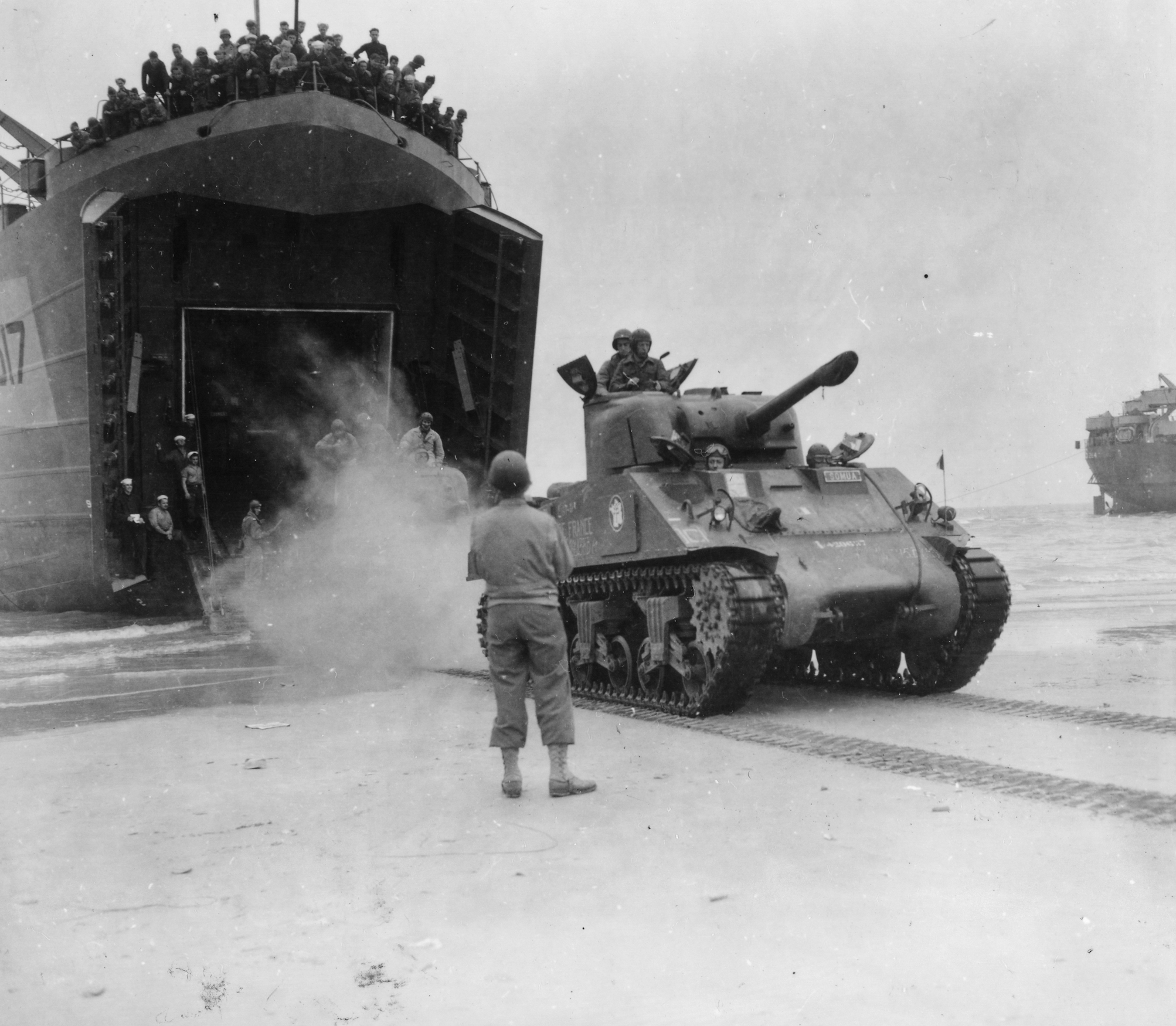
The 2nd Free French Armored Division comes ashore at Utah Beach.

The 2nd Free French Armored Division comes ashore at Utah Beach.

Perhaps no French unit achieved the level of fame during World War II that the 2nd Free French Armored Division did. Formed from about 15,000 men from different Free French units that had been fighting in North Africa since 1940, the 2nd included some 3,600 Colonial troops, primarily Moroccans and Algerians, along with a contingent of Spanish Republican volunteers. The rest of the division was drawn from French troops and citizens who had escaped France proper during the German invasion, or who had been out of the nation when the 3rd Republic sued for peace in June 1940.

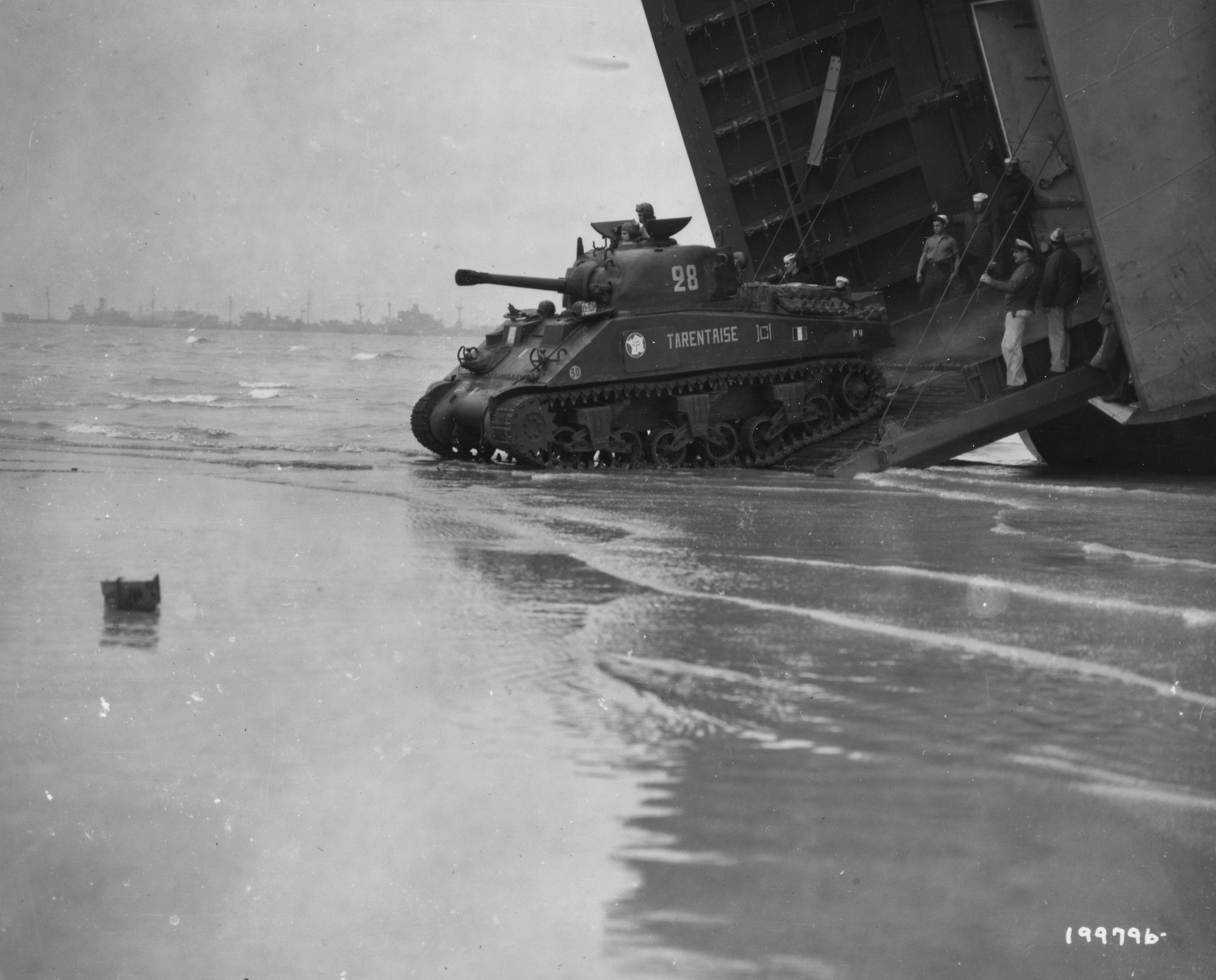
Organized and equipped like a U.S. Army armored division, the 2nd included three tank regiments, a tank destroyer regiment and three mechanized infantry regiments, along with engineers, artillery, truck and logistical support units. The division employed M4 Sherman tanks, American halftracks, M8 75mm motor gun carriages and other American vehicles. The Soldiers were equipped with standard U.S. Army gear, including M1 rifles, M1919 light machine guns, etc.

The division rejoined the fight in July 1944 when it landed at Utah Beach. The 2nd was thrown straight into the fray and ended up in the middle of the Falaise Pocket battle, forming the crucial hinge between Canadian and American units. During the fighting that August, the French tankers and armored infantry all but destroyed the remnants of the German 9th Panzer Division, knocking out over a hundred armored vehicles and taking almost nine thousand prisoners. But by the end of the battle, the 2nd had paid a steep price–about a thousand killed, wounded and missing.

Another shot of the division's M4 Shermans coming ashore  at Utah.

Another shot of the division’s M4 Shermans coming ashore at Utah.

At the end of the month, General Philippe LeClerc, the divisional commander, was ordered to drive on Paris with the U.S. 4th Infantry DIvision. What followed was the unit’s most lasting moment. Fighting side by side with American troops, the Free French could sense their hour of redemption was at hand. They fought like banshees, pushing toward their capital with impassioned fury, taking heavy losses at times. Some five hundred more men from the 2nd were killed and wounded, but the division forced its way into Paris and accepted the German surrender. The moment triggered a national catharsis, with French citizens celebrating in the streets and showering the Allied troops with tokens of their appreciation. France’s national honor had been restored, but much fighting lay ahead.

The 2nd pushed on East, destroying the 112th Panzer Brigade the following month in a chaotic battle at Dompaire. They liberated parts of the Vosges Mountains and wrested Strasbourg from German control at the end of November 1944 in daring actions that later led the division to be awarded an American Presidential Unit Citation. During this phase of its combat career, the 2nd fell under the U.S. Army’s  XV Corps.

Paris, August 26, 1944. The 2nd Free French Armored DIvision's most famous hour.

Paris, August 26, 1944. The 2nd Free French Armored DIvision’s most famous hour.

An M10 Wolverine tank destroyer from the Régiment Blindé de Fusiliers Marins, 2nd Free French Armored Division, outside Halloville, France on November 13, 1944.

After Strasbourg, the 2nd was shifted west to clear out German pocket of resistance along the coast, but it was transferred back to the main front in April 1945 in time to strike deep into the heart of the 3rd Reich. Soldiers of the 2nd were among the first Allied troops to reach Hitler’s Eagles Nest, and ended the war in Bavaria.

From July 1944 through May 1945, the division suffered about six thousand casualties out of approximately 15,000 men. It was deactivated in 1946 after serving France and the cause of Freedom with great and courageous distinction.


Categories: Allies, World War II Europe, World War II in Europe | Tags: , , , , , , , , , , , , , , , , , , , , | Leave a comment

Photo of the Day: The 1st French Army in Action

1st French Army Belfort France  Bren Gun and Sten Gun teams 112144   (1 of 1)

French troops and Maquis fighters, armed with British weapons including a Sten gun and a Bren light machine gun, cover a major intersection in Belfort, France during the battle to liberate the city on November 21, 1944.


Categories: Allies, World War II Europe, World War II in Europe | Tags: , , , , , , , , , , | Leave a comment

70 Years Ago Today

 John Buford’s Ghost:

Day One in the Ardennes

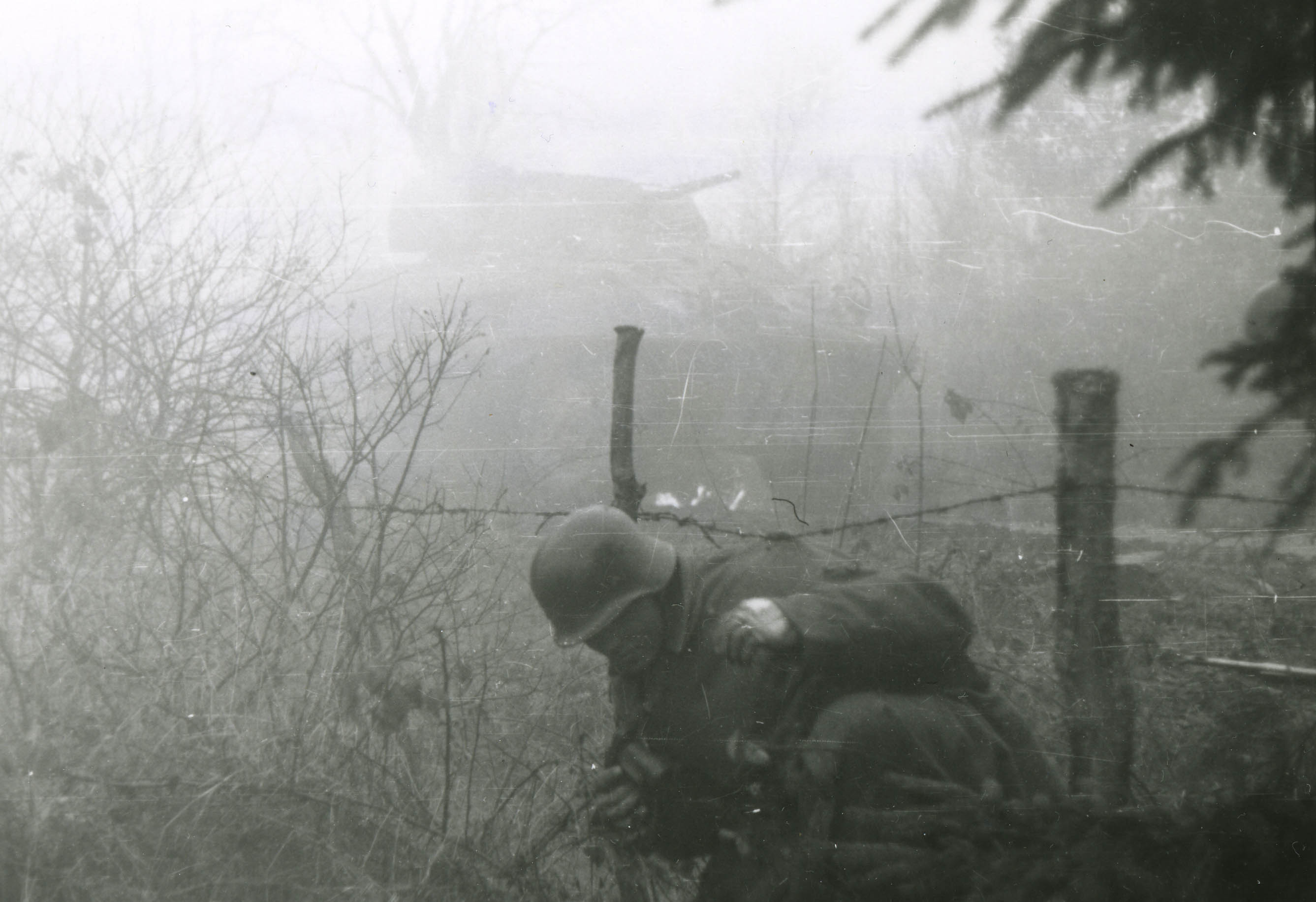
Photo 5M german ss patrol malmedy nazi going through barbed wireIn mid-December 1944, Lieutenant Colonel Robert E. O’Brian Jr. had a hunch. As commander of the 38th Cavalry Reconnaissance Squadron, he’d been tasked with defending the ancient city of Monschau, which served as an important part of the local road network. One north-south road passed through town, intersecting with an eastward running route that could take the traveler to Rohren (still held by the Germans) or southeast to Hofen and the 3rd Battalion, 395th Infantry.

O’Brian held an important part of the line, and his hunch led him to believe that the Germans might counter-attack him.  As a result, in the final days before Watch on the Rhine began, he kept his troopers busy digging trenches, clearing fields of fire, laying mines and trip flares. He brought in eighty truck loads of barbed wire and made sure that all of his platoons and troops were wired in tight. For additional support, he placed a platoon of tank destroyers to overwatch the main roads leading into town. His M5 Stuart light tank company covered the town itself and the route leading east, while his troopers dug in on the hills and slopes east of town, scraping their fighting positions out of hip-deep snow and frozen ground in places. The work was hard and rugged, but O’Brian’s men would be prepared. On the night of December 15, 1944, his troopers hunkered down in their holes, waiting to see if the squadron commander’s hunch would play out.

The venerable M5 Stuart light tank served throughout the campaign in Western Europe despite being undergunned and vulnerable to German anti-tank fire. This one belonged the 3rd Armored Division, and the crew is watching a German air attack on December 18, 1944, two days into the Battle of the Bulge.

The venerable M5 Stuart light tank served throughout the campaign in Western Europe despite being undergunned and vulnerable to German anti-tank fire. This one belonged the 3rd Armored Division, and the crew is watching a German air attack on December 18, 1944, two days into the Battle of the Bulge.

Across No-Man’s Land, the men of Sepp Dietrich’s Sixth SS Army made their final preparations for Operation Watch on the Rhine.

Photo 5C Bulge374

Sepp Dietrich.

Sepp Dietrich was a street fighter. An NCO during World War I, he returned home and embraced the chaos of post-war Germany. He became one of the earliest Nazi adherents, and one of Hitler’s oldest confederates. As a combat leader, he was despised and derided by the blue-blooded Prussian elite that formed the nexus of the Werhmacht’s officer corps. They thought he owed his position entirely to his relationship with Hitler, and that anyone with his luddite level of intelligence was best left in the NCO corps, not commanding entire SS armies. Perhaps so, but the fact was Dietrich commanded almost reverence among his men. Time and again, he inspired them with his front-line example as well as his refusal to live better than they did. He shared their hardships and privations, and the Waffen-SS soldiers loved him for it.

But by 1944, Dietrich’s heart wasn’t in it anymore. After Normandy, he knew the war was lost, and Hitler’s insistence to continue it only got more of his men killed. After learning of Operation Watch on the Rhine that fall, he approached the Ardennes counter-offensive with a very pessimistic view of how things would go.

He was not disappointed.

The Sixth SS Army was supposed to attack after a heavy initial bombardment along a front that ranged from about ten miles north of Monschau south to the Losheim Gap. The terrain here was low and swampy—impossible tank country. Behind and to the south of Monschau stretched the high ground of the Elsenborn Ridge. That ridge was the key to the Sixth SS’s initial attack. Take it, and the roads to the south the panzers needed to get to the Meuse would be opened up. The Sixth SS Army had been assigned five main roads that would hopefully carry the panzers west to the Meuse River. Taking Elsenborn Ridge would open up three of those five routes to the river.Bulge534 14th CavGrp Camp

Dietrich assigned his LXVII Corps to launch the initial attack around Monschau. This would be the hinge of the entire Sixth SS Army’s assault, and was designed to protect the right flank of Dietrich’s main effort.

Originally, it was supposed to be carried out by the 272nd and 326th Volksgrenadier Divisions, supported by a battalion of behemoth Jagdtiger tank destroyers. Fate threw the first curveball of the game, though, when the Jagdtigers failed to arrive before December 16th. They’d been loaded aboard trains and sent forward. On the way, Allied fighter bombers shot up the tracks. The Jagdtigers could not get forward in time to support the initial blows. The volksgrenadiers would make their attack unsupported.

The LXVII Corps faced another problem on the morning of the 16th. The Americans had been driving forward with the 2nd, 9th, 78th and part of the 99th Infantry Division right on the north side of the Ardennes, intending to grab the Roer River dams before Christmas. Three days before the offensive’s scheduled start,  the 272nd Volksgrenadier divisions had been sucked into a furious house-to-house urban battle in Kesternich. Part of the 326th had to actually go and reinforce it, which bled away much of the corps’ initial strength in its own assault.

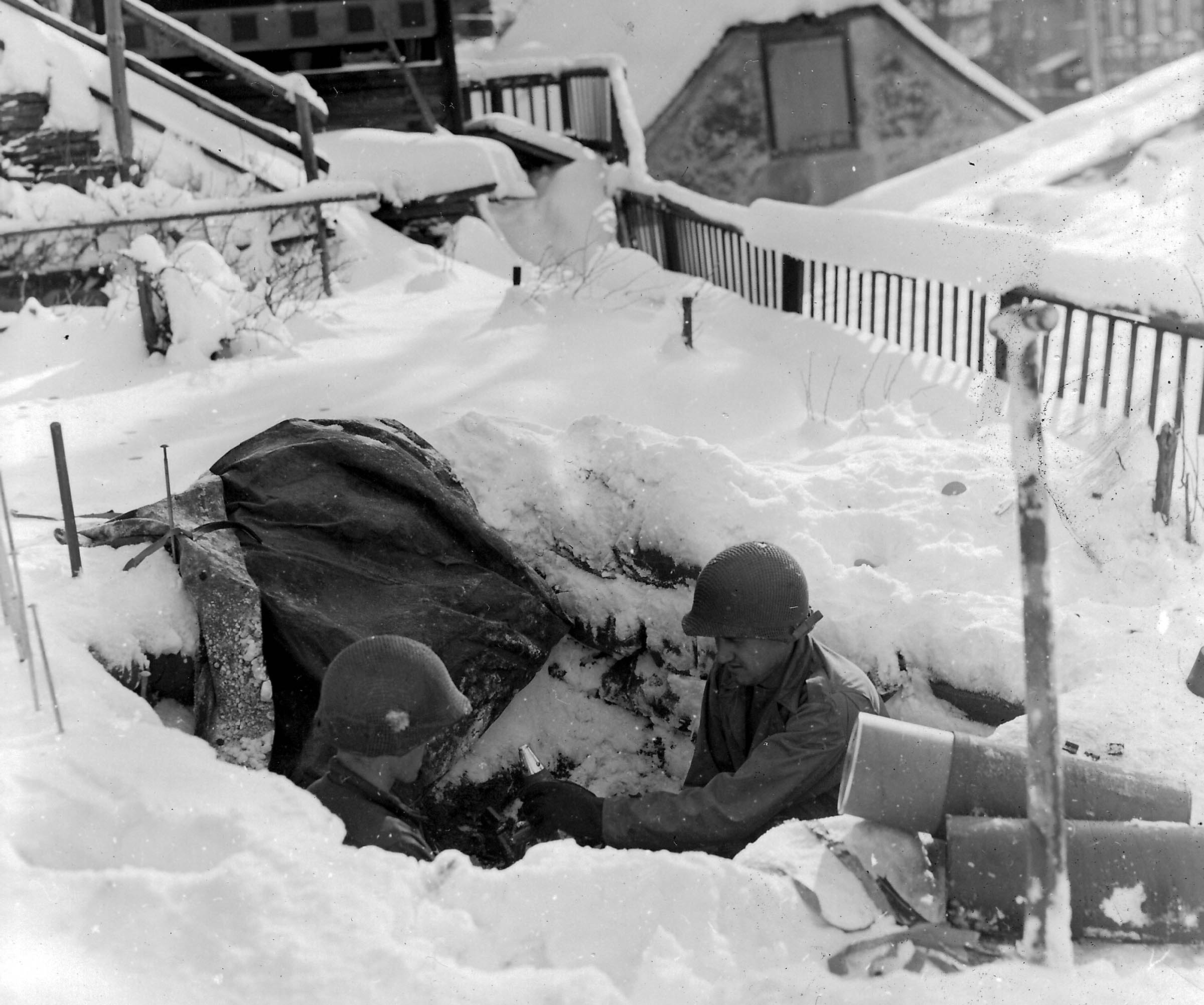
Bulge048 60mortMonschauJan23

An American 60mm mortar team in Monschau.

None of this mattered to the men in the frozen foxholes east of Monschau when the first German shells began to fall at 0530. All up and down the ninety miles Ardennes front line, over a thousand German guns roared to life. Everything from mortars to 14 inch naval guns rained high explosive death down on the American positions. Within minutes, the shells severed most of the communication lines that ran between the front line units and their headquarters, or the artillery units. )

Twenty minutes later, at Monschau, Sepp Dietrich’s Volksgrenadiers padded across the snow-covered forested hills and slammed into O’Brian’s defenses.  The American cav troopers were waiting, virtually unscathed by the opening bombardment thanks to their defensive preparations. In fact, O’Brian had ordered wire parties out to restore communications with their assigned field artillery battalions in the rear before the barrage had even ended.

28th cav recon sqn bulge jan 23 45 wiltz lux904

Lightly armed and equipped, the cav units in the Ardennes faced overwhelming odds in the first days of the Battle of the Bulge. These troopers belonged to the 28th Cav and are seen in Wiltz, Luxemburg later on during the battle.

They had not yet finished repairing the lines when the first Volksgrenadiers from the 751st Regiment slipped into view. If the 38th Cav folded, V Corps headquarters would be vulnerable to an attack from the rear and flank. It was a seminal moment for the American cavalry, and like General John Buford’s troopers on Gettyburg’s Seminary Ridge two generations before, they more than rose to the challenge.

The first wave of Germans reached the outskirts of Monschau and ran right into the waiting M5 Stuarts from F Company. The tankers loaded their guns with 37mm canister shells, and when they opened fire, the massed effect of these gigantic shotgun-like blasts tore apart an entire Volksgrenadier company. The survivors recoiled as their comrades, so vibrant a moment before, lay in gruesome horror around them. They left behind at least fifty, probably more like seventy-five dead and dying men.

The 38th Cav suffered seven casualties. Sepp Dietrich’s far north assault had failed completely.  

Photo 5G bulge trench scene438

A typical snow covered entrenchment in the Ardennes that December.

A few miles to the south, the 99th Infantry Division’s 3-395 had weathered a dreadful barrage that saw at least two hundred and fifty shells land in the battalion’s area of operations around Hofen. At ten minutes to six, the 2nd Battalion, 751st Volksgrenadiers, 326th VG Division charged through the morning fog across broken terrain and hit the 3-395 Infantry at five points almost simultaneously. The German main effort slammed into the junction between I and K Companies, which happened to be just east of Hofen. Without communications re-established with the artillery units in the rear, the battle that unfolded here pit a green U.S. infantry battalion against a green German Volksgrenadier Division.

The Volksgrenadiers surged for the American lines and ran straight into point-blank small arms fire. Some of the U.S. BAR men held their fire until the Germans were not even ten feet away from their camouflaged foxholes. The dead heaped around these positions, and some of the stricken grenadiers actually tumbled into the BAR men’s foxholes. Mortars shells fell and machine guns unleashed their fearsome destructiveness, and the grenadiers died in the snow. The attack continued, but each successive rush was stopped by American gunfire.

99th inf div soldier elsenborn ridge bulge830

One of the 99th Infantry Division’s defenders of Elsenborn Ridge.

At 0650, an hour after the attack began, the battalion restored communication with the artillery units I the rear. Within minutes, the forward observers in the trenches called down hell itself on the Germans. Multiple battalions of 105mm howitzers and the massive 155mm Long Tom cannons joined the battle.

The grenadiers attacked with desperate bravery, and in some places they made it through the curtain of artillery to battle the Americans with bayonets and butt stocks. The men of the 3-395 held firm, refusing to be driven from their foxholes even as heaps of German dead piled around them. By 0745, the attack had failed. Almost half the 2nd Battlion, 751st Grenadiers lay dead or dying in the snow. Photo 5O Bulge128 reloadM1deadGer83IDJan15

As the grenadiers withdrew and regrouped, they left behind over a hundred and fifty wounded men. Some lay as close as two hundred feet from 3-395’s foxholes. Throughout the day, they groaned, and cried out in agony, unable to move. In places, the lesser wounded men scrabbled through the snow to give what succor they could to their dying comrades. Here and there, a German medic would brave American fire to rush forward, administer some morphine and first aid. But there weren’t enough brave medics that day, and by nightfall, the moans and pleas grew steadily weaker. By morning, the battlefield was silent; the wounded had frozen to death. 

Excerpted from my book:


http://www.amazon.com/Battle-Bulge-Photographic-History-American/dp/0760335680/ref=tmm_hrd_swatch_0?_encoding=UTF8&sr=8-1&qid=1418765588


Categories: Uncategorized, World War II Europe, World War II in Europe | Tags: , , , , , , , , , , , , , | 1 Comment

The Remains of Company I, December 12, 1944

9th Inf Div 39th Inf Regt Soldiers and German POWs Coming out of Hurtgen Forest Campaign Jungersdorf Germany 121244 ii  (1 of 1)

Men of Company I stand guard over exhausted and cold German veterans of the Hurtgen Forest campaign. Captured at Jungersdorf on December 12, they were organized and marched out of the front lines that morning by the equally exhausted survivors of Company I, 39th Infantry Regiment.

The Battle of the Hurtgen Forest remains one of the longest, and bloodiest, battles fought by the United States Army. Through the fall of 1944, two American offensives into the hilly, heavily wooded terrain cost tens of thousands of casualties for little territorial gain. German defenders mined the forest, booby trapped entire sections, and covered all avenues of approach with snipers, automatic weapons and artillery. Attacking into the dense woods led American units to get lost, then pinned down and destroyed by German fire. Many historians have concluded that the fighting in the Hurtgen was among the most needless battles of the war, arguing that the U.S. First Army should have gone around it instead of trying to batter its way headlong through it. Altogether, the U.S. Army lost over 30,000 men; the Germans 28,000. Though most of the fighting ended in December, 1944, some firefights continued to flare up in the area until February 1945.

9th Inf Div 39th Inf Regt Soldiers and German POWs Coming out of Hurtgen Forest Campaign Jungersdorf Germany 121244 III (1 of 1)

An American Soldier from Company I, 2-39th Infantry speaks to a hollow-eyed German prisoner of war. Jungersdorf, December 12, 1944.

Though the story of the 8th and 28th Division’s maulings in the Hurtgen have been the subject of numerous books, less well known is the 9th Infantry Division’s contribution to the battle. The Old Reliable Division was actually the first American unit to advance into the Hurtgen Forest in mid-September. They fought through the worst portion of the campaign in October, then participated in the final 1944 offensives in the woods in November and December, losing thousands of men killed, wounded and missing. Non-battle losses were also very high in the division–trench foot, psychological shock and frostbite took a significant toll as the weather dropped and the point-blank carnage day after day wore the men down.

On December 12, 1944, the 39th Infantry Regiment, 9th ID, captured the village of Jungersdorf, a hamlet not far from the Roer River near Dueren. A Signal Corps photographer named Cravens was with I Company, 39th Infantry on that day to capture these scenes of the aftermath of a long and traumatic fight, the cost of which can be seen in the eyes of the men Cravens photographed.


9th Inf Div 39th Inf Regt Soldiers Coming out of Hurtgen Forest Campaign Jungersdorf Germany 121244 (1 of 1)

The veterans of Company I slog through the mud and ruins of Jungersdorf at the end of their tenure in the Hurtgen Forest. There would be no respite for these men. Fresh from the horrors of the Hurtgen campaign, they were thrust into the path of the 6th SS Panzer Army and played a key role in the defense of the Bulge’s North Shoulder during the German Ardennes Offensive–which started less than a week after this photo was taken.


Categories: World War II in Europe | Tags: , , , , , , , , , | 3 Comments

The Fate of the Oklahoma

raising the oklahoma257

Righting the Oklahoma took almost 3 months. At bottom of the photo is the wreck of the Arizona, still leaking fuel. May 1943

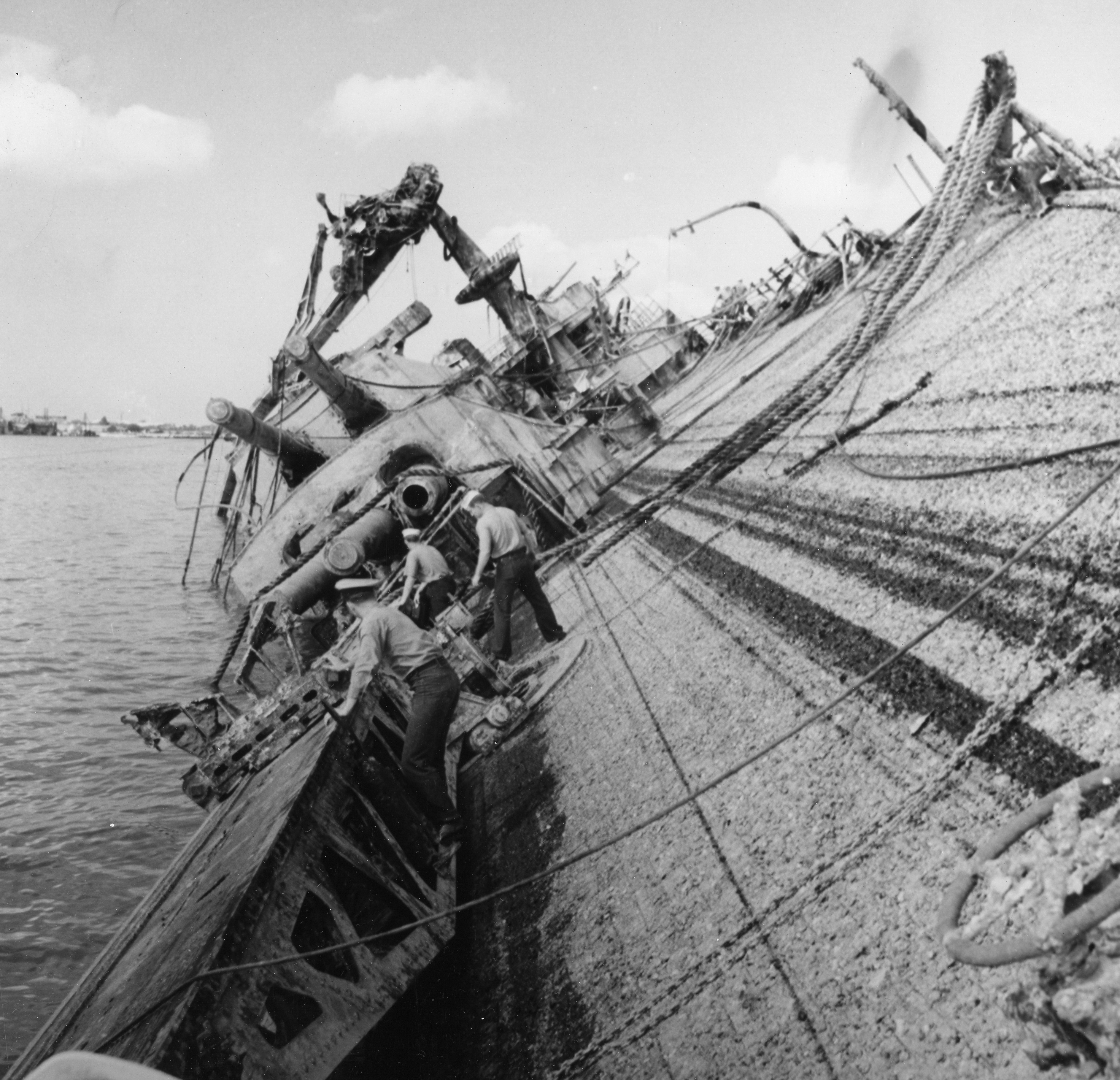
During the Pearl Harbor attack on December 7, 1941, Japanese B5N “Kate” bombers scored five torpedo hits on the USS Oklahoma’s port side. The massive damage to this aged battleship prompted her to begin listing to port. Within minutes, she had turned turtle, trapping hundreds of sailors in her hull. In the hours and days after the attack, civilian shipyard workers and other sailors worked furiously to cut openings in the Oklahoma’s exposed keel in order to rescue the men still alive inside the ship. The effort saved thirty-two men. Stephen Young, one of those rescued, later wrote a gripping account of what he and his fellow sailors endured during those horrific hours after the ship turned turtle. Find his book here:

raising the oklahoma249

The cable system employed to right the Oklahoma had to be reset every few days as the ship began to roll. It was slow work and took months to complete.

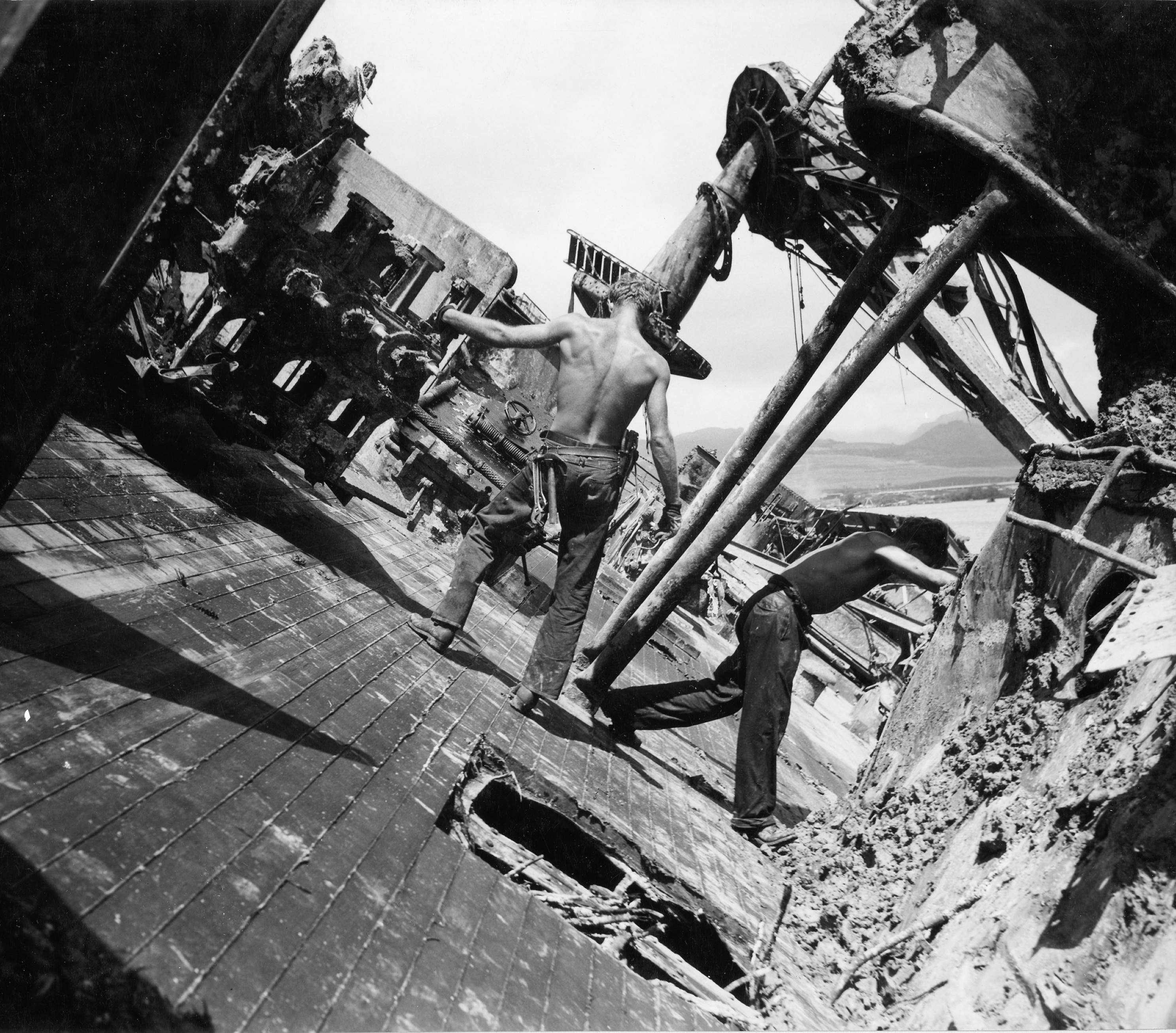
Four hundred and twenty-nine men died aboard the Oklahoma. Only the Arizona‘s destruction cost more American lives on December 7th. Most of those sailors died within her hull, and as salvage work began on her in mid-1942, one of the first tasks was to recover those remains. For the sailors, divers and civilian contractors assigned to the vessel, the work was gruesome, dangerous and emotionally taxing to the utmost.


raising the oklahoma258

From the spring of 1942 to the summer of 1943, the salvage operation continued. Patches needed to be welded to the hull to cover the torpedo damage and make the ship watertight again. Teams of divers and workers cleared out ammunition, cut away damage and pumped out the thousands of gallons of fuel still remaining in the battleship’s tanks. As that work continued, other teams emplaced twenty-one massive winches on Ford Island. The salvage team rigged cables between the ship and the winches, and these were used to gradually pull the Oklahoma upright. It was a slow task that required intricate engineering work. After three agonizing months, the winches finally righted the wrecked battleship.

Hawaiian Female Salvage Worker Pearl Harbor 43 943

A civilian salvage worker aboard the Oklahoma in 1943. This was grueling, dangerous work which included having to recover the remains of hundreds of fallen sailors who’d been trapped aboard the battleship when she turned turtle.

Oklahoma Salvage May 43 941

Almost righted, May 1943.

Once back on an even keel, the work to make her watertight was finished. Machinery, the rest of her ammunition and weaponry were pulled off and she was basically stripped to await scrapping. She was eventually towed to drydock where the work was finished. She spent the rest of the war moored in the harbor as a silent reminder of that terrible day in December 1941.Oklahoma Salvage May 43 937raising the oklahoma252

She was sold for scrap after the war, but while under tow to San Francisco in May 1947, she and her two tugs encountered a heavy storm. The battered old battlewagon couldn’t take the rough seas. She began to take on water, and a dangerous list developed. As she began to sink, the Oklahoma nearly dragged both tugs down with her. Fortunately, quick action on the part of the tugs’ crews prevented such a disaster. Oklahoma went to the bottom some five hundred miles east of Pearl Harbor. Her hull may lay in an anonymous Pacific grave, but her heart was torn out on Battleship Row in 1941.

raising the oklahoma254


Categories: World War II in the Pacific | Tags: , , , , , , , , , | 1 Comment

Blog at WordPress.com.